PVC-U vs CPVC in Construction: Where Each Material Belongs
Most buildings need both PVC-U and CPVC. The recurring mistake is picking one and pushing it across the entire scope.
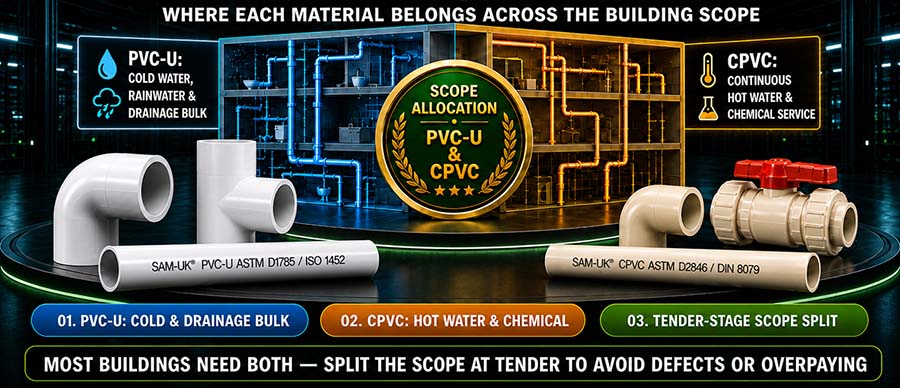
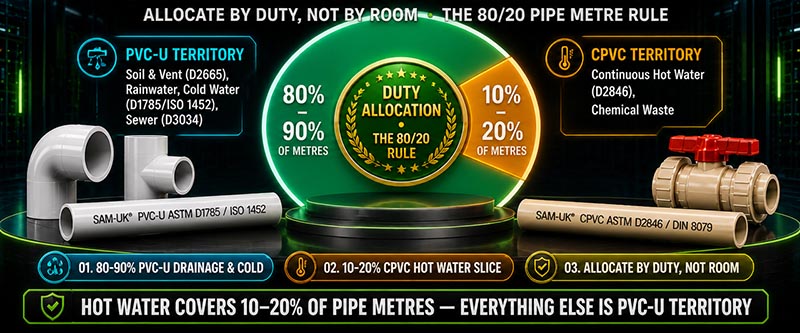
Here is the working position. PVC-U carries the drainage, rainwater and cold-water bulk at a cost per metre that no competing material beats. CPVC earns its premium only where hot-water or chemical duty is genuinely continuous — a thin slice of the pipe metres that carries a fat share of the risk. Decide that split at tender stage and the job runs smoothly. Decide it badly in either direction and you either overpay across the whole bill of quantities or hand over a system that fails inside the defects liability period.
Scope allocation, code acceptance, cost distribution and the failures that surface at handover matter more than polymer chemistry. That is the ground this guide covers.
hat Each Material Is For, and Where the Line Falls
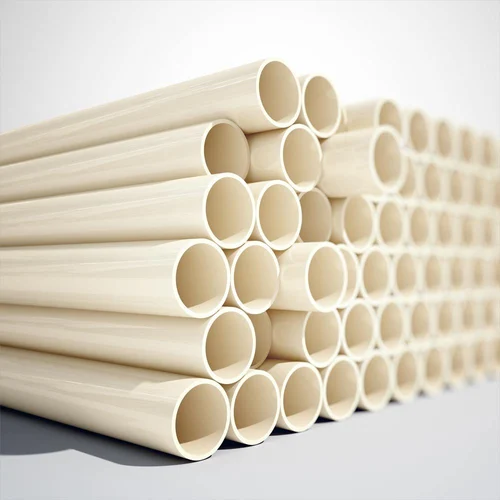
PVC-U is unplasticized polyvinyl chloride — rigid, no plasticiser, and the default for soil and waste, vent, rainwater, cold water and underground gravity drainage. Its continuous service ceiling sits around 60°C (140°F), and that number is a limit, not a design point. At 60°C the allowable strength of PVC-U falls to roughly 20% of its 23°C value, so a line running hot near that ceiling is a badly undersized line, whatever the print on the pipe says.
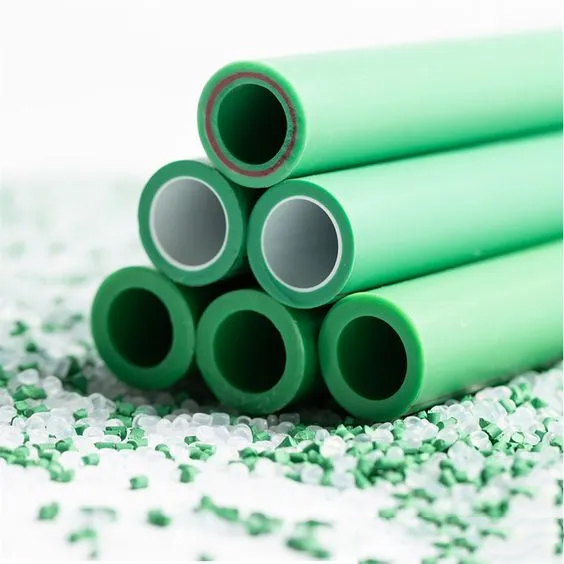
CPVC is the same base resin after chlorination, arriving at roughly 63–67% chlorine by weight, which lifts continuous ratings to about 93°C (200°F). Pressure behaviour is where project teams get caught. A CPVC tube to ASTM D2846 is marked 400 psi at 73°F and 100 psi at 180°F. Same pipe, same wall, a quarter of the pressure capability once it is hot. Any specification that quotes a single pressure figure without a temperature is incomplete.
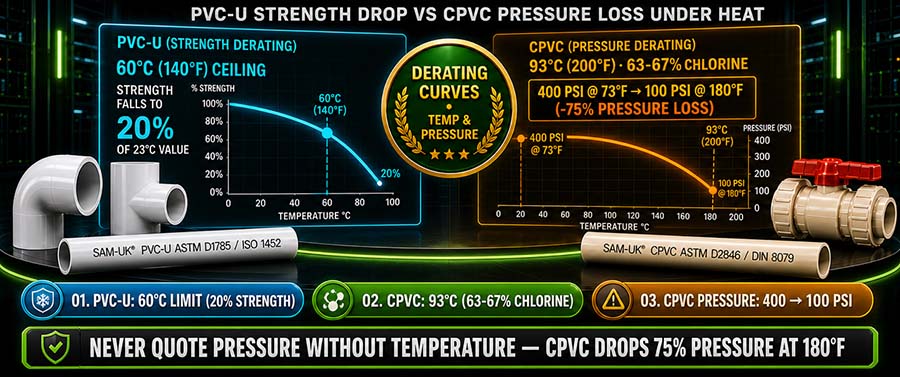
So the split is not “good material, cheap material.” It is two products engineered for different duty, and the design question is which duty exists where. Walk the services drawings and allocate by duty, not by room. This is the pattern that holds on most commercial and residential work.
| 范围 | Usual material | 为什么 | Standard to cite |
|---|---|---|---|
| Soil, waste and vent (in-building) | PVC-U | No sustained heat; rigid, quiet at low flow, cheapest compliant wall | ASTM D2665 (DWV); EN 1329 |
| Rainwater downpipes and gutters | PVC-U | Cold duty, large diameters, cost dominates | DWV family; project drainage spec |
| Cold water distribution | PVC-U (pressure grades) | Below 60°C in nearly all cases; solvent-jointed and fast | ASTM D1785 (sch 40/80); ISO 1452 / EN 1452 |
| Hot water distribution | CPVC | Continuous 60–93°C duty; PVC-U cannot hold this | ASTM D2846 (SDR 11, CTS) |
| Underground gravity sewer | PVC-U | Buried, cold, deflection governs rather than pressure | ASTM D3034 |
| Plant room, chilled and condenser water | Steel or lined steel above ~2 in.; thermoplastics on small branches only | Pump-induced surge and vibration exceed thermoplastic joint tolerance at larger sizes | Mechanical spec, not pipe standard |
| Chemical and fume waste | CPVC, PP or PVDF depending on effluent | Concentration and temperature together decide; no single answer | ASTM F441 / F442; compound cell class per D1784 |
Specification Traps That Cost Money After Award
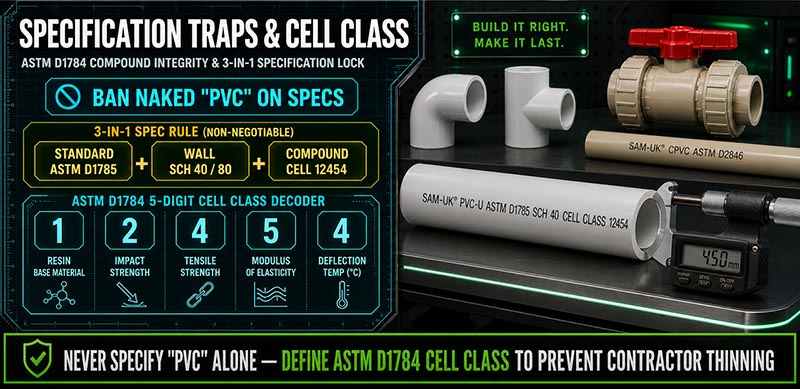
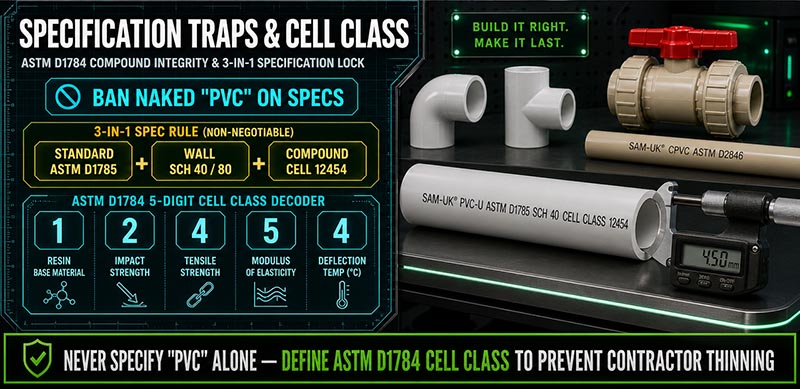
The most expensive word in a pipe specification is “PVC” on its own. It names a family, not a product, and a contractor pricing to win will read it as permission to buy the thinnest wall that satisfies the words on the page. Name the standard, the schedule or SDR, and the cell class in the same line — “PVC-U pressure pipe to ASTM D1785, Schedule 40″ leaves no room to argue.
Cell class is the trap almost nobody checks. Two pipes can both carry a PVC 1120 designation and still differ in impact and tensile design values, because the five-digit cell class per ASTM D1784 encodes the compound, not just the resin. Impact-modified drainage compound and a general-purpose extrusion compound are not interchangeable on a riser that takes a hammer blow during fit-out.
Then there is substitution, in both directions. A CPVC hot-water spec gets value-engineered to PVC-U by a subcontractor who assumes plastic is plastic, and it surfaces 18 months later at 70°C. The reverse happens too: CPVC across all domestic water, including the cold side, where it buys capability nothing will use.
One item sits on the buyer’s checklist, not the manufacturer’s. Many markets restrict plastic pipe in certain occupancies, and the accepted-materials list for the governing building code decides. Confirm what your local authority requires before the submittal goes out — never infer it from a datasheet.
The Cost Reality Nobody Puts in the Tender
CPVC costs materially more than PVC-U at like-for-like diameter — commonly in the range of two to four times the pipe cost, and the multiplier moves with size and grade. On the 15% of a project that is genuinely hot-water duty, that premium is easy to justify. Applied to the whole building, it is a budget event. A developer who approves CPVC everywhere has effectively paid a heat-resistance premium on drainage pipe sitting at 25°C.
But material cost is the small number. The money lands in labour, rework and callbacks. Cutting out one failed solvent joint in a riser after the ceiling closes costs more than the entire material delta on that riser.
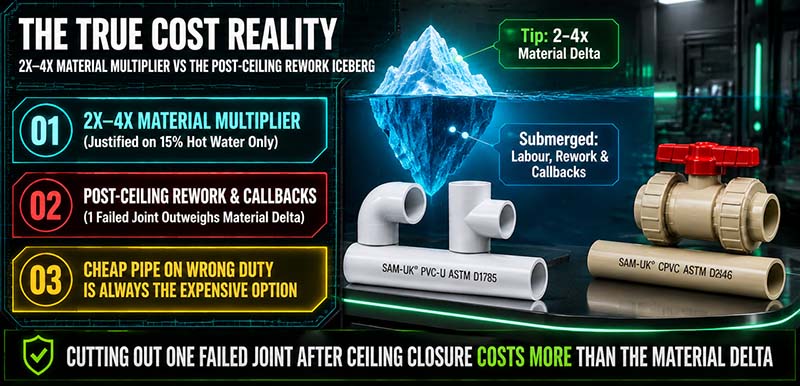
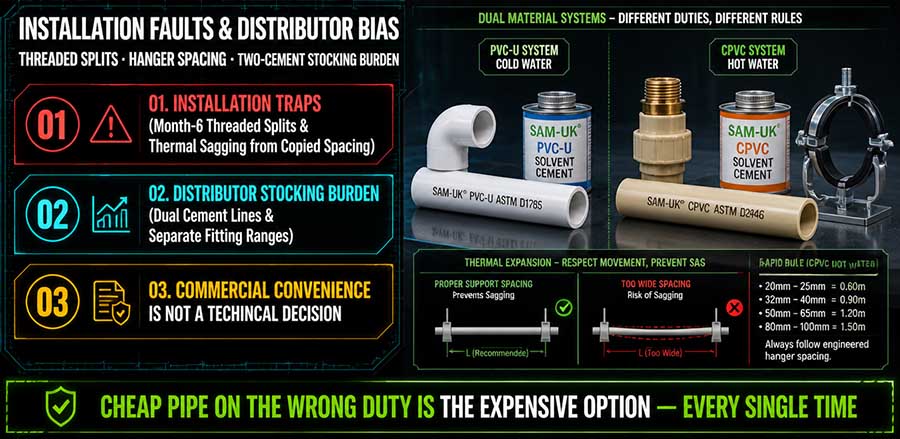
Same story with a threaded transition that splits in month six, or a hot line sagging because the hanger spacing was copied off the cold-water sheet. Cheap pipe on the wrong duty is the expensive option. Every time.
Distributors carry a cost that rarely gets modelled. Stocking both means two solvent cements, two fitting ranges and two training conversations with installers. That burden is why a branch sometimes pushes one material for everything — a commercial convenience the project inherits as a technical decision.
Site Handling: Joints, Cure Time, Expansion, UV
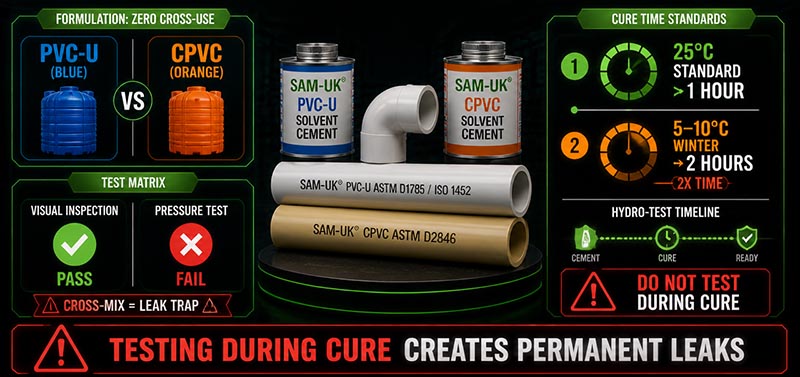
CPVC needs CPVC solvent cement. PVC-U cement is not a substitute, not in an emergency, not “just this once.” The two cements are formulated for different resins and a joint made with the wrong one will pass a visual inspection and fail a pressure test. Two tins of the same colour on the same site is how this happens; label the stores and separate the shelves.
Cure time gets compressed on every programme. Published tables are temperature-dependent and the drop is steep — a joint needing over an hour before pressure testing at 25°C may need roughly double that in a 5–10°C winter fit-out. Test while it is still curing and you create a leak that never existed.
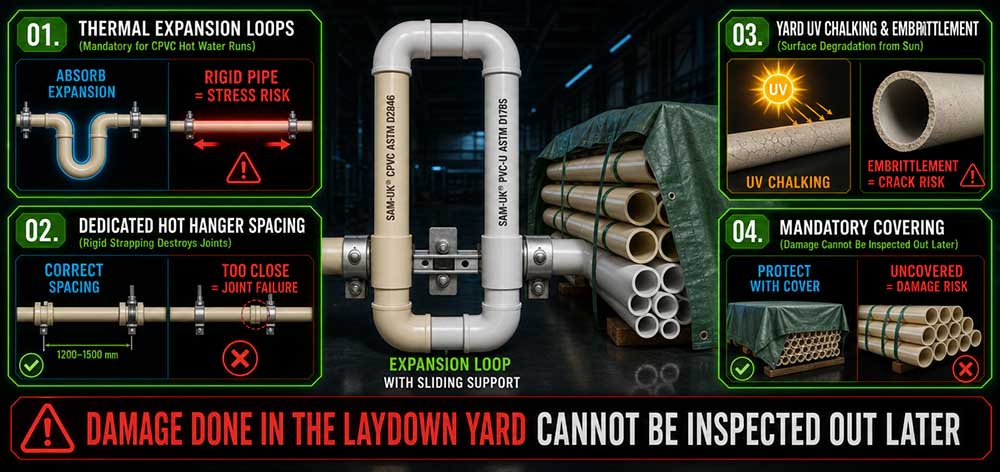
CPVC moves more per degree than PVC-U, so hot runs need offsets, loops or change-of-direction anchors. Strap a hot line rigidly to the structure and that movement goes into the joints. Support spacing on a hot line is set by the expansion allowance, not by the cold run beside it.
UV exposure is the quiet one, and it usually happens before installation. Pipe stored outdoors for a season, or left on a roof pending cover, chalks and embrittles. CPVC is not a shortcut around this — both materials need protection, coating or prompt covering, and damage done in the laydown yard cannot be inspected out later.
What Fails at Handover — and Who Pays
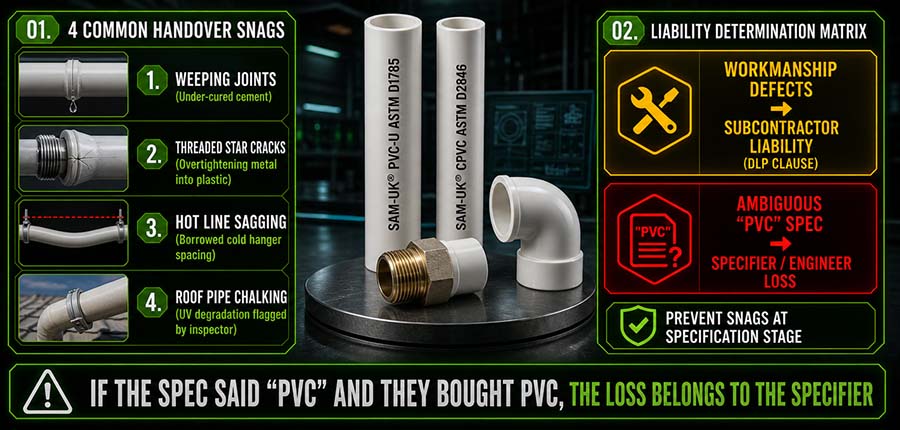
Handover snagging on plastic systems is remarkably consistent. Weeping joints from under-cured or over-primed connections. Star cracks at threaded transitions where metal was overtightened into plastic. Sagging hot runs from borrowed hanger spacing. Chalked pipe on an exposed roof that an inspector flags even though it holds pressure.
Responsibility usually lands on the installing subcontractor under the defects liability clause, and that is fair for workmanship. It is not fair, and not accurate, when the specification was ambiguous. If the spec said “PVC” and the contractor bought PVC, the loss belongs to whoever wrote the spec — and recovering it after handover is slow, political and rarely complete.
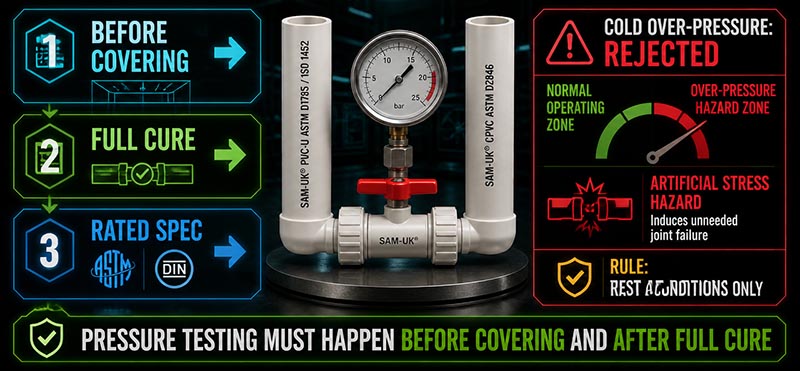
Pressure testing needs its own line in the method statement: before covering, at the pressure and temperature the standard requires, with joints fully cured. Over-pressurising a hot-rated line with cold test water to “prove” it stresses the system in a condition it never sees.
A Decision Framework the Project Team Can Apply
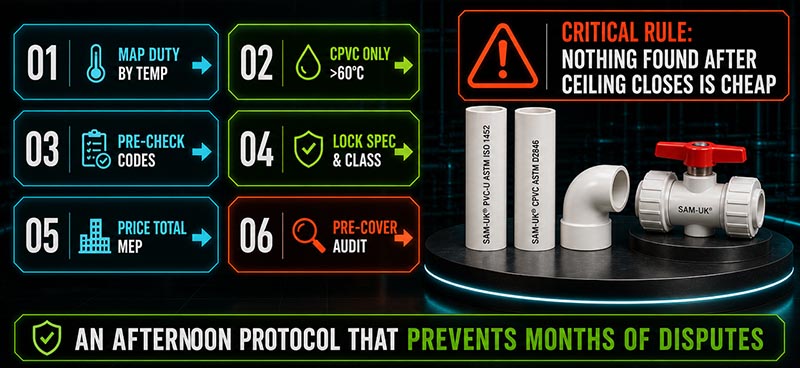
Six steps, in this order. They take an afternoon and save the argument later.
- Map duty by temperature and continuity, not by room or by floor. A pipe in a bathroom is not automatically a hot line.
- Allocate CPVC only where service is continuously above roughly 60°C, or where chemical duty demands it.
- Check the governing code’s accepted-materials list for the occupancy before the submittal, not after.
- Write standard, schedule or SDR, and cell class into every pipe line item on the schedule.
- Price the hybrid against the single-material option, then compare against total MEP value — not against pipe cost alone.
- Inspect joints and support spacing before cover. Nothing found after the ceiling closes is cheap.
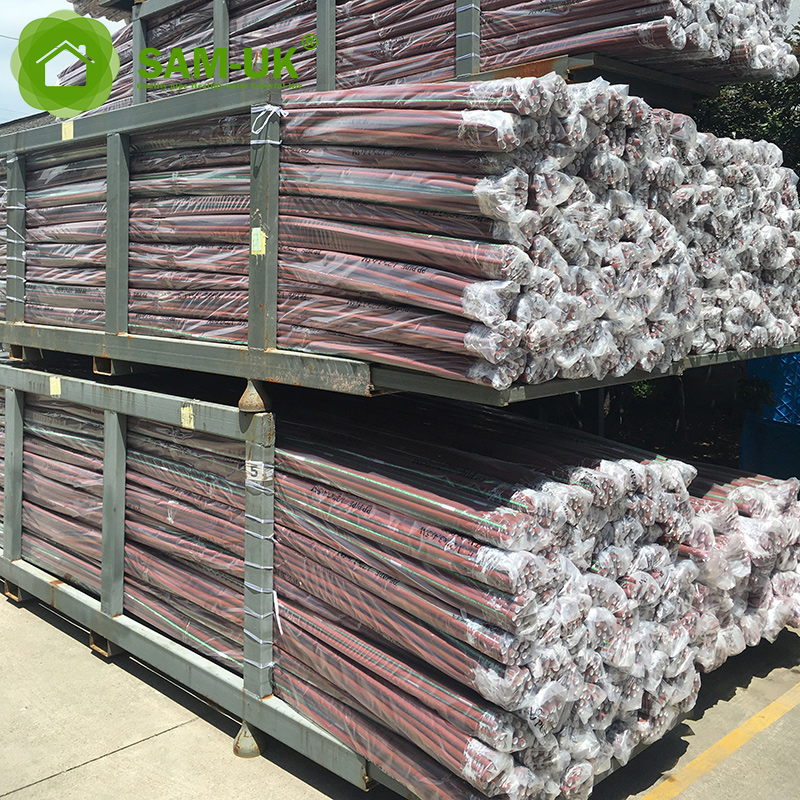
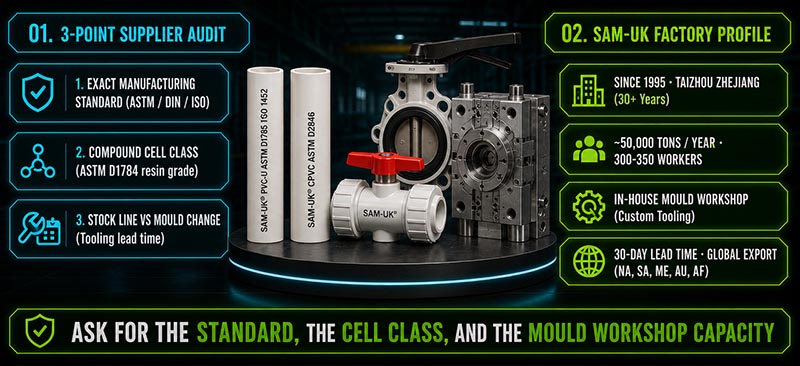
When you evaluate suppliers for either leg of that split, ask for the standard the pipe is actually made to, the compound cell class, and whether the schedule you need is a stock line or a mould change. SAM-UK, the export brand of Taizhou Zhuoxin Plastics Co., Ltd., has been making pipe and fittings in Taizhou, Zhejiang since 1995 with 300–350 employees and roughly 50,000 tonnes a year, an in-house mould workshop, 30-day lead times on standard programmes and OEM service, across PVC/uPVC, CPVC, PPH 和 PPR pipe and fittings plus PVC ball and butterfly valves, exported to North America, South America, Australia, Africa and the Middle East. Ask the same of any supplier you shortlist. More at www.sam-uk.com.
常见问题解答
Can PVC-U be used for hot water if the temperature stays low?
Only at the margins, and rarely worth the argument. PVC-U derates hard as temperature climbs — allowable strength drops to roughly 20% of its 23°C value at 60°C. A line that occasionally sees 50°C is not the same as one designed for it. If the duty is hot water, specify CPVC to ASTM D2846 and stop negotiating with the physics.
Is CPVC worth specifying for cold water lines as well?
Usually no. The cold side never uses the heat capability you paid for, and CPVC brings lower impact resistance and a bigger expansion allowance than PVC-U. The common exception is a combined manifold where mixing materials creates more joint complexity than the saving justifies.
What is the difference between Schedule 40 and SDR ratings?
Two ways of expressing wall thickness. Schedule numbers are fixed wall dimensions from ASTM D1785; SDR is the ratio of outside diameter to wall, so a lower SDR means a thicker wall. They are not directly comparable, which is why the spec must name which system it uses.
Can I use PVC cement on a CPVC joint?
不 CPVC requires CPVC-specific solvent cement. A joint made with PVC cement can look sound and still fail under pressure or heat. Keep the two cements physically separated in the site store and label primers the same way.
Does CPVC resist UV better than PVC-U?
Not enough to matter. Both materials degrade under prolonged sunlight and both need coating, jacketing or covering. The damage is usually done during storage and laydown, before the pipe is ever installed, so protect it from delivery rather than after installation.
Who is responsible when a plastic pipe system fails at handover?
Workmanship defects sit with the installing subcontractor. Ambiguous specifications sit with the specifier, and that is the more common root cause — a schedule that says “PVC” without a standard, a schedule or a cell class leaves the material choice to whoever is pricing lowest.
关于卓信塑业
SAM-UK 是专业人士 20年以上 生产乙烯基建筑型材产品的制造商,以及 聚氯乙烯 , CPVC , PPH , PPR , 聚丙烯 管道及管件、阀门、水龙头等。请参阅我们的 认证记录和具体产品的适用范围. 我们支持颜色/尺寸定制。欢迎咨询 目录 和 产品您可以通过电子邮件与我们联系 [email protected]