What Pipe Distributors Should Do While the Market Favors Buyers
PVC resin prices Q3 2026 are as buyer-friendly as this market gets. China’s benchmark spot sits near two-decade lows, US pipe-grade resin contracts have no upward momentum, and every major thermoplastic resin family is running long on supply. Below: the regional price picture with dated sources, why the balance favors pipe buyers, and a locking strategy for plastic pipe procurement.

Where PVC Resin Prices Stand in Q3 2026, Region by Region
The headline number: China’s benchmark PVC spot traded flat at 4,890 CNY/ton on September 4, 2026 — up 9.69% over the past month, but just 2.28% above this time last year (Trading Economics, Sep 4, 2026). Spot prints near 4,400 CNY/ton in November 2025 were called a two-decade low (per market coverage, Dec 1, 2025); the 14,790 CNY/ton October 2021 peak is history.
Outside China, the regional spread tells a sharper story. US domestic PVC resin averaged $644/MT in Q2 2026, up 19.2% quarter-on-quarter, with Japan at $609/MT, Germany at $946/MT, India at $834/MT and Brazil at $455/MT in the same June window (IMARC, Jul 2026). Quick conversion: that’s roughly 29 cents a pound — and the Q2 US jump was mostly import-cost pain (freight, insurance, Hormuz risk on cargoes booked months earlier), not demand pull.
| Market | PVC resin price | Basis & date | Source |
|---|---|---|---|
| China (spot benchmark) | 4,890 CNY/ton | Domestic spot, Sep 4, 2026 | Trading Economics |
| China (model forecast) | 4,494 CNY/ton | End-Q3 2026 forecast | Trading Economics |
| United States | $644/MT | Q2 2026 (June), domestic | IMARC |
| Japan | $609/MT | Q2 2026 (June) | IMARC |
| Germany | $946/MT | Q2 2026 (June) | IMARC |
| India | $834/MT | Q2 2026 (June) | IMARC |
| Brazil | $455/MT | Q2 2026 (June) | IMARC |
What the price table doesn’t tell you
ResinSmart, a buyer-side intelligence service, reports that US PVC inventories grew significantly in June — during the seasonal demand peak — pushing days of supply to nearly 20, with demand rates negative and exports declining sharply (per PlasticsToday, Jul 20, 2026). In plain English: the June data behind that $644/MT print is stale — Q3 momentum is down, not up.
Why the PVC Pipe Market 2026 Favors Resin Buyers
Strip the noise and the logic is simple: too much resin chasing too little housing. US single-family new home sales fell 7.3% in May to 580,000 units — the lowest level since January — and the NAHB/Wells Fargo Housing Market Index sat at 35, the 14th consecutive month below 40 (per PlasticsToday, Jun 30, 2026). Residential construction is the demand engine PVC Pipe Series depends on — and it isn’t firing.

US PVC inventories rose 48 million pounds in May to 735 million pounds even as domestic sales ticked up 4% (per PlasticsToday, Jun 30, 2026). In China, producers keep running well above what a weak property sector can absorb, and the surplus has to travel — toward Southeast Asia, South Asia, Africa and Latin America. That export pressure is why PlasticsToday concluded that buyers heading into Q3 2026 held their strongest negotiating position in 18 months; PE inventories alone sat near 46 days of supply. A feedstock-wide glut, with PVC in the middle.

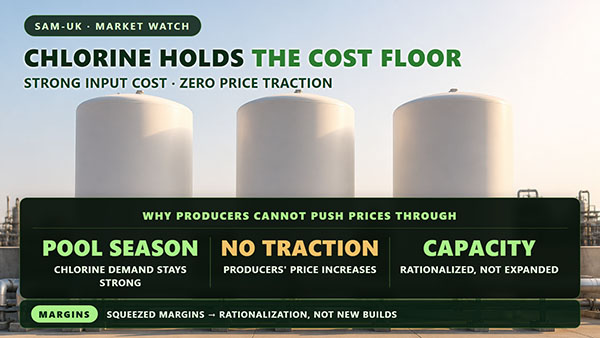
One genuine floor exists on the cost side. Chlorine demand is strong through pool season, and chlorine is PVC’s key input — so producers face real cost pressure even as they fail to push increases through. Falling demand pull, rising input costs, zero increase traction: that’s squeezed margins, and it’s why resin makers are rationalizing capacity rather than chasing market share with new builds.
Trade Remedies and Hormuz: The Ceiling and the Floor
Here’s what most forecasts miss. Oversupply puts a ceiling on PVC resin prices, but trade policy and shipping lanes put a floor under them — and both are moving at once.
India is the clearest case. New Delhi’s trade remedy authority (DGTR) recommended five-year anti-dumping duties of $22–$284 per metric ton on PVC resin in August 2025 — covering imports from China, Japan, Taiwan, South Korea, Thailand, Indonesia and the United States (per IMARC). In early August 2026 the commerce ministry went further, imposing a minimum import price of $766/MT on suspension-grade PVC resin to block “unfairly low” imports (Indian Express, Aug 2–3, 2026), and on August 25, 2026 DGTR opened a fresh anti-dumping investigation into suspension resin from China, Indonesia, Japan and South Korea (DGTR case notice). South Korea opened its own probe into Chinese PVC imports in July 2026, and Mexico is running an AD case against US PVC suspension resin (US trade.gov, Mar 2026).
The world’s biggest import markets are all building walls around PVC at the same time. The $766/MT Indian floor price is particularly instructive — it sits above what Chinese resin can land in India at current spot levels, which means Chinese exporters must redirect those tonnes to open markets. That’s why Southeast Asia, Africa and Latin America stay soft even as India hardens.
Then there’s the Strait of Hormuz. US and Israeli strikes on Iran in March spiked transpacific container freight roughly $800 per FEU within weeks (Freightos, Apr 27, 2026) — spread over a container of bagged resin, that’s a $30-plus per-tonne adder nobody budgeted for, and bulk add-ons on affected lanes ran higher still. Crude swung all year: WTI fell $4.68 to $71.92/bbl when Hormuz briefly reopened to commercial tankers in late June (per PlasticsToday, Jun 30, 2026), then jumped from $72.08 to $78.95 on renewed escalation in July (per PlasticsToday, Jul 20, 2026). Tanker earnings stayed at decade highs into early September (CNBC, Sep 3, 2026). Any re-escalation reprices every import-dependent market on earth.
Three Procurement Moves for Plastic Pipe Buyers in Q3 2026
Enough market theory. Here’s what a distributor or purchasing manager should actually do this quarter — in order of impact.
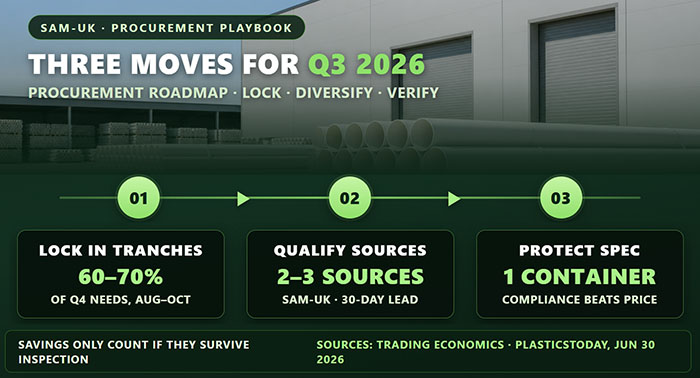
- Lock in tranches now — don’t wait for a crash. The Trading Economics model has China spot at 4,494 CNY/ton by end of Q3 and 4,218 CNY/ton twelve months out — real but modest downside from 4,890. Waiting for a collapse before covering Q4 is how buyers miss the market; layering 60–70% of needs across August–October contracts captures the softening without betting the warehouse on a forecast.
- Diversify qualified sources before you need them. In a buyer’s market, the temptation is to chase the cheapest offer sheet each month. The better play is qualifying two or three converters who can deliver on spec, then rotating volume between them. Supplier fundamentals separate the professionals here, and the benchmark matters: Taizhou Zhuoxin Plastics (SAM-UK) — since 1995, 300–350 staff, 50,000 tonnes of annual pipe and fitting capacity, its own mold shop, 30-day lead times — carries exactly the profile a distributor wants in a down-cycle supplier: stable, self-tooled and fast enough to flex with your orders.
- Protect specification compliance — the cheapest resin quarter is when corners get cut. Every dollar you save on resin can evaporate in one rejected container, one failed hydrotest, one specification breach on a code-governed job.
Verify certifications before you commit volume:
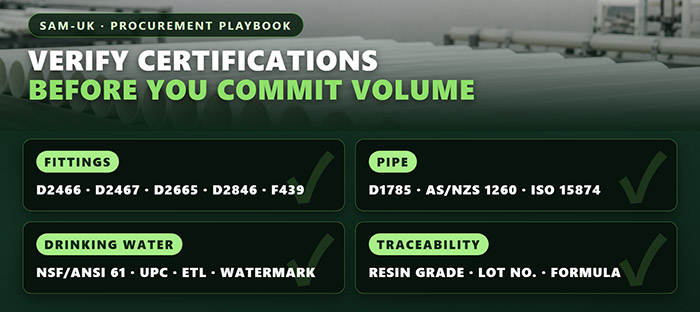
- Fittings: ASTM D2466 (sch 40), D2467 (sch 80), D2665 (DWV), D2846 (CPVC), F439 (socket fittings)
- Pipe: ASTM D1785, AS/NZS 1260, ISO 15874 for PPR systems — and ask for the batch test report, not just the certificate number
- Drinking-water compliance: NSF/ANSI 61, UPC, ETL, CE, Watermark — depending on your end market
- Material traceability: resin grade, lot numbers, and compound formulation on file for every production run
Run that checklist against any new supplier and most of them quietly fail. And that’s the point: the suppliers who pass — with documented test data, audited plants and real certifications — are the ones worth building Q4 and 2027 volume commitments with.
PVC Resin Price Forecast: Second-Half 2026 and Beyond

How long does the buying window stay open? The structural oversupply argues for stable-to-soft pricing through the rest of 2026 and into 2027. India alone is adding about 3,000 kilotonnes of new domestic PVC capacity in 2026–27 (Indian Express, Aug 2026), which will push even more Chinese and Northeast Asian export volume into open markets.
But don’t confuse “soft” with “risk-free.” Three events could close the window faster than any forecast: a Hormuz re-escalation that re-adds freight premiums, a Gulf Coast hurricane season that takes out US chlor-alkali capacity, or a fresh wave of AD duties that reshuffles trade flows mid-contract. Each of those is a supply event, not a demand event — and supply events hit pipe buyers twice: in resin, then in freight.
Zoom out and the demand story underneath all of this is genuinely constructive. Fortune Business Insights projects the global plastic pipe market growing from $90.10 billion in 2026 to $137.36 billion by 2034, a 5.4% CAGR (Aug 17, 2026); Grand View Research pegs 2026 closer to $78 billion. Water infrastructure, irrigation and drainage demand is secular — municipalities don’t cancel pipe projects the way developers cancel condos.
Frequently Asked Questions
Will PVC resin prices keep falling through Q3 2026?
Modest downside, not a collapse. Trading Economics models China spot at 4,494 CNY/ton by end of Q3, about 8% below the September 4 print. US contract momentum is soft — PVC days of supply hit nearly 20 in June, with no increase initiatives gaining traction (per PlasticsToday, Jul 20, 2026).
Is Q3 2026 a good time to sign quarterly or annual pipe supply contracts?
Yes — with structure. Annual contracts signed now lock in resin-linked pricing that reflects a buyer’s market, but include tranche releases and a price-adjustment clause so freight or trade policy moves can’t strand you.
How do India’s $22–284/MT duties and the $766/MT floor price affect buyers outside India?
Strongly, but indirectly. India’s $766/MT minimum import price (Aug 2026) and its August 25 anti-dumping investigation into suspension resin from China, Indonesia, Japan and South Korea redirect those countries’ export volumes toward Southeast Asia, Africa and Latin America. That’s why non-Indian buyers see soft offers — the surplus is being pushed at them.
Where is PVC resin cheapest right now, and should we switch sources to chase it?
Brazil prints the lowest index at $455/MT (IMARC, Q2 2026), but freight eats much of that gap for most buyers. Specify ASTM D2466/D2467/D1785 or AS/NZS 1260 with batch test reports, plus NSF/ANSI 61 for potable systems, then compare landed costs only between qualified suppliers.
How long will this buyer’s market for PVC last?
Through Q3 2026 and most of Q4. Structural oversupply — Chinese export pressure plus roughly 3,000 kilotonnes of new Indian capacity in 2026–27 — caps any rally into 2027. The early-exit risks are supply-side: Hormuz escalation, hurricane-season outages on the US Gulf Coast, or new anti-dumping walls that reshuffle trade flows. Watch those three, not the price ticker.
What should a pipe buyer verify before locking in with a new converter?
Four things: certifications covering your end market (NSF/UPC/ETL/CE/Watermark), in-house tooling, lead times stated in writing, and resin traceability with batch test reports. A converter with its own mold shop and documented 30-day lead times — the SAM-UK profile, 50,000 tonnes of annual capacity since 1995 — can respond when conditions change. A trading house reselling someone else’s production cannot.
About SAM-UK
SAM-UK are a professional 20+ years manufacturer in producing vinyl building profile products and PVC , CPVC , PPH , PPR , PP pipes and pipe fittings, valves, taps and so on. We own the certificates of SGS\SONCAP\ISO9001\CE\NSF,support color /size customization. Welcome to consult for Catalog and Product. you can contact us at email [email protected]