Which One Actually Fits Your Project?
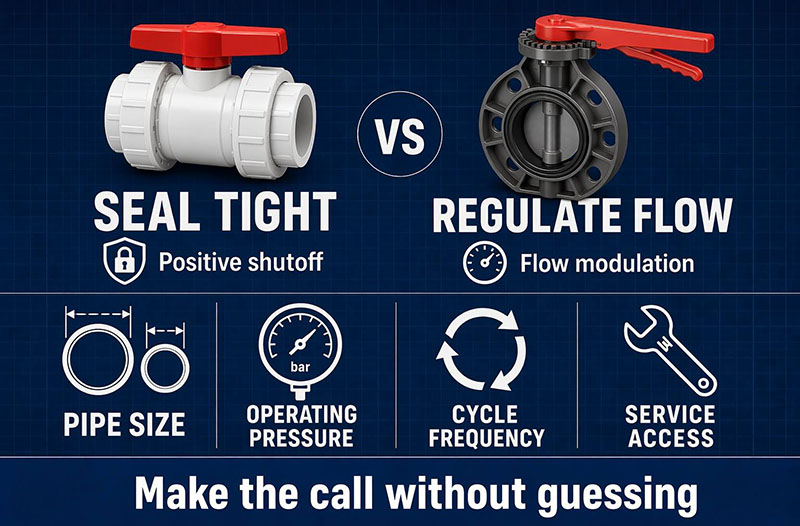
Ball valves seal tight. Butterfly valves regulate flow. That’s the one-sentence answer most engineers will give you. But the real decision comes down to application specifics — pipe diameter, operating pressure, how often you need to cycle the valve, and whether anyone will need to service it five years from now. Here’s how to make the call without guessing.
The Fundamental Trade-Off: Seal Quality vs Flow Control
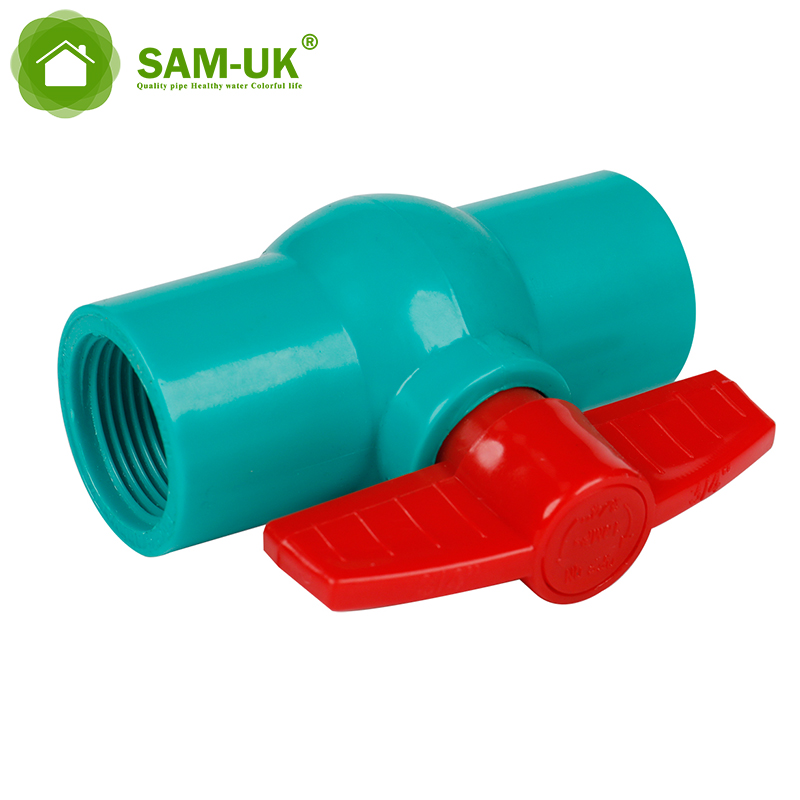
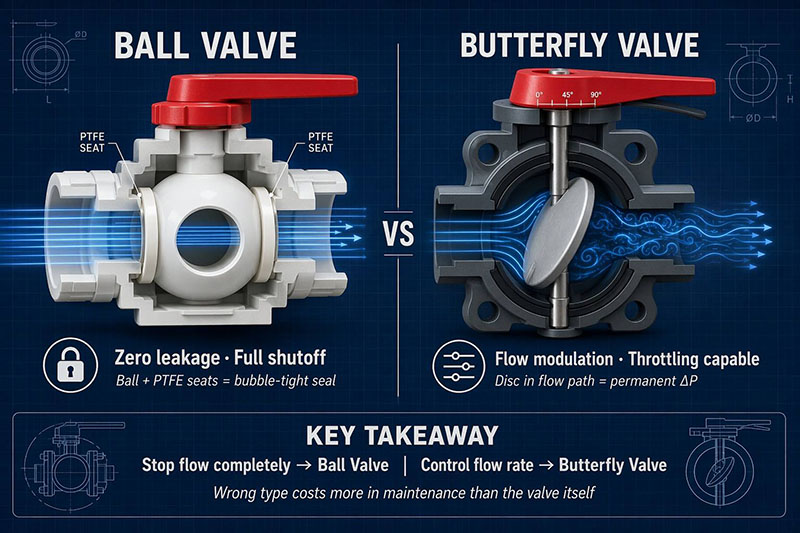
PVC ball valves use a machined sphere with a bore through the center. Quarter-turn rotation aligns the bore with the pipe for full flow, or blocks it completely for shutoff. The ball seats against PTFE or EPDM seals on both sides. When closed, there’s essentially zero leakage — which is why ball valves dominate applications where positive shutoff matters: pump isolation, tank outlets, chemical feed lines.
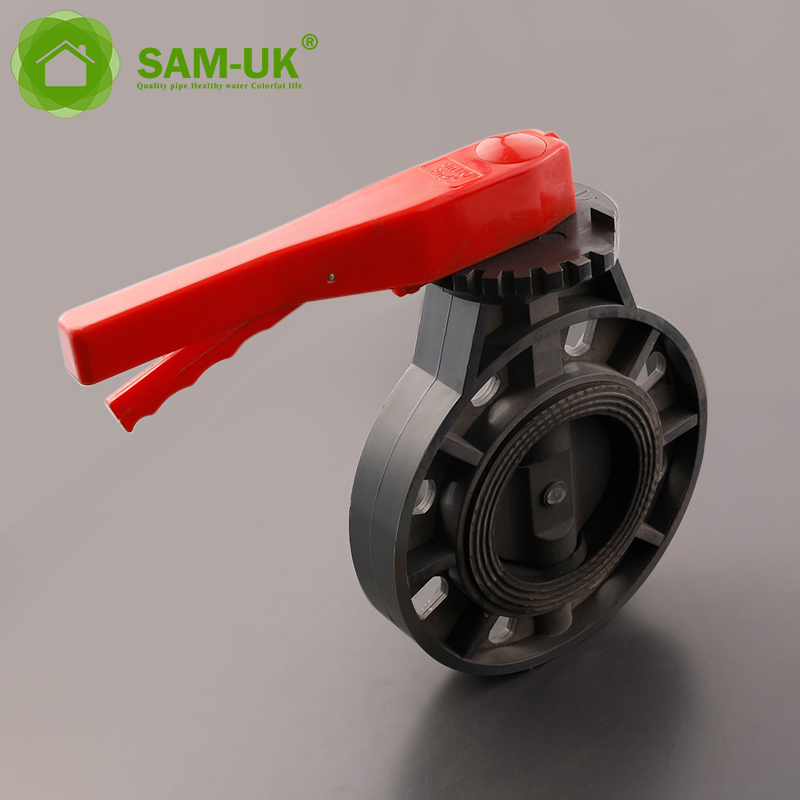
Butterfly valves use a disc mounted on a central shaft. Quarter-turn rotation positions the disc parallel to flow (open) or perpendicular (closed). The disc stays in the flow path even when fully open, creating a permanent pressure drop. That’s the trade-off for getting flow modulation capability — you can set a butterfly valve at 30% open and get roughly proportional flow. Try that with a ball valve and you’ll get cavitation, seat damage, and a valve that doesn’t seal properly anymore.
Pressure, Size, and Space: Where Each Valve Wins
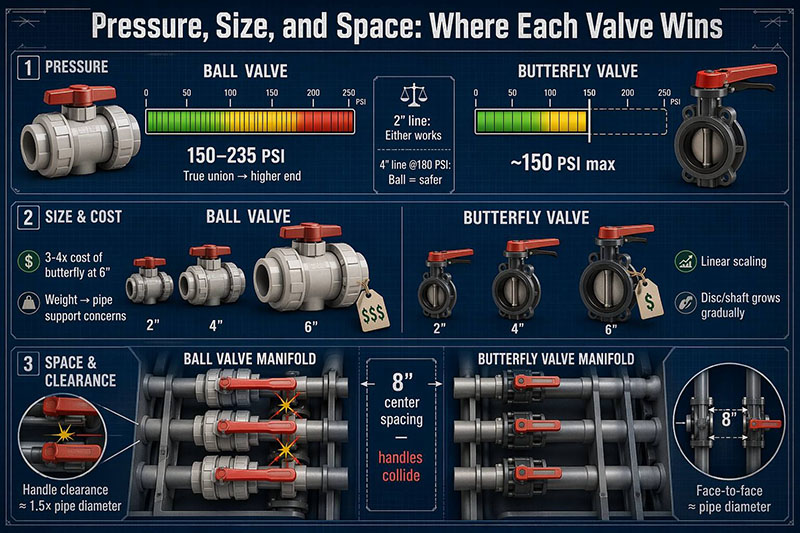
PVC ball valves typically handle pressures up to 150-235 PSI depending on size and schedule, with true union designs pushing toward the higher end. Butterfly valves in PVC generally top out around 150 PSI. For a 2-inch line at municipal water pressure, either works. For a 4-inch industrial chemical line at 180 PSI, the ball valve is the safer bet.
But size changes the equation fast. Above 3 inches, PVC ball valves get bulky, heavy, and expensive — the ball alone becomes a substantial machined component. A 6-inch PVC ball valve costs 3-4 times what a comparable butterfly valve costs and weighs enough that you’re thinking about pipe supports differently. Butterfly valves, by contrast, scale gracefully — the disc and shaft assembly grows linearly with diameter, and the actuator torque requirement increases gradually rather than jumping at each size increment.
Space is another factor that catches people off guard. A butterfly valve with a lever handle needs about the same face-to-face dimension as the pipe diameter. A ball valve with a handle needs roughly 1.5 times the pipe diameter in handle clearance radius. In a tight mechanical room with multiple parallel pipes at 8-inch center spacing, those handles can interfere with each other. We’ve seen installations where someone spec’d ball valves for a manifold, then realized the handles physically can’t all rotate without hitting the adjacent valve.
| Factor | PVC Ball Valve | PVC Butterfly Valve |
|---|---|---|
| Shutoff quality | Zero-leakage (bubble-tight) | Minimal leakage, not zero |
| Flow control | On/off only — don’t throttle | Good modulation across 20-80% range |
| Pressure drop (open) | Negligible — full bore | Permanent — disc in flow path |
| Size sweet spot | 1/2″ to 4″ | 2″ to 12″+ |
| Typical pressure rating | 150-235 PSI | 100-150 PSI |
| Space requirement | High — handle swing radius | Low — compact face-to-face |
| Weight (6-inch) | Heavy — solid ball mass | ~75% lighter |
| Cost (6-inch) | 3-4x butterfly equivalent | Economical at large diameters |
| Serviceability | True union: fully field-serviceable | Seat and disc replaceable |
True Union Ball Valves: Why They’re Worth the Extra Cost
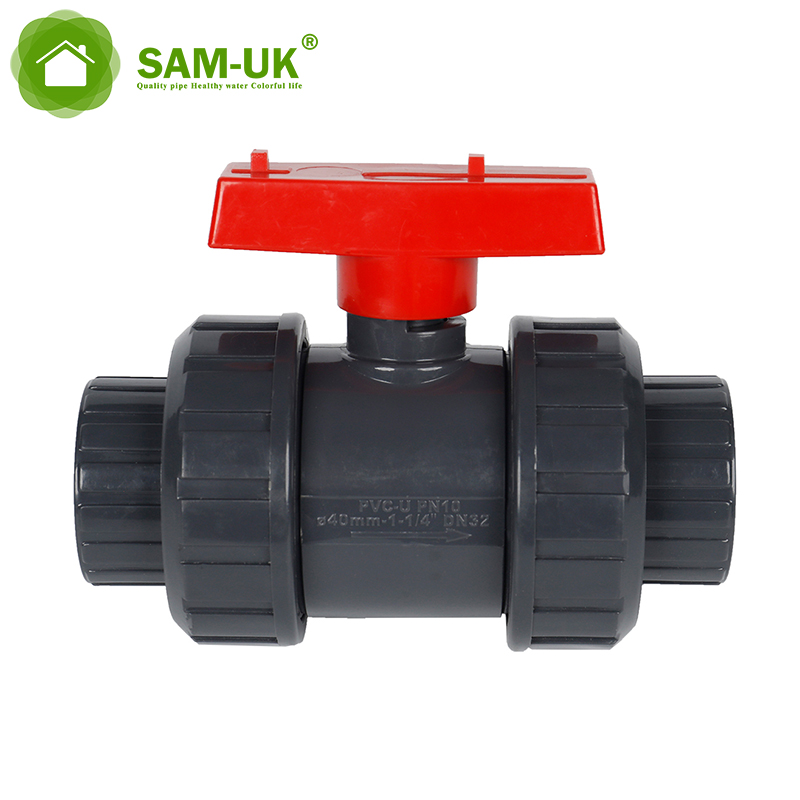
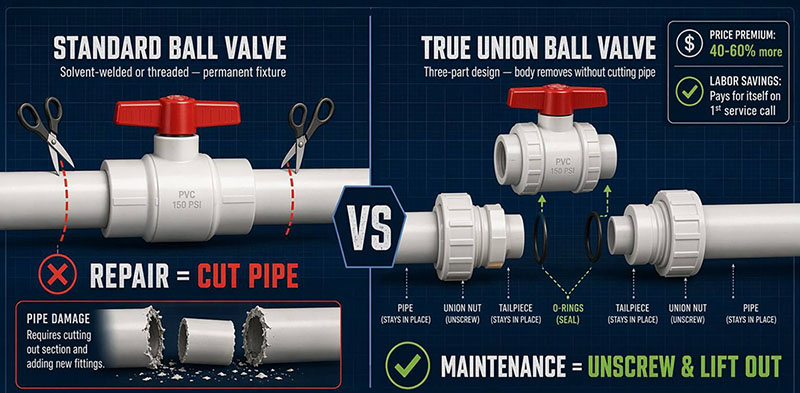
Standard PVC ball valves are solvent-welded or threaded into the line. When the seats wear out — and they will, especially if the valve gets cycled frequently or exposed to abrasive fluids — you’re cutting pipe to replace the valve. True PVC union ball valves solve this with a carrier body that threads apart at both ends, letting you remove the entire valve body for cleaning, seat replacement, or swap-out without touching the pipe connections.
The price premium is real — a true union valve costs roughly 40-60% more than an equivalent single-union or standard ball valve. But the labor savings on a single replacement event usually pay for that premium several times over. If the valve is in an accessible location and sees fewer than 50 cycles per year, a standard ball valve is fine. If it’s buried in a pipe rack behind three other lines or cycling daily, the true union pays for itself on the first service call.
Butterfly Valve Actuation: Manual vs. Automated
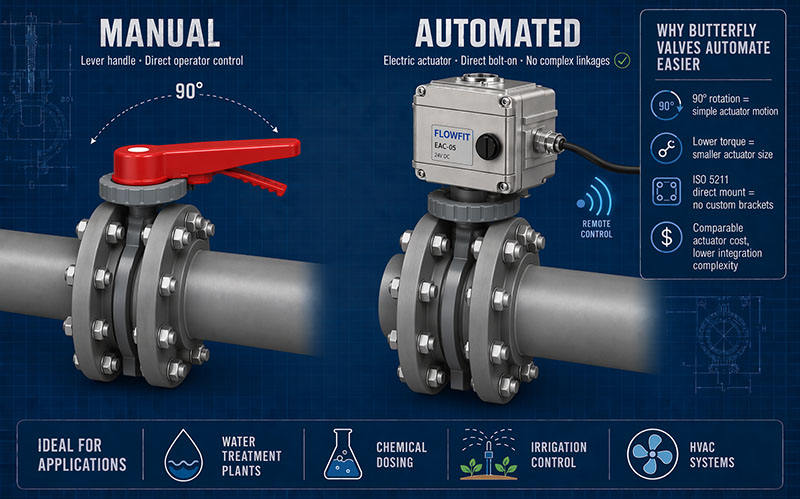
One advantage butterfly valves have that doesn’t show up in spec sheets: they’re inherently easier to automate. The 90-degree rotation and relatively low torque requirement means a standard electric or pneumatic actuator bolts on without the complex linkages that automating a ball valve often requires. For applications where remote operation or automated process control is part of the spec — water treatment plants, chemical dosing systems, irrigation control — butterfly valves with actuators are the default choice. The actuator cost is comparable, but the integration complexity is lower.
Material Compatibility: Seats, Seals, and the Chemicals They’ll Meet
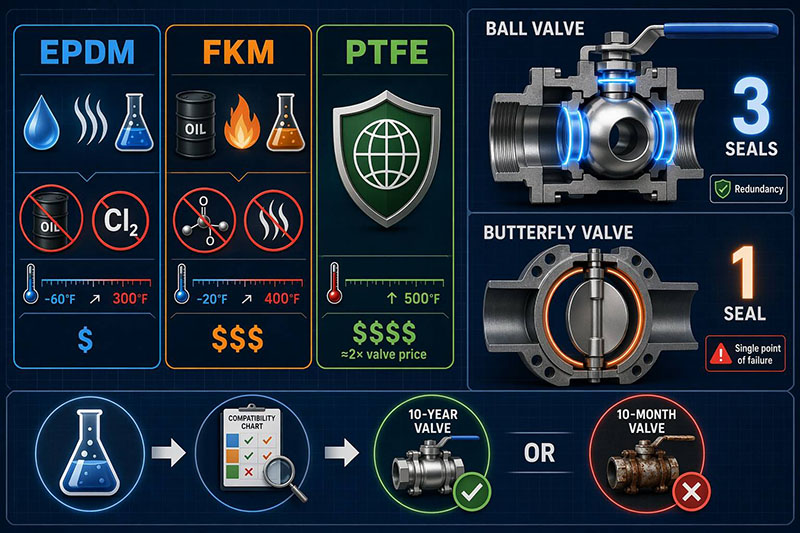
Both valve types rely on elastomeric seals that are application-specific. Standard EPDM seats and O-rings handle water, weak acids, and alkalis. FKM (Viton) is the upgrade for stronger chemicals, solvents, and higher temperatures. PTFE seats exist for aggressive chemical service but add cost — figure roughly double the valve price for PTFE over EPDM.
The seal configuration difference between the two types matters in practice. A ball valve has two seats (upstream and downstream), plus a stem seal. A butterfly valve has a single circumferential seat that seals against the disc edge and the pipe wall simultaneously. More seals mean more potential leak paths, but also redundancy — if one ball valve seat degrades, the other still holds some pressure. The butterfly valve’s single seat is simpler, but when it fails, it fails completely.
Decision Framework: Which Valve for Which Application?
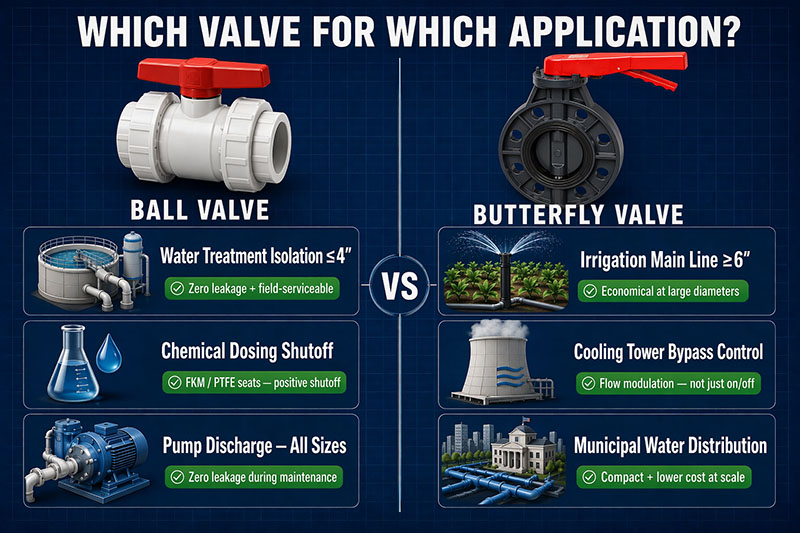
- Water treatment plant isolation valves (up to 4″): True union PVC ball valve. Zero leakage for maintenance safety, field-serviceable without cutting pipe.
- Irrigation main line flow control (6″ and above): Butterfly valve. Economical at large diameters, adequate flow modulation.
- Chemical dosing system shutoff: Ball valve with FKM or PTFE seats. Positive shutoff is non-negotiable when chemicals are involved.
- Cooling tower bypass control: Butterfly valve. You need flow modulation, not just on/off.
- Pump discharge (all sizes): Ball valve. You want zero leakage when the pump is offline for maintenance.
- Municipal water distribution vaults: Butterfly valve. Compact installation, lower cost at large diameters, adequate for distribution shutoff.
Frequently Asked Questions
Can I use a PVC ball valve for throttling?
No — and this is one of the most common installation mistakes we see. PVC ball valves are designed for fully open or fully closed operation. Partially opening a ball valve creates high-velocity flow across the partially exposed seat, causing erosion, cavitation, and permanent seat damage. The valve will eventually fail to seal completely, even when fully closed. Use a butterfly valve or globe valve for throttling applications.
What is a true union ball valve and when should I use one?
A true union ball valve has threaded carrier nuts at both ends that allow the entire valve body to be removed from the pipe connections without cutting. Use them anywhere the valve will need future service — pump connections, filter assemblies, chemical injection points. The 40-60% price premium typically pays for itself on the first maintenance event.
What pressure rating do I need for a PVC butterfly valve?
Standard PVC butterfly valves are typically rated for 150 PSI at 73°F, with derating at higher temperatures. At 100°F, expect roughly 110 PSI maximum. At 140°F, you’re down near 70 PSI. Always check the manufacturer’s pressure-temperature chart — the derating curve varies between manufacturers based on disc and seat design.
Are PVC valves suitable for compressed air service?
Generally no — and this is a safety issue, not a performance one. PVC is not rated for compressed gas service. In the event of a failure, PVC shatters rather than tearing, creating shrapnel hazards. Use metal valves or specifically rated plastic valves designed for pneumatic service. PVC valves are for liquid applications only unless the manufacturer explicitly certifies them for compressed gas.
About SAM-UK
SAM-UK are a professional 20+ years manufacturer in producing vinyl building profile products and PVC , CPVC , PPH , PPR , PP pipes and pipe fittings, valves, taps and so on. We own the certificates of SGS\SONCAP\ISO9001\CE\NSF\UPC\ETL\Watermark,support color /size customization. Welcome to consult for Catalog and Product. you can contact us at email [email protected]