The B2B Buyer’s Guide to Sourcing, Standards & Supplier Selection
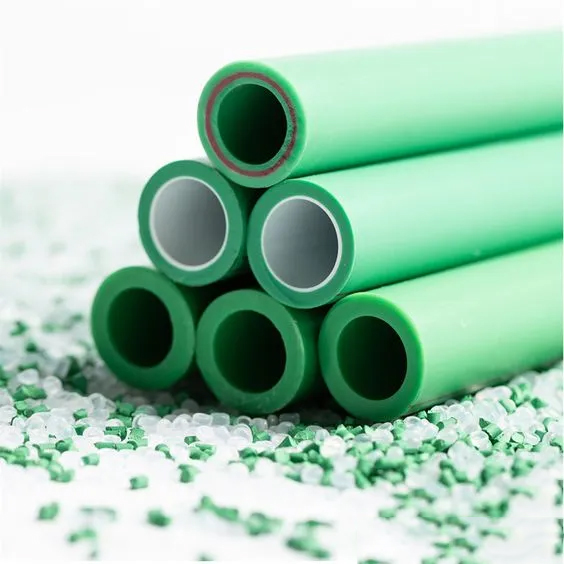
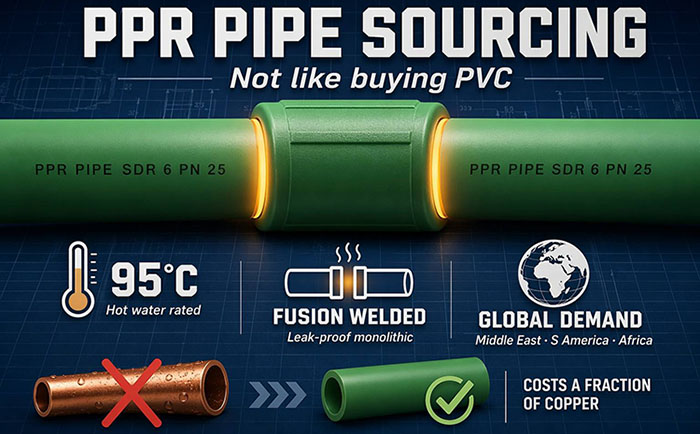
PPR is quietly becoming the default hot water plumbing material across the Middle East, South America, and Africa. It welds into leak-proof monolithic systems, handles 95°C without softening, and costs a fraction of copper. But sourcing PPR pipes and fittings isn’t like buying PVC — the welding process, the standards, and the supplier qualification are different. Here’s what procurement teams need to get right.
Why PPR Is Gaining Ground — and Where It Still Falls Short
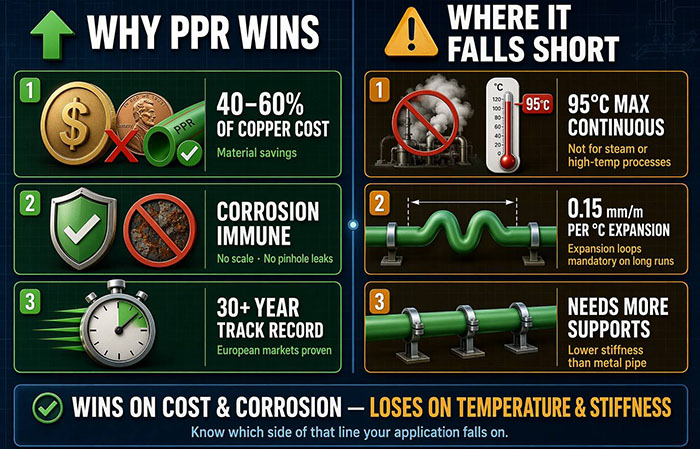
Polypropylene Random Copolymer isn’t new. European markets have been installing PPR hot and cold water systems for over 30 years. What’s changed is the economics. Copper prices have been volatile enough that project estimators are actively looking for alternatives, and PPR delivers comparable hot water performance at roughly 40-60% of the material cost for an equivalent copper system. The corrosion immunity alone — no scale buildup, no pinhole leaks from aggressive water chemistry — eliminates a class of failures that copper and galvanized steel both suffer from.
The performance ceiling is real, though. PPR maxes out around 95°C (203°F) continuous service. For residential and commercial hot water, that’s plenty — most systems run at 60-70°C. For industrial steam lines or high-temperature chemical processes, PPR isn’t the answer. The material also has higher thermal expansion than metal — roughly 0.15 mm/m per °C — which means expansion loops or compensators are mandatory on long straight runs. Ignore this and you’ll get bowed pipes pushing fittings out of alignment within the first year.
Key takeaway: PPR pipe & fittings wins on cost, corrosion resistance, and installation speed for hot/cold water plumbing. It loses on temperature ceiling (above 95°C) and stiffness (needs more supports than metal). Know which side of that line your application falls on before you spec it.
PPR pipe Heat Fusion: The Strength and the Weakness
PPR joints aren’t glued or threaded. They’re heat-fused — pipe and fitting are heated to 260°C (500°F) on a welding tool, then pushed together under pressure. The polypropylene melts, the molecules intermingle, and the joint cools into a single homogeneous piece. There is no joint. That’s the fundamental advantage: a properly fused PPR system has zero leak paths because the pipe and fitting become one continuous material.
The process also introduces the single biggest PPR failure mode: bad welding. The heating time, insertion depth, and cooling time are all diameter-specific and non-negotiable. A 20mm pipe needs roughly 5 seconds of heating and 4 seconds of cooling. A 63mm pipe needs about 14 seconds heating and 8 seconds cooling. An installer who rushes the process — “it looked melted enough” — produces joints that pass the initial pressure test and fail 6-12 months later under thermal cycling.
This is why PPR system quality depends as much on the installer as the manufacturer. A factory producing dimensionally perfect PPR fittings can’t prevent field failures from bad welding.
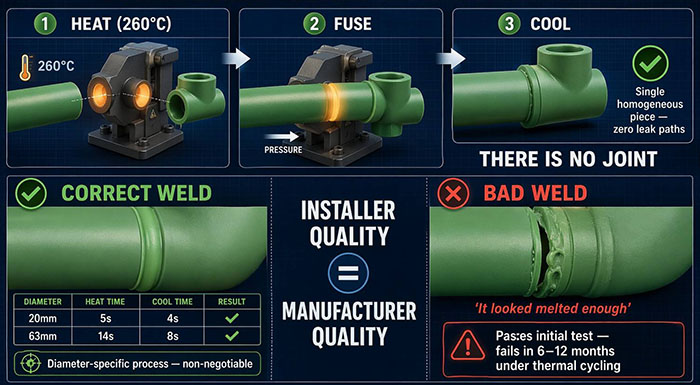
Key takeaway:For procurement teams, this means vetting the installation crew matters as much as vetting the supplier — and for projects where installation quality is uncertain, push-fit or mechanical joint alternatives may be the safer call despite higher material cost.
| Pipe Diameter | Heating Time | Processing Time | Cooling Time | Insertion Depth |
|---|---|---|---|---|
| 20 mm | 5 sec | 4 sec | 2 min | 14 mm |
| 25 mm | 7 sec | 4 sec | 2 min | 16 mm |
| 32 mm | 8 sec | 6 sec | 4 min | 18 mm |
| 40 mm | 12 sec | 6 sec | 4 min | 20 mm |
| 50 mm | 12 sec | 6 sec | 4 min | 23 mm |
| 63 mm | 14 sec | 8 sec | 6 min | 26 mm |
ISO 15874: The Standard That Separates PPR from Pretenders
ISO 15874 is the governing international standard for PPR piping systems for hot and cold water installations. It’s a multi-part standard covering pipes (Part 2), fittings (Part 3), and system fitness (Part 5). Any PPR product claiming hot water capability should reference ISO 15874 on its documentation. If it doesn’t, ask why.
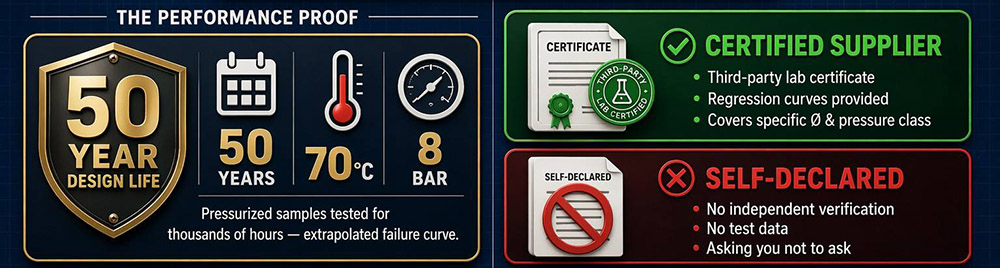
The standard specifies minimum requirements for long-term hydrostatic strength, thermal stability, and resistance to oxidation. Practically speaking, a PPR system compliant with ISO 15874 has been tested to survive 50 years at 70°C and 8 bar pressure — the design basis most European and Middle Eastern plumbing codes reference. The testing isn’t theoretical. It involves pressurizing pipe samples at elevated temperatures for thousands of hours and extrapolating the failure curve. Manufacturers who invest in this testing can provide the regression curves. Those who can’t are hoping you won’t ask.
For procurement, the certification question is straightforward: ask for the ISO 15874 compliance certificate from an accredited third-party lab. A manufacturer’s self-declaration is not the same thing. The certificate should cover the specific diameter range and pressure class you’re buying. A certificate for 20-32mm PPR pipe doesn’t validate their 63mm product.
PPR vs. Copper vs. PVC: The Cost Equation
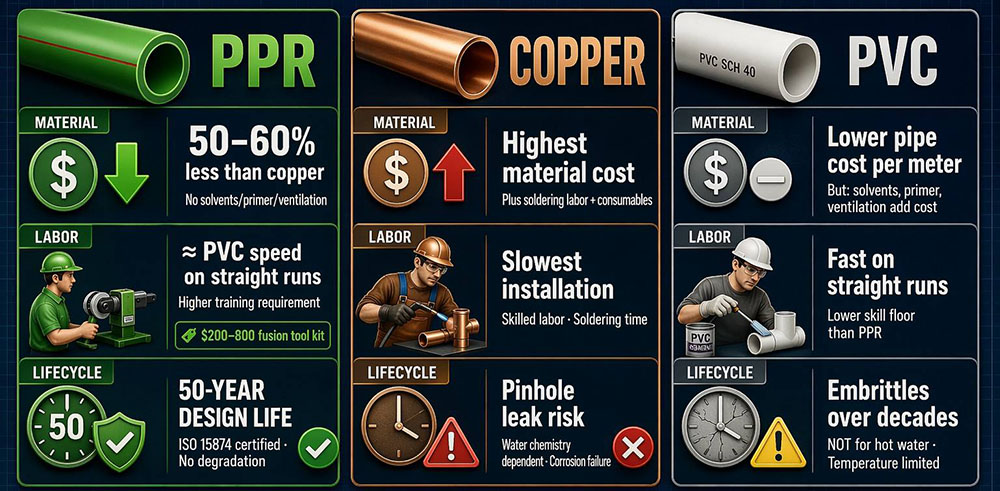
Material cost is where PPR shines. A 25mm PPR pipe with fittings for a standard residential plumbing rough-in costs roughly 50-60% less than equivalent copper — and that’s before factoring in the soldering labor and consumables that copper requires. Against PVC, PPR costs more per meter of pipe but the system-level cost narrows because PPR doesn’t need solvent cement, primer, or the ventilation that PVC installation requires.
Labor cost is the wildcard. A trained PPR fusion crew installs at roughly the same speed as a PVC crew on straight runs, and faster than copper soldering. But the training requirement is higher — PPR fusion is less forgiving of shortcuts than solvent welding. On large projects, the learning curve flattens after the first few hundred joints. On small projects, the tooling investment ($200-800 for a basic fusion kit) can eat into the material savings if you’re not amortizing it across enough work.
The lifecycle cost comparison tilts further in PPR piping systems favor over time. Copper develops pinhole leaks from aggressive water chemistry — a problem that’s getting worse as water treatment practices change in many regions. PVC can embrittle over decades, especially with hot water exposure. PPR’s chemical inertness means it essentially doesn’t degrade in normal plumbing service. The 50-year design life under ISO 15874 isn’t marketing. It’s conservative.
Supplier Evaluation: What Separates a Reliable PPR Manufacturer
PPR production is more technically demanding than PVC. The random copolymer formulation — ethylene content, molecular weight distribution, stabilizer package — directly determines long-term strength and thermal stability. Small variations in raw material produce large variations in field performance. This is not a product where “generic PPR” is a safe procurement strategy.
A reliable PPR manufacturer should provide:
- ISO 15874 certification from an accredited third-party lab — not self-declared, and not a certificate that only covers a subset of the product range you’re buying.
- Raw material traceability — which resin supplier, which grade, with documented incoming QC testing. If the manufacturer switches resin suppliers based on spot pricing, your next shipment won’t perform the same as the last one.
- Fusion welding support — technical documentation, training materials, or on-site training for installation crews. A manufacturer that sells PPR without supporting proper installation is creating future warranty claims.
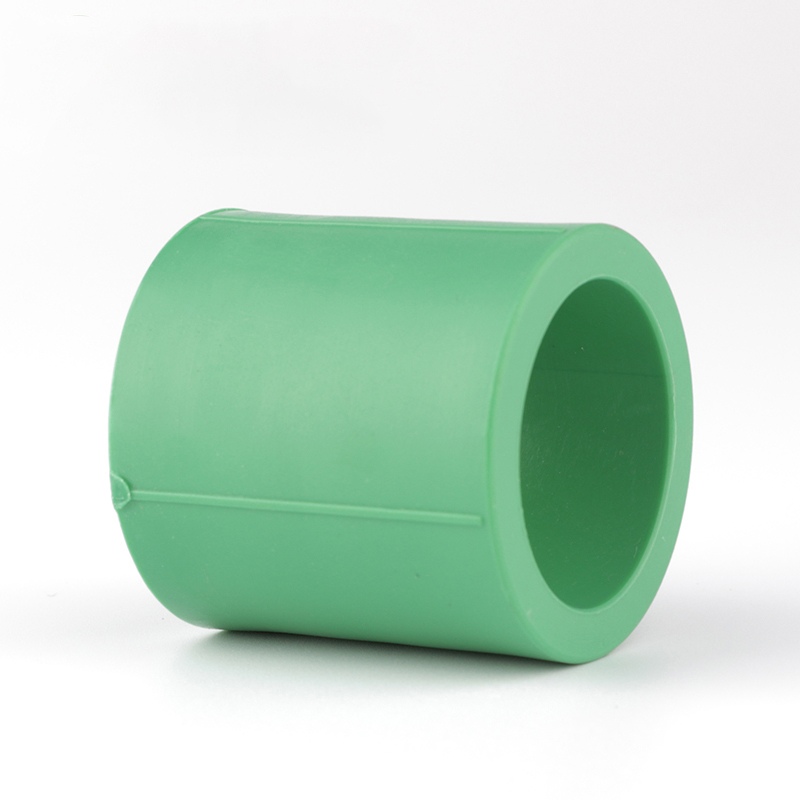
- Integrated fittings production — a manufacturer that extrudes pipe but outsources fittings has a quality control gap. PPR pipe and fittings must use the same base resin formulation for consistent fusion behavior. Different resins from different factories mean inconsistent joint strength.
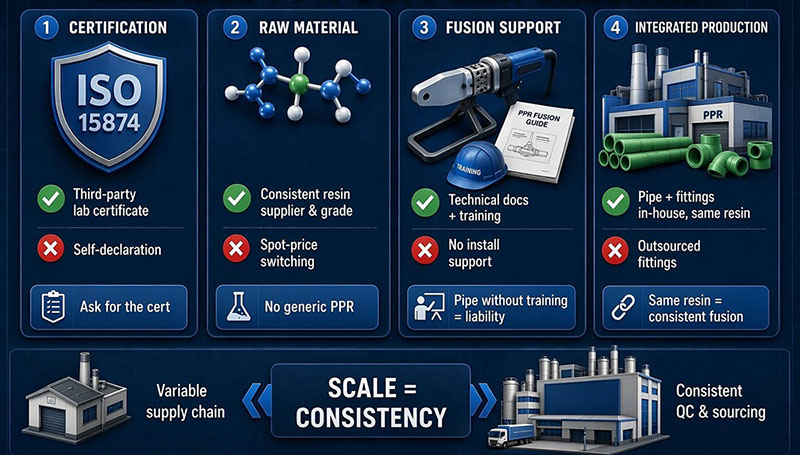
Key takeaway:Production scale matters here in a way it doesn’t for simpler products. A manufacturer running 50,000 tonnes annual capacity with integrated pipe extrusion and injection-molded fittings production has the volume to justify consistent raw material sourcing and the QC infrastructure to catch formulation drift before it reaches customers. Smaller operations may produce perfectly fine pipe — but their supply chain is inherently more variable.
Frequently Asked Questions
What temperature can PPR pipes handle?
PPR pipes are rated for continuous service up to 70°C at standard pressure ratings, with short-term capability up to 95°C. For hot water plumbing systems running at typical 60-70°C, PPR is well within its design envelope. For applications above 95°C — steam lines, high-temperature industrial processes — PPR is not suitable; consider CPVC or metal alternatives.
How long do PPR pipe systems last?
Under ISO 15874 testing methodology, properly installed PPR systems are designed for a minimum 50-year service life at 70°C and rated pressure. In practice, PPR’s chemical inertness means it doesn’t corrode, scale, or degrade from water chemistry — the system life is typically limited by installation quality rather than material degradation.
Can PPR pipes be used for cold water only?
Yes — PPR works perfectly for cold water distribution and is widely used for combined hot/cold plumbing systems. However, if the application is cold water only and budget is the primary constraint, PVC or PE may be more cost-effective. PPR’s price premium is justified by its hot water capability; using it for cold-only service leaves that value on the table.
What’s the difference between PPR and PPR-CT pipes?
PPR-CT (Polypropylene Random Copolymer with Crystalline modification — also called PPR-FR or fiber-reinforced PPR) incorporates a middle layer of fiber-reinforced polypropylene that significantly reduces thermal expansion. Standard PPR expands roughly 0.15 mm/m per °C. PPR-CT cuts that by about 70%. The trade-off is slightly higher cost and the need for a stripping tool to remove the outer layer before fusion welding. PPR-CT is recommended for long straight hot water runs and riser applications where expansion compensation is difficult.
How do I verify a PPR manufacturer’s ISO 15874 compliance?
Request the test certificate from the accredited third-party lab, not a self-declaration. Check that the certificate covers the specific pipe diameters and pressure classes you’re ordering. Verify the testing included long-term hydrostatic strength at elevated temperatures — a certificate based on dimensional checks alone does not validate material performance. Reputable manufacturers will provide this documentation without hesitation.
About SAM-UK
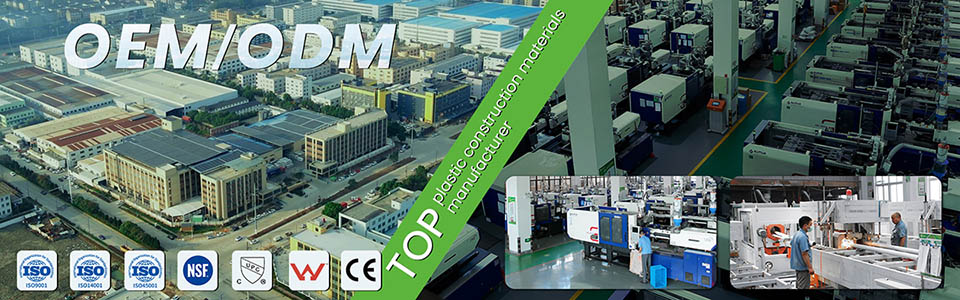
SAM-UK are a professional 20+ years manufacturer in producing vinyl building profile products and PVC , CPVC , PPH , PPR , PP pipes and pipe fittings, valves, taps and so on. We own the certificates of SGS\SONCAP\ISO9001\ISO15874\CE\NSF\UPC\ETL\Watermark,support color /size customization. Welcome to consult for Catalog and Product. you can contact us at email [email protected]