Types of PVC Valves: The Complete Selection Guide for Industrial, Water and Chemical Lines
If you buy or specify thermoplastic valves, you already know the trap: ball, true union, butterfly, check and gate all look similar in a catalog photo and behave completely differently in the pipe. This guide walks every type of PVC valve in common service — what each does well, where each fails, what seals and pressure classes actually mean — and closes with a decision table you can take straight into a quote review. The quick takeaway: for small-line isolation, buy true-union ball valves; above roughly 6 inches, buy butterfly valves; and never use a gate valve where a ball valve belongs.
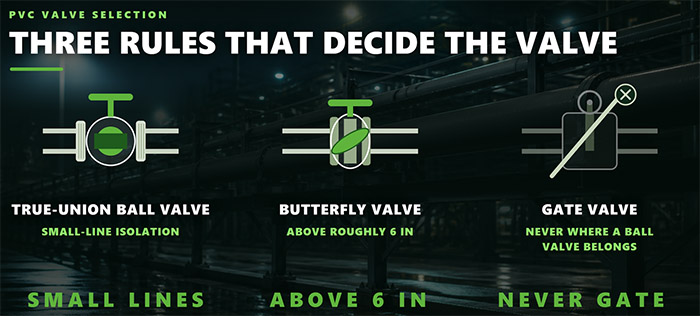
Quick Selection Table: Which PVC Valve Type for Which Job
Scan this before reading further — it’s the condensed version of everything below.
| Application need | Valve type | Size sweet spot | Key advantage |
|---|---|---|---|
| On/off isolation, water & mild chemicals | Ball valve (standard port) | 1/4″–4″ (DN8–DN100) | Quarter-turn, low cost, near-zero flow resistance when open |
| Isolation that must be serviced in-line | True union ball valve | 1/2″–4″ | Cartridge removes without cutting pipe |
| Large header or tank isolation, 6″ and up | Butterfly valve (wafer or lug) | 2″–12″+ (DN50–DN300+) | Light, cheap at big sizes, good throttling |
| Backflow prevention on pump discharge | Check valve (swing or spring ball) | 1/2″–8″ | Automatic, no operator |
| Slow full-bore isolation, visible position | Gate valve (rising stem) | 1/2″–4″ | Full bore, minimal pressure drop |
| Slurry, abrasives, corrosive dosing | Diaphragm valve | 1/2″–4″ | Media never touches working parts |
Two rules govern everything else. First, match the valve’s pressure class to the pipe class you already bought — a sch 40 valve on a sch 80 line is a weak point, not an upgrade. Second, match the elastomer to the media before you match the body to the pipe, because EPDM and FKM/Viton are not interchangeable and the wrong O-ring fails in months.
The Five PVC Valve Types, Explained in Depth
PVC Ball Valves — Standard Port vs Full Port
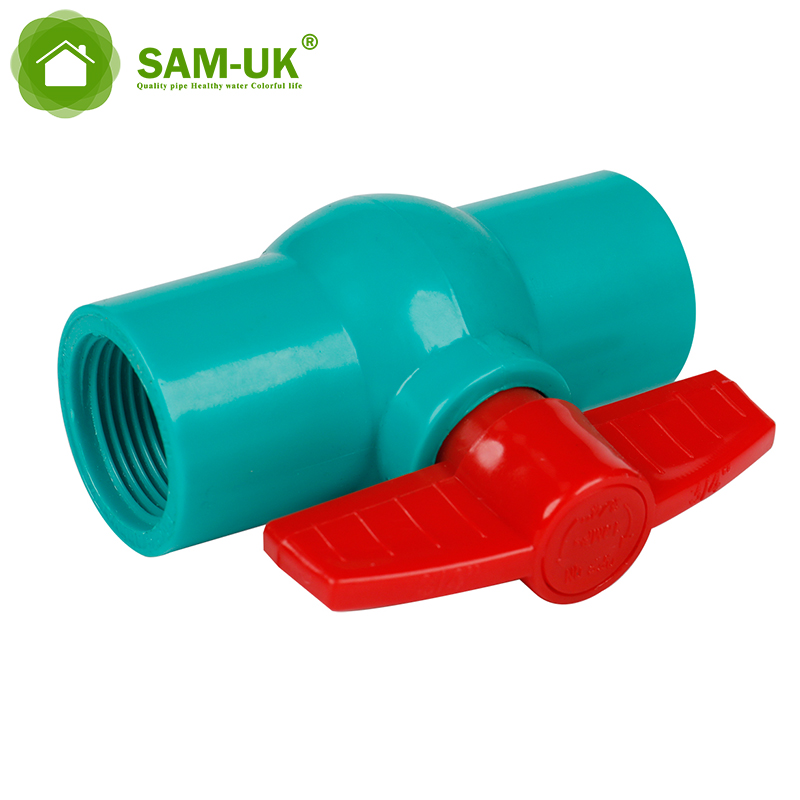
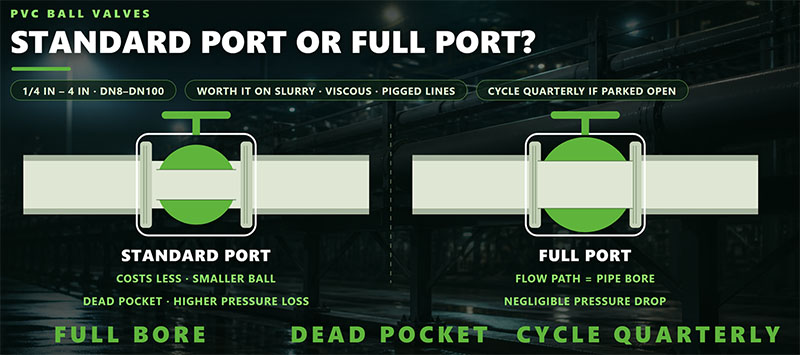
The ball valve is the workhorse of thermoplastic flow control, and for good reason: a quarter turn takes it from fully closed to fully open, and in the open position the flow path through a full-port design is essentially the same bore as the pipe — which means pressure drop across an open ball valve is negligible. Sizes typically run from 1/4 inch to 4 inches (DN8 to DN100); above that, a PVC ball of real bore gets heavy, expensive and slow to machine, which is why you rarely see them bigger.
Standard port (sometimes called reduced bore) valves cost less and have a smaller ball. That’s fine for clean water shutoff, but remember the reduced opening raises velocity and pressure loss, and creates a dead pocket where media can settle. Full port costs more and is worth every cent on slurries, viscous fluids and lines that get pigged or rodded. One habit from the field: on any ball valve that sits open for months in process service, cycle it quarterly — balls left parked in one position develop seat set and can torque hard when you finally need them.
True Union PVC Ball Valves — the Serviceable Workhorse
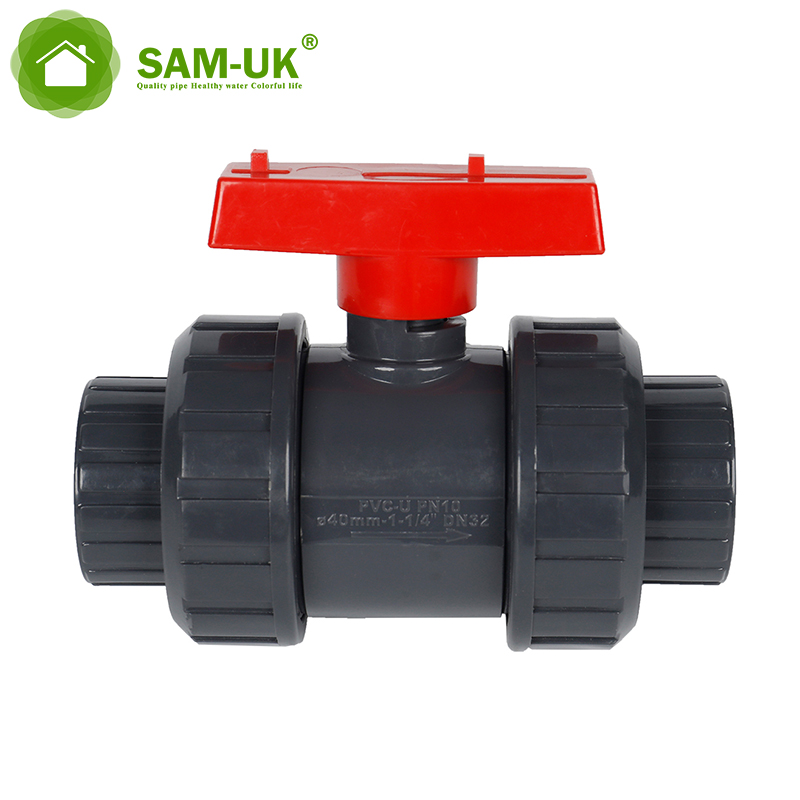
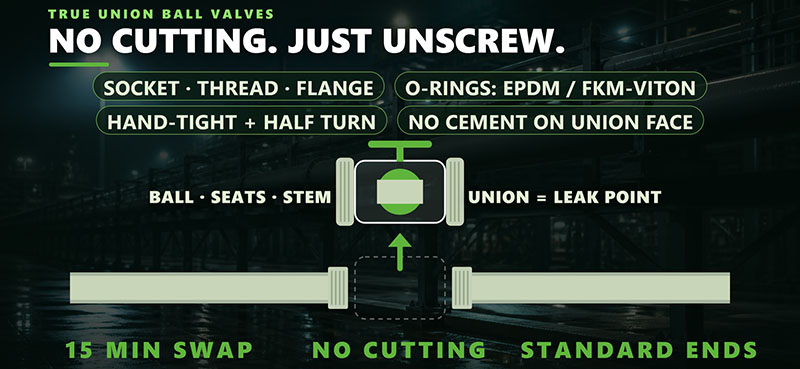
If there is one valve a maintenance crew will thank you for buying, it’s the true union ball valve. The body is built with two union ends, so the entire center cartridge — ball, seats and stem — unscrews out of the line without cutting a single piece of pipe. Seal replacement, seat cleaning or a stuck-ball rescue takes fifteen minutes instead of a re-pipe. This is the design SAM-UK has built its valve program around, and the reason is simple: industrial plant engineers stopped wanting throwaway valves decades ago.
The tradeoff is real and worth stating. Every union is a potential leak point, and the union threads rely on O-rings — usually EPDM, with FKM/Viton offered for aggressive chemistry. Installers must resist the urge to over-torque the union nuts; hand-tight plus a firm half turn is the standard, and a cheater bar on a PVC union is how you crack a body that looked fine in the photo. Also keep solvent cement off the union threads during installation — cement on a union face is a guaranteed weep that you’ll chase for years.
True unions come socket, threaded (NPT/BSP) and flanged, and a smart buyer standardizes the end connections across the plant. A double-union pattern with one socket and one thread covers both new solvent-welded runs and tie-ins to existing threaded equipment — one SKU doing two jobs shrinks inventory fast.
PVC Butterfly Valves — the Big-Bore Economizer
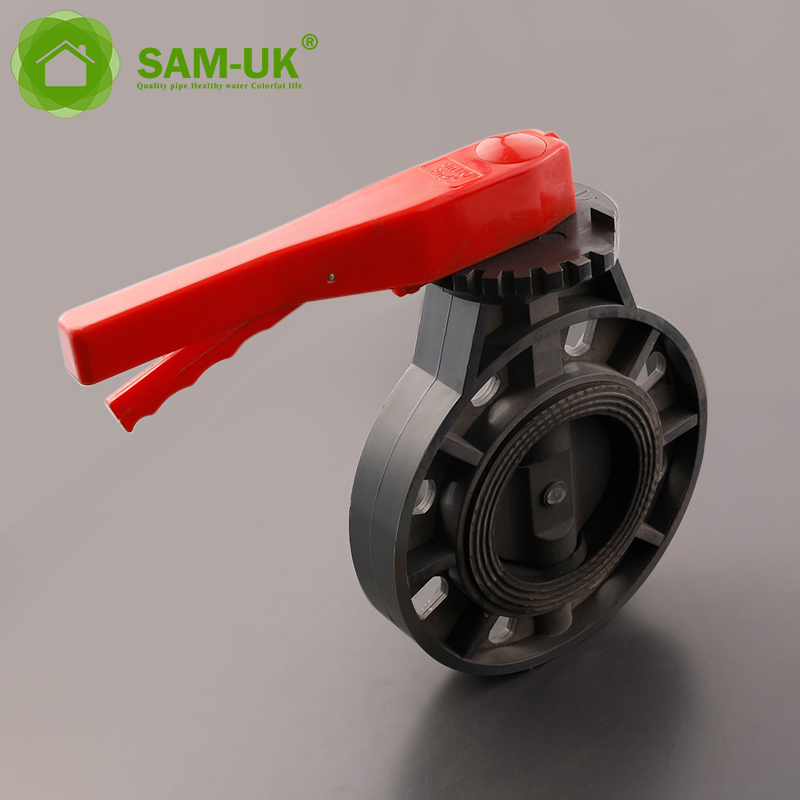
Once the line passes about 6 inches, ball valves get priced like jewelry and butterfly valves take over. A PVC butterfly valve is a thin disc on a shaft inside a short body — light, compact and dramatically cheaper than a ball valve at 6 inches and above, which is why they dominate large-diameter tank isolation, header service and water treatment. Wafer pattern (sandwiched between two flanges with long bolts) is the budget default; lug pattern has threaded inserts so the valve can be bolted to one flange and still hold pressure — that’s the one to spec when downstream equipment must be serviced or blanked off with the valve closed (dead-end service).
Butterfly valves throttle better than balls — the disc gives a roughly linear flow response through the mid-stroke, so they’re a legitimate choice for flow balancing, not just isolation. What they are not: slurry-friendly. Solids get trapped between disc edge and liner, and a disc closing onto debris distorts the liner and wrecks the seal. And they need operating space: the handle sweeps an arc, and big sizes demand a gearbox. Never extend a butterfly handle with a pipe for leverage — the extra torque overdrives the disc into the liner and you’ve turned a $200 valve into a $2,000 removal job.

PVC Check Valves — Swing, Spring and Ball Types
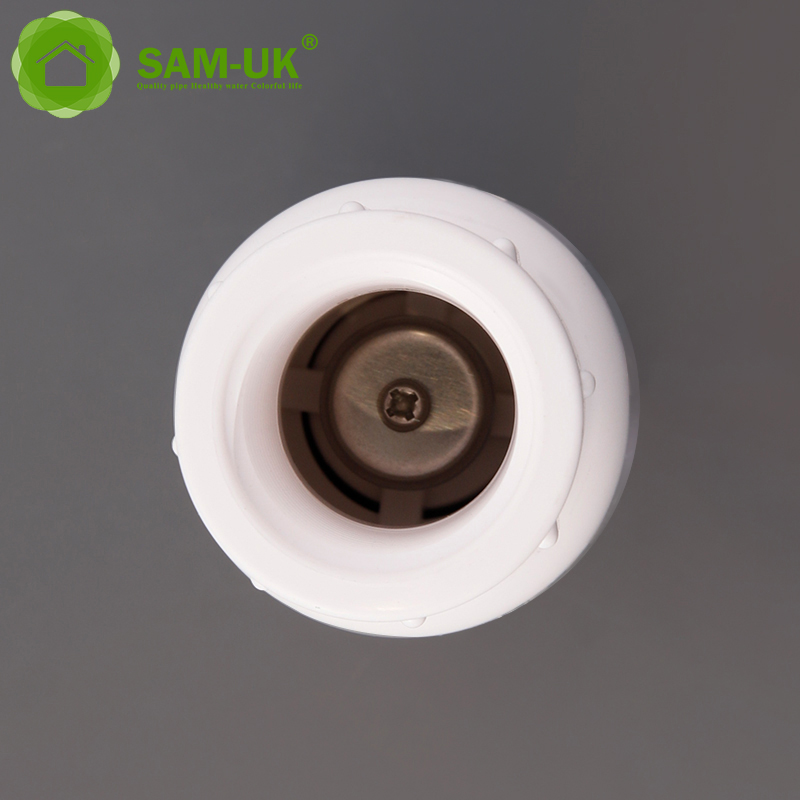
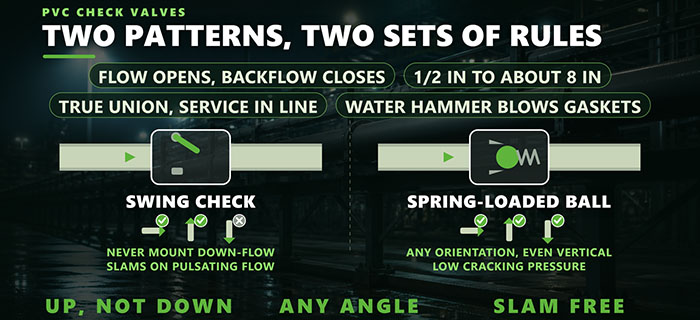
A check valve is an automatic backflow guard: flow opens it, reverse flow closes it, no operator involved. The three PVC patterns cover different hydraulics. Swing check valves — a hinged flap — are the classic choice for horizontal lines with steady flow; they can also mount in vertical up-flow, but never vertical down-flow, and they will slam on pulsating flow from a reciprocating pump. Spring-loaded ball check valves — a ball held on a seat by a spring, often in a true-union body — install in any orientation including vertical, need only a low cracking pressure, and are the right pick for gravity or low-pressure systems where a heavy swing flap might never fully open.
Size range for PVC checks runs from 1/2 inch to about 8 inches across manufacturers, with true-union patterns (like Hayward’s TC or NIBCO’s T45 families) giving the same in-line serviceability as a true-union ball. The silent killer with checks is water hammer — if a pump starts and stops hard on a long line, a fast-closing check slams and sends a pressure spike that can blow a gasket or crack a fitting a hundred meters away. Spring-loaded checks close before reversal and suppress exactly that slam; spend the extra money when the pump is big or the line is long.
PVC Gate Valves — and a Note on Diaphragm Valves
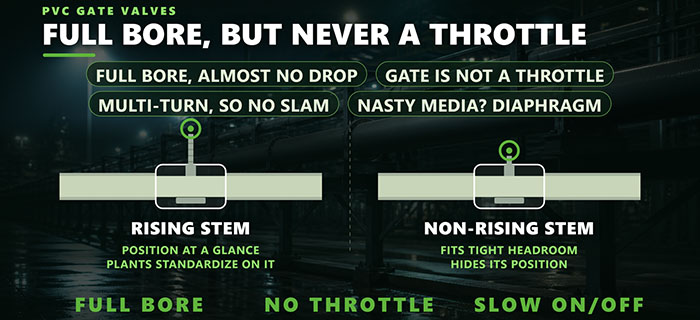
Gate valves are the slow, deliberate on/off specialists: a wedge or gate lowers across the bore with multiple turns of a rising or non-rising stem. Rising stem shows open/closed position at a glance; non-rising stem suits tight headroom but hides its position — and the PVC rising-stem pattern is the one most plants standardize on because position visibility saves confusion. Full bore means full flow with almost no pressure drop, and the multi-turn operation makes them forgiving in systems where a sudden quarter-turn shutoff would slam the line.
What a gate valve is not: a throttle. Partially open, the gate chatters, the seat erodes and you’ll be back in six months replacing it. Use ball or butterfly for throttling. Gate valves also cost more than ball valves at the same size and operate slower — that’s why they’ve lost ground in plastic piping, though they still appear where full bore plus slow closure matters, like gravity drain isolation. If your media is slurry, abrasive or chemically aggressive enough to attack wetted trim, skip all of the above and consider the diaphragm valve: the media touches only the body and a flexible diaphragm, so the working parts stay clean and the valve throttles and isolates bubble-tight. It costs more, but on nasty service it’s the one that survives.
Seals and Materials: EPDM vs FKM/Viton, and Why PTFE Seats Matter
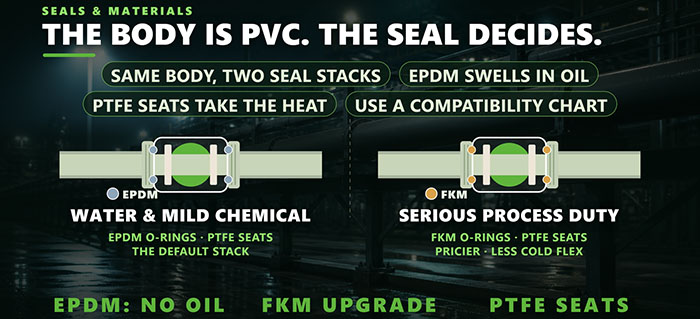
The body is PVC; the valve’s personality is the elastomer. EPDM is the default seal for water, wastewater, mild chemicals and weather exposure — it handles hot water and steam well and costs little. What it cannot handle is oil, grease and hydrocarbons: EPDM swells and degrades in contact with them, and an EPDM-sealed valve on an oily line is a scheduled failure. FKM (Viton) is the chemical-duty upgrade — broad resistance to oils, fuels, mineral acids and many solvents, at higher cost and with less low-temperature flexibility.
Then there are seats. Most industrial PVC ball valves use PTFE (Teflon) seats, prized for low friction and near-universal chemical resistance, and the ball/seat pair is what gives that smooth quarter-turn feel. PTFE seats also handle the temperature spread better than elastomer seats. Here’s the practical rule: if the line carries anything beyond water — pick the seal stack from a chemical compatibility chart, not from memory. A 2-inch true-union ball valve with EPDM O-rings and PTFE seats is a water/mild-chemical valve; the same body with FKM O-rings steps up to serious process duty. Buyers who skip that distinction are the ones replacing stems and weeping valves a year in.
Pressure Classes: sch 40 vs sch 80 Bodies, and the CPVC Option
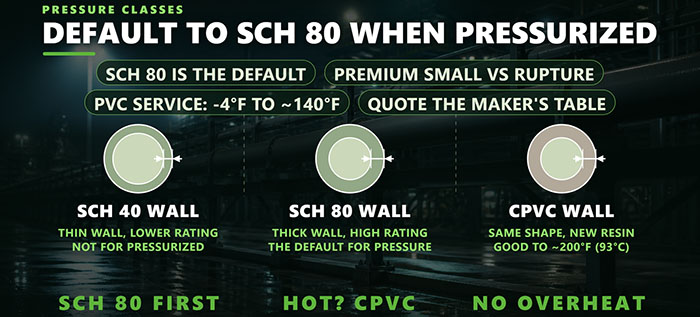
Thermoplastic valves follow the same wall logic as pipe. Schedule 80 bodies have thicker walls and higher pressure ratings than schedule 40, and industrial buyers should default to sch 80 for anything pressurized — the premium is small next to a rupture. Real catalog numbers vary by maker and size: a typical 2-inch sch 80 true-union ball valve is rated around 150 psi at 73°F (23°C), with smaller sizes often carrying more and larger sizes less. Never quote a number from this article — quote the maker’s published table for the exact size and pattern.
Temperature is the second half of the rating. PVC valves are generally serviceable from about -4°F up to 140°F (-20°C to 60°C), and the pressure rating derates as you climb toward that ceiling. When the process runs hot — continuous water above 140°F, or aggressive chemicals at elevated temperature — step up to CPVC valves, which carry body ratings to roughly 200°F (93°C). Same geometry family, same true-union and butterfly patterns, different resin. Trying to save money by running a PVC valve past its temperature band is how plants lose containment on the least replaceable component in the line.
Common PVC Valve Failure Modes — and the Prevention That Actually Works
Every failure below is one we’ve seen in real plants, and every one is preventable:
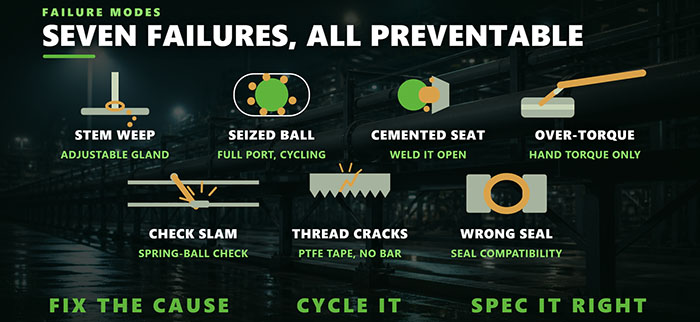
- Stem O-ring weeping. The classic: a slow drip at the stem after years of cycling. Prevention: buy valves with adjustable stem glands or replaceable O-ring kits (true unions win here), and cycle stems occasionally so seals don’t set.
- Ball seized by dried or crystallized media. Media dries in the ball cavity, the ball cements in place. Prevention: full-port pattern for solids-bearing lines, quarterly cycling, and flushing before long shutdowns.
- Solvent cement damage during installation. Cement gets on seats or ball and bonds the valve shut or ruins the seat. Prevention: assemble and solvent-weld with the valve in the open position, and wipe spills immediately — never let cement pool inside the body.
- Butterfly over-torque. Cheater bars and power tools overdrive the disc into the liner. Prevention: hand torque, gearbox or properly sized actuator above 6 inches; replace liner and disc as a set, never one alone.
- Check valve slam. Pulsating flow slams swing checks and hammers the whole line. Prevention: spring-loaded ball check for pump service, and mount swing checks horizontal or vertical-up only.
- Threaded joint stress cracks. Overtightening NPT/BSP PVC creates micro-cracks at the thread root that grow under pressure. Prevention: PTFE tape (never pipe dope that attacks PVC), snug by hand plus half a turn, and no wrench on the body.
- Wrong elastomer. EPDM in oil service swells and fails; the plant blames the valve, not the spec. Prevention: chemical compatibility check before purchase — the seal chart decides, not the sales photo.
The unglamorous truth is that most PVC valve failures are installation and specification errors, not manufacturing defects. When you do compare manufacturers, look at what the factory controls: a supplier with its own mold shop — SAM-UK has run one since 1995 in Taizhou, at 50,000 tons of annual capacity — keeps ball-to-seat geometry and wall thickness consistent batch to batch, which is exactly what prevents premature seat wear and body cracks. Ask for hydrostatic test certificates and NSF/UPC/ETL listings the same way you’d ask for a material cert on the pipe; a valve is only as trustworthy as the documentation behind it.
Decision Framework: From Application to Valve Type
Work this table left to right and you’ll land on the right family nine times out of ten.
| Application scenario | Recommended valve | Reasoning |
|---|---|---|
| Water isolation, 1/2″–4″, clean service | Full-port true union ball valve, EPDM seals | Quarter-turn speed, serviceable in-line, minimal pressure drop |
| Aggressive chemical dosing line | True union ball valve, FKM/Viton seals + PTFE seats (CPVC body if hot) | Seal stack matches the media; cartridge serviceable without draining the line |
| Large tank/header isolation, 6″+ | Lug butterfly valve with gearbox | Dead-end capable, light, economical at big bore |
| Pump discharge backflow protection | Spring-loaded ball check valve | Works any orientation, low cracking pressure, kills water hammer |
| Horizontal gravity line backflow prevention | Swing check valve | Simple, low maintenance, proven on steady horizontal flow |
| Hot water or steam condensate above 140°F | CPVC ball or butterfly valve | CPVC body rated to ~200°F; PVC is out of its temperature band |
| Slurry, abrasive or scaling media | Diaphragm valve (or full-bore ball with frequent cycling) | Media never reaches working parts; no cavity to pack with solids |
| Full-bore gravity isolation, visible position | Rising-stem gate valve | Slow closure, zero flow restriction, position visible at a glance |
One sourcing note to close. Valves are the highest-failure component in any thermoplastic system, so buy them like a component, not a commodity: demand published pressure ratings, chemical compatibility data and third-party certifications (NSF, UPC, ETL, Watermark) from whoever bids. A manufacturer like SAM-UK (sam-uk.com) that molds its own bodies, stocks the full true-union and butterfly range and quotes a 30-day lead time is the benchmark — a distributor that only repackages imported valves can’t show you the mold shop, and on a component that fails in service, you want the shop.
Frequently Asked Questions
Which is better, a PVC ball valve or a butterfly valve?
Size decides it. Ball valves win below about 4–6 inches: quarter-turn isolation, near-full bore, negligible pressure drop, easy actuation. Butterfly valves win above that, where balls get heavy and costly — they’re lighter, cheaper at big bore and throttle acceptably. Above 6 inches, butterfly is the default.
What is a true union PVC ball valve, and is it worth the extra cost?
A true union ball valve has union ends on both sides, so the ball cartridge unscrews out of the line without cutting pipe. Yes, it’s worth it wherever maintenance happens: seal and seat replacement, stuck-ball recovery and line flushing take minutes instead of a re-pipe. The tradeoff is two extra union seals to keep torqued correctly.
What is the difference between standard port and full port PVC ball valves?
Standard port has a smaller ball and a reduced opening — cheaper, but higher pressure drop, higher velocity and a pocket where debris can settle. Full port matches the pipe bore, so flow resistance is minimal and solids pass more freely. For slurry or pigged lines, always full port.
Can PVC check valves be installed vertically?
Spring-loaded ball checks install in any orientation, including vertical. Swing checks are different: horizontal lines, or vertical with upward flow only — never vertical down-flow, because the flap can’t close against gravity and backflow protection is lost.
What is the difference between schedule 40 and schedule 80 PVC valves?
Wall thickness and pressure rating. Schedule 80 bodies are thicker and rated higher — a typical 2-inch sch 80 true-union ball valve is around 150 psi at 73°F, varying by size and maker. Industrial pressurized service should default to sch 80, and always derate as temperature climbs toward the 140°F ceiling.
Can I use a PVC valve for hot water or aggressive chemicals?
Not above 140°F (60°C) — use CPVC valves, rated to about 200°F, for hot service. For chemicals, the body isn’t the limit; the elastomer is. Water service takes EPDM; oils, fuels and aggressive acids require FKM/Viton seals with PTFE seats. Check the compatibility chart before you buy.
About SAM-UK
SAM-UK are a professional 20+ years manufacturer in producing vinyl building profile products and PVC , CPVC , PPH , PPR , PP pipes and pipe fittings, valves, taps and so on. We own the certificates of SGS\SONCAP\ISO9001\CE\NSF,support color /size customization. Welcome to consult for Catalog and Product. you can contact us at email [email protected]