North American Pipe Certification Roadmap: NSF, UPC, ETL & What They Actually Require
Three certification bodies, completely different scopes and testing protocols — here’s what North American plumbing codes actually demand and why getting it wrong costs international suppliers millions.
Let’s be honest: the North American certification landscape is a mess to navigate. Most international suppliers learn about it the hard way — when a container gets held at port because the certification doesn’t match the spec. I’ve seen it happen. A shipment of perfectly good CPVC fittings, manufactured to ISO standards, rejected at Long Beach because the buyer’s plumbing inspector demanded NSF/ANSI 14 listing and UPC code compliance — neither of which the factory had. The factory lost the order. The buyer lost six months. Everyone went home angry. Don’t let that be you.

NSF/ANSI 61 vs. NSF/ANSI 14 — Health vs. Performance
These two standards get confused constantly, even by people who should know better. They test completely different things.
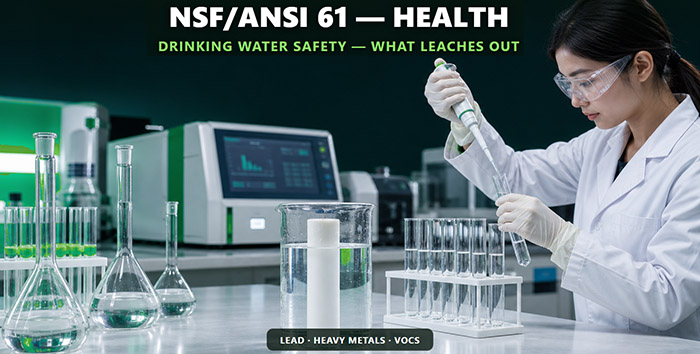
NSF/ANSI 61 — officially “Drinking Water System Components — Health Effects” — is about what leaches out of the pipe into your drinking water. It tests for lead, heavy metals, volatile organic compounds, and other contaminants that migrate from pipe materials into water. If your pipe touches drinking water in North America, NSF/ANSI 61 is non-negotiable. End of story. Every model plumbing code in the US and Canada references it.
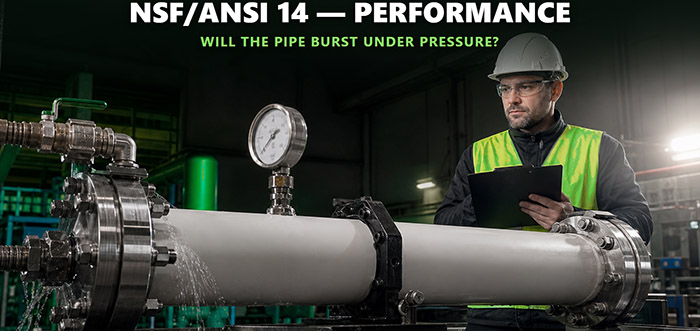
NSF/ANSI 14 is a different beast entirely. It covers physical performance and safety requirements for plastic piping system components: burst pressure, impact resistance, dimensional tolerances, long-term hydrostatic strength, and material formulation consistency. Think of NSF 61 as “will this pipe make people sick?” and NSF 14 as “will this pipe burst under pressure?” A pipe can pass one and catastrophically fail the other.
Most plumbing codes require both for potable water applications. The pipe needs to not contaminate the water (NSF 61) AND not fail structurally (NSF 14). For drainage/waste/vent applications where drinking water contact isn’t relevant, NSF 14 alone may be sufficient — but always check your local code. Always.
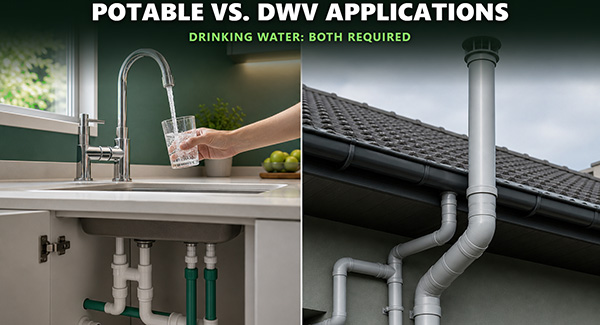
| Feature | NSF/ANSI 14 | NSF/ANSI 61 |
|---|---|---|
| What it tests | Physical performance: burst, impact, dimensions, long-term strength | Health effects: contaminant leaching into drinking water |
| Applies to | All plastic piping system components | Products contacting potable (drinking) water |
| Required by code? | Yes — for all plastic pipe in plumbing systems | Yes — for any product in contact with drinking water |
| Typical timeline | 3-6 months for initial certification | 3-6 months for initial certification |
| Surveillance audits | Annual unannounced facility audits + product retesting | Annual unannounced facility audits + product retesting |
| Online verification | NSF Product Listings | NSF Product Listings |
UPC (IAPMO) — The Plumbing Code Certification
The Uniform Plumbing Code, administered by IAPMO (International Association of Plumbing and Mechanical Officials), is not a material standard — it’s a code compliance certification. UPC certification means the product has been tested and found to comply with the Uniform Plumbing Code requirements. This covers installation compatibility, system-level performance, and adherence to referenced material standards like NSF 14 and NSF 61.
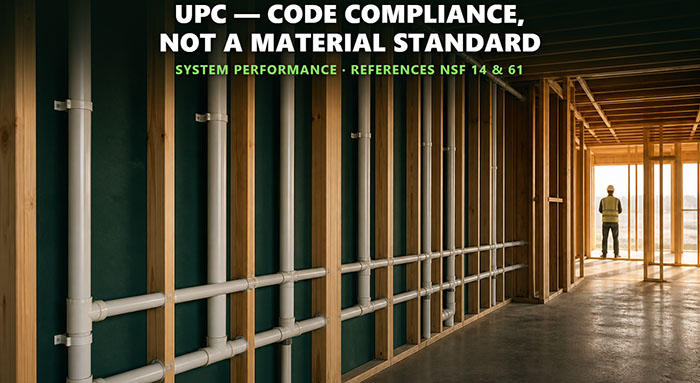
Here’s where it gets interesting. UPC certification is widely adopted across the western United States, but not universal. Some jurisdictions use the International Plumbing Code (IPC) instead, which also references NSF standards. The practical reality: carrying both UPC and NSF certifications maximizes your addressable market. A plumbing inspector in California may specifically look for the UPC shield mark. A specifier in Texas may accept either. Why limit yourself?

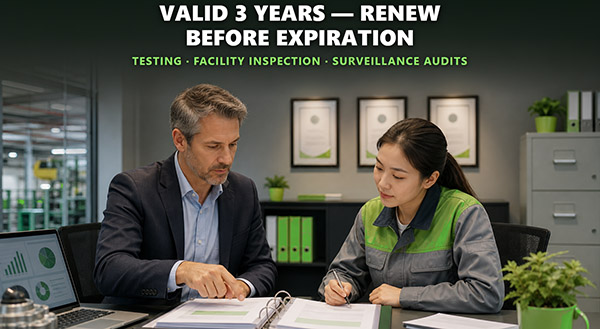
IAPMO certifications are valid for three years and must be renewed before expiration. The certification process includes initial product testing, facility inspection, and ongoing surveillance audits. One detail buyers often miss: IAPMO requires you to maintain a registered quality management system — usually ISO 9001 at minimum — as part of ongoing compliance. No ISO system, no UPC renewal.
Key insight: UPC certification is not a substitute for NSF 14/61. It’s complementary. UPC certification typically references NSF 14 and 61 compliance as prerequisites, then adds additional code-specific requirements. Think of UPC as the umbrella that covers everything a plumbing inspector needs to see.
ETL (Intertek) — The Multi-Purpose Alternative
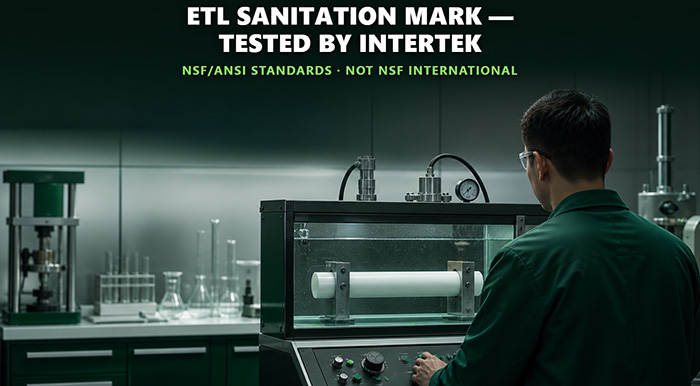
ETL certification, issued by Intertek, is the third major player in North American plumbing certification. The ETL Sanitation Mark indicates compliance with NSF/ANSI standards — tested by Intertek instead of NSF International. Both are ANSI-accredited certification bodies. From a code compliance standpoint, ETL and NSF marks are functionally equivalent. Plumbing codes accept both.
So why do most international pipe suppliers pursue NSF directly rather than ETL? Brand recognition. Specifiers, engineers, and plumbing inspectors recognize the NSF mark instantly. The ETL mark is equally valid but less familiar in plumbing — it’s more associated with electrical and safety certifications. That said, ETL certification can be faster and less expensive for certain product categories, and Intertek has excellent global testing capacity. For a supplier entering the market, ETL is a legitimate path — just be prepared to explain it to buyers who are less familiar with the mark.
Also worth noting: Intertek offers the ETL Sanitation Mark specifically for products tested to NSF/ANSI standards. This isn’t a different standard — it’s the same standard tested by a different accredited body. The testing requirements are identical. The certificate says something different, but the underlying compliance is the same.
| Feature | NSF International | UPC (IAPMO) | ETL (Intertek) |
|---|---|---|---|
| Scope | Material standards: NSF 14 (performance), NSF 61 (health) | Plumbing code compliance (references NSF standards) | Tests to NSF/ANSI standards; equivalent to NSF mark |
| Market recognition | Highest — universal in North America | High — dominant in western US and Canada | Moderate — valid but less recognized in plumbing |
| Certification timeline | 3-6 months initial | 3-6 months initial | 2-5 months initial (often faster) |
| Renewal cycle | Annual surveillance; listing maintained continuously | 3-year renewal with annual surveillance | Annual surveillance; listing maintained continuously |
| Online verification | nsf.org product listings | iapmo.org directory | intertek.com directory |
| Cost range (estimate) | $15,000–$40,000 initial + $5K–$15K/yr | $10,000–$30,000 initial + $3K–$10K/yr | $10,000–$25,000 initial + $3K–$8K/yr |
⚠️ Cost warning: These are ballpark ranges. Actual costs depend on product count, material types, size ranges, and whether you have existing ISO 9001 certification. A factory certifying 200+ SKUs across PVC, CPVC, and PPH can expect costs at the upper end. Plus, facility audit travel expenses for international manufacturers are typically billed separately.
The Certification Process — Timeline, Costs, and Ongoing Maintenance
The certification journey follows roughly the same path regardless of which body you choose, but the details matter. Here’s what a 12-month roadmap actually looks like:
- Application & scope definition (Month 1): You submit product listings, material formulations, and manufacturing facility details. Under-specify here and you’ll pay for it later — adding products to an existing certification costs almost as much as the initial application for each new material or size range.
- Documentation review (Month 1-2): The certification body reviews your quality manual, material specifications, and test data. A factory with existing ISO 9001 and in-house test data sails through this. A factory starting from scratch stalls here for months.
- Sample submission & testing (Month 2-4): Physical samples are tested at the certifier’s lab — not yours. Burst testing, impact testing, dimensional checks, and for NSF 61, contaminant extraction testing over extended exposure periods. This is the bottleneck. Products fail here more than anywhere else.
- Initial facility audit (Month 3-5): An auditor visits the factory to verify manufacturing capability, QC systems, material traceability, and equipment calibration. This is unannounced for some bodies, scheduled for others.
- Certification issuance (Month 4-6): If all tests pass and the audit is clean, you get your certificate and listing. Your products appear in the online directory.
- Ongoing surveillance (continuous): Expect 1-2 unannounced audits per year per certification body. They’ll pull samples off your production line for retesting. Fail the surveillance audit and your listing is suspended immediately — not after a grace period.
Why Multi-Certification Matters for International Suppliers
Here’s what separates a commodity supplier from a strategic partner: holding NSF, UPC, AND ETL simultaneously. Most international pipe factories carry one certification — usually ISO 9001 plus whatever the local market demands. A factory that maintains all three major North American marks is operating at a fundamentally different level.
Why? Because each certification body conducts independent surveillance audits. A factory with NSF + UPC + ETL faces at minimum 3-6 unannounced inspections per year from different auditors with different checklists. There is simply no way to fake your way through that. The systems have to be real. The QC has to be consistent. The records have to be impeccable. You can coast on one certification. You cannot coast on three.

For B2B buyers, multi-certified suppliers mean one supplier covers multiple end markets — no need to qualify a different vendor for US projects vs. Canadian projects. One factory. One quality system. One relationship. That simplicity has real procurement value, and it’s why multi-certified suppliers command longer contracts and better payment terms.

And the reality of certification maintenance is brutal: surveillance failures cascade. If NSF pulls your listing for a QC failure, UPC and ETL typically follow within weeks — they all reference the same facility conditions. Multi-certification is not just about market access. It’s a forcing function for continuous operational discipline.
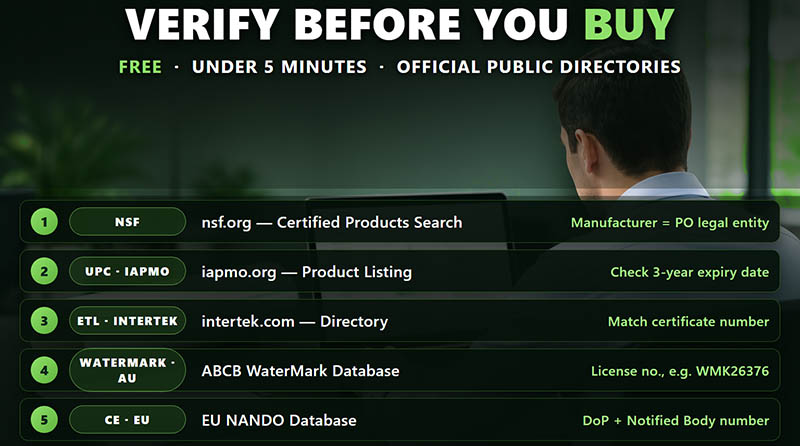
How to Verify Certifications Online
Before you buy, verify. It takes under 5 minutes and it’s free. Every legitimate certification body maintains a public online directory. Here’s how:
- NSF: Go to nsf.org/certified-products-systems. Search by company name or product standard. Verify that the manufacturer name matches the legal entity on your purchase order — not a shell company or trading entity.
- IAPMO/UPC: Visit iapmo.org and use their product listing directory. Check the certificate expiration date — IAPMO certs expire after 3 years and must be renewed.
- ETL/Intertek: Search the Intertek online directory. Match the certificate number to the one on the supplier’s documentation.
- Watermark (Australia): For Australian market products, search the ABCB WaterMark product database. Look for the license number (e.g., WMK26376) and verify it matches.
- CE marking (Europe): Request the Declaration of Performance (DoP) and verify the Notified Body number against the EU NANDO database.
Frequently Asked Questions
Does NSF/ANSI 61 cover both PVC and CPVC pipes?
Yes. NSF/ANSI 61 applies to all materials in contact with drinking water — PVC, CPVC, PEX, HDPE, PPR, and metal pipes alike. Each material type is tested separately under different extraction protocols appropriate to its formulation. A factory’s NSF 61 certification for PVC does NOT automatically cover its CPVC products — each material formulation requires separate testing and listing.
How long does it take to get all three certifications (NSF, UPC, ETL)?
For a factory that already has ISO 9001, an in-house QC lab, and organized documentation, expect 12-18 months to achieve all three simultaneously if pursued in parallel. Going sequentially could stretch to 24+ months. The factory audit portion can overlap, but product testing must be done independently by each body. The fastest path: apply to all three simultaneously, share the same quality manual and test data where permitted, and coordinate audit schedules.
Are ETL and NSF certifications really equivalent under plumbing codes?
Yes, legally. Both NSF International and Intertek are ANSI-accredited certification bodies. US and Canadian plumbing codes accept both marks for products tested to the same standards. However, some local plumbing inspectors are more familiar with the NSF mark and may question ETL certification. This is a perception issue, not a legal one — but in construction, perception matters. For drinking water pipe products heading to the most conservative jurisdictions, NSF certification is the path of least resistance.
What happens if a factory fails a surveillance audit?
The certification body issues a non-conformance report (NCR) with a deadline for corrective action — typically 30-90 days depending on severity. For major non-conformances (safety issues, failed product testing, systemic QC breakdowns), the listing may be suspended immediately pending resolution. During suspension, the factory cannot mark products with the certification logo and products already in distribution may need to be recalled. This is why multi-certified suppliers invest so heavily in QC — the cost of a suspension dwarfs the cost of prevention.
Can a pipe be certified to NSF 14 but not NSF 61?
Absolutely. Many drainage, waste, vent, and industrial pipes carry NSF 14 certification for physical performance but do not require NSF 61 because they never contact drinking water. Conversely, a pipe used solely for potable water distribution needs both. Check the application before you check the certificates — specifying the wrong certification is as bad as having no certification at all.
About SAM-UK
SAM-UK are a professional 20+ years manufacturer in producing vinyl building profile products and PVC , CPVC , PPH , PPR , PP pipes and pipe fittings, valves, taps and so on. We own the certificates of SGS\SONCAP\ISO9001\CE\NSF,support color /size customization. Welcome to consult for Catalog and Product. you can contact us at email [email protected]