Introduction
The global plastic pipe market is growing at 5.4-6.6% CAGR and irrigation is one of the fastest segments. But here’s what the market reports don’t tell you: the pipe material you choose directly affects crop yield, water efficiency, and your maintenance budget for the next two decades. Get the material wrong and you’re fixing leaks while your crops stress. Get it right and the system runs for 50 years.

The Irrigation Pipe Material Landscape
Three materials dominate agricultural irrigation: HDPE, PVC, and PPR. Each has a role. The trick isn’t finding the “best” material — it’s matching the material to the specific job in your irrigation network. A mainline buried 2 meters deep has different requirements than a lateral line running through a greenhouse at 40°C.

HDPE — The Mainline Workhorse
For buried water mains and main distribution lines, HDPE (high-density polyethylene) is the standard in modern irrigation design. It’s specified under ISO 4427 for water supply applications, with PE100 being the grade you want for pressure systems. PE100 gives you 10 MPa minimum required strength (MRS), which translates to a 16-bar (232 PSI) pressure rating on standard dimension ratio pipe.
What makes HDPE dominant in mainlines? Three things. First, butt fusion and electrofusion joints create a monolithic pipeline — no gaskets to leak, no joints to separate under ground movement. The fusion joint is actually stronger than the pipe wall itself. Second, the material’s flexibility means it can be coiled for smaller diameters (up to 110mm typically), reducing joints and installation labor. Third, HDPE with carbon black (2-2.5%) has outstanding UV resistance — that’s why you see black HDPE pipe sitting in farm supply yards for years with zero degradation.
But HDPE isn’t perfect. It’s typically 15-30% more expensive per meter than PVC in equivalent diameters. The fusion equipment adds to installation cost. And if you’re installing in rocky soil without proper bedding, HDPE’s flexibility becomes a liability — sharp rocks can puncture the wall under soil pressure. Always specify a sand bedding layer for HDPE in rocky ground.

PVC — The Lateral Line Standard
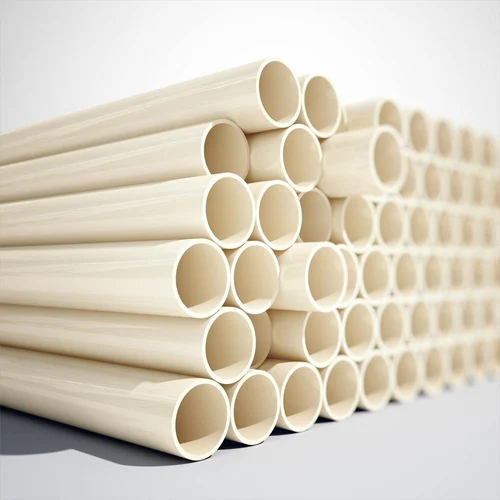
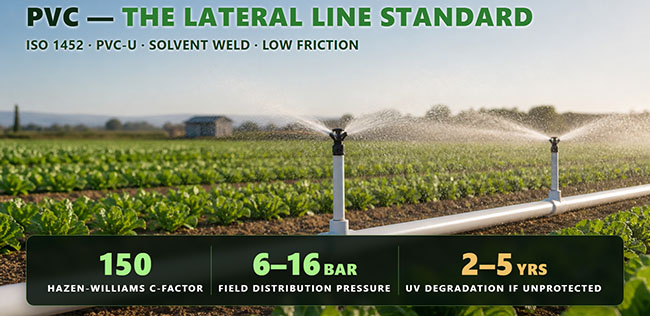
Once water reaches the field, PVC takes over. PVC-U (unplasticized PVC) lateral lines are the cost-effective standard for distributing water to sprinklers, drip tape headers, and flood irrigation gates. Governed by ISO 1452 for PVC-U pressure pipes, these systems thrive in the moderate-pressure (6-16 bar), moderate-temperature world of field distribution.
PVC’s advantages for laterals are straightforward: lower material cost, solvent weld joints that are fast to assemble and create permanent leak-free connections, and excellent hydraulic smoothness (Hazen-Williams C-factor of 150 — among the lowest friction losses of any pipe material). The rigidity of PVC also means fewer supports and simpler anchoring compared to flexible HDPE.
The limitations? PVC becomes brittle below 5°C (40°F) and can crack under impact. It’s not UV-stable without additives — unprotected PVC exposed to direct sunlight will degrade within 2-5 years, showing surface chalking and impact strength loss. For above-ground installation, specify UV-stabilized PVC or apply protective coating/paint. And at diameters above 315mm (12″), PVC’s weight and rigid handling make HDPE more practical for mainlines.
PPR — Greenhouse & Specialized Systems
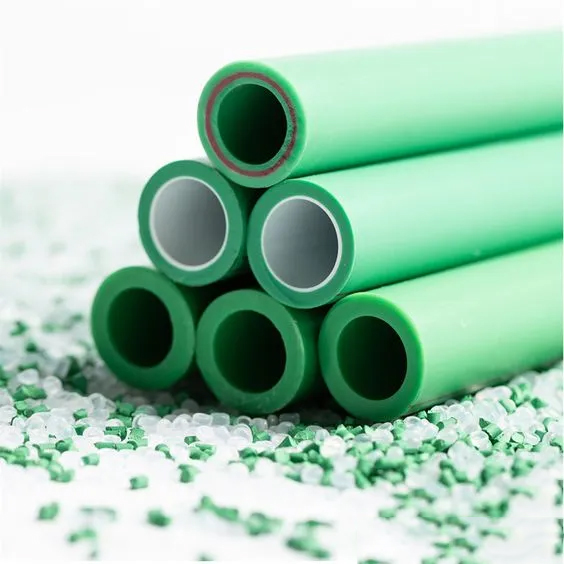
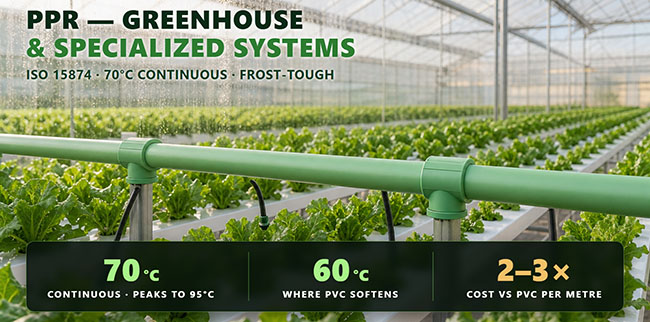
PPR Pipe & Fittings fills the gap where PVC and HDPE struggle: elevated temperature irrigation systems. In greenhouses, hydroponic setups, and solar-heated irrigation, water temperatures can hit 70-80°C (158-176°F). PVC softens above 60°C. HDPE loses significant strength. PPR, governed by ISO 15874, handles continuous operation at 70°C and short-term peaks to 95°C without losing pressure rating.
PPR also offers superior frost resistance. In climates where irrigation lines freeze overnight during shoulder seasons, PPR’s elasticity allows expansion without cracking. This matters in high-altitude agriculture, northern China, Central Asian markets, and temperate zones where overnight frosts occur during the growing season.
The downside: PPR costs 2-3x PVC per meter. The fusion welding equipment is specialized and slower than solvent welding. For standard ambient-temperature irrigation, it’s overkill. But for greenhouse heating loops, geothermal irrigation, and frost-prone distribution, it’s the right call.
Standards for Irrigation Pipe
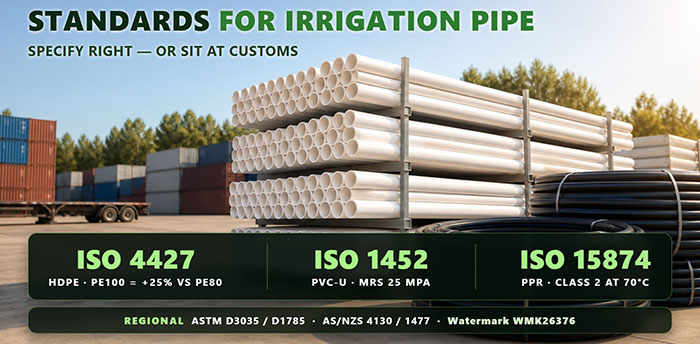
Specifying the wrong standard can get your shipment held at customs — or worse, pipes installed that fail inspection. Here’s what matters:
- ISO 4427 (HDPE): The international standard for PE pipes in water supply. Specifies PE80 and PE100 material grades, dimensional tolerances, and test methods. Always specify ISO 4427-2 for pipes and ISO 4427-3 for fittings. Look for PE100 grade — it gives 25% higher pressure rating than PE80 at the same wall thickness.
- ISO 1452 (PVC-U): Covers PVC-U pipes for water supply and irrigation. Replaces the older ISO 4422 series. Specifies MRS 25 MPa material. Verify your supplier certifies to the current 2009/2010 edition — older pipes may still reference ISO 4422.
- ISO 15874 (PPR): For polypropylene piping in hot and cold water. The key parameter for irrigation is the application class — Class 2 (70°C) covers most greenhouse and solar irrigation needs.
- Regional variants: North American projects often require ASTM D3035 (PE) and ASTM D1785 (PVC Schedule). Australia/New Zealand follows AS/NZS 4130 (PE) and AS/NZS 1477 (PVC). SAM-UK carries Watermark certification (WMK26376) for Australian market compliance.
Cost Analysis — Material, Installation, 20-Year Lifecycle
Looking at material cost alone is amateur hour. The real numbers come from total lifecycle cost over 20 years. Here’s how it breaks down for a typical 100-hectare irrigation project:
| Cost Factor | HDPE (PE100) | PVC-U | PPR |
|---|---|---|---|
| Material Cost (per 100m, 110mm OD) | $800-1,200 | $550-850 | $1,400-2,100 |
| Joint Method | Butt fusion (specialized equipment, ~$5-8 per joint) | Solvent weld (~$1-2 per joint, hand tools) | Socket fusion (specialized, ~$4-6 per joint) |
| Installation Labor | Moderate — fusion equipment slows pace, but long coil lengths reduce joints | Low — fast solvent welding, but more joints on rigid lengths | High — fusion welding is slowest per joint |
| 20-Year Maintenance | Very low — monolithic joints, no corrosion | Low — but UV degradation risk on exposed sections | Very low — excellent chemical and thermal stability |
| Expected Service Life | 50+ years (buried, per ISO 4427 design basis) | 50+ years (buried, per ISO 1452) | 50+ years (per ISO 15874) |
| 20-Year Total Cost (Indexed) | 100 (baseline) | ~80-90 (20-30% cheaper total ownership) | ~130-150 (30-50% premium for thermal capability) |
The bottom line: PVC wins on total lifecycle cost for ambient-temperature field distribution. HDPE is worth the premium for mainlines where fusion joints and flexibility matter. PPR is for thermal applications — if you don’t need the heat resistance, don’t pay for it.
UV Resistance & Buried vs Above-Ground Installation
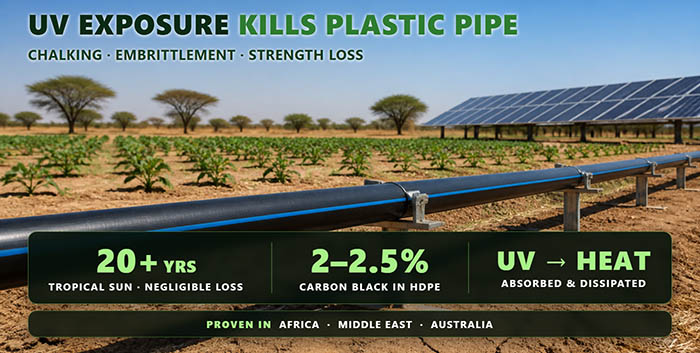
UV exposure kills plastic pipe — slowly but inevitably. The mechanism: UV radiation breaks polymer chains at the surface, causing chalking, embrittlement, and progressive strength loss. How fast depends on the material and additives.
HDPE with 2-2.5% carbon black is the gold standard for above-ground UV resistance. The carbon black absorbs UV and dissipates it as heat, protecting the polymer matrix. Properly formulated black HDPE can sit in direct tropical sunlight for 20+ years with negligible degradation. That’s why you see it used for above-ground irrigation headers across Africa, the Middle East, and Australia.
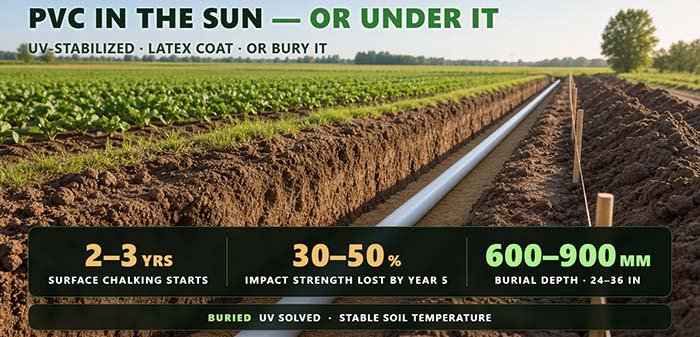
PVC without UV stabilizers is a different story. After 2-3 years of direct sun, surface chalking appears. By year 5, impact strength can drop 30-50%. For above-ground PVC installation, either spec UV-stabilized compound (with titanium dioxide as a UV blocker — that’s why some PVC is light gray/white and lasts longer outdoors) or coat it. Latex paint is a cheap and effective UV barrier for PVC pipe — seriously, a coat of light-colored exterior latex paint extends outdoor PVC life dramatically.
Buried installation solves UV entirely and adds thermal stability (ground temperature fluctuates less than air). For mainlines and most laterals, burial is the correct approach regardless of material. The rule of thumb: bury below the frost line in cold climates, below the cultivation depth in farm fields (typically 600-900mm / 24-36 inches for field crops).
Sourcing Strategy for Agricultural Pipe Projects
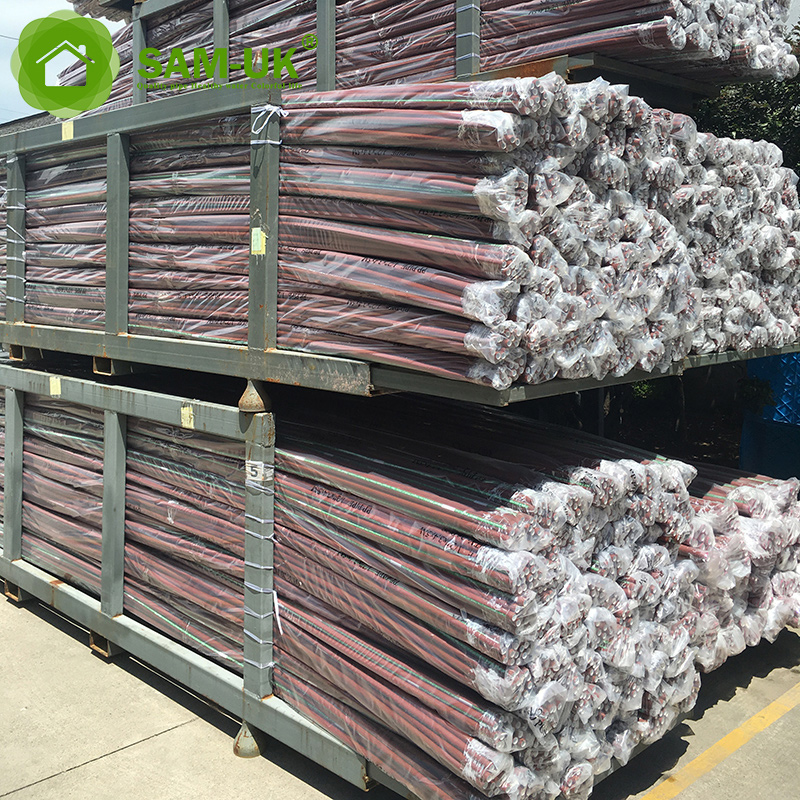
Here’s the thing about agricultural irrigation pipe procurement: pipe is bulky and shipping costs dominate. A 40-foot container fits roughly 1,000-1,500 meters of 160mm HDPE pipe. If your project needs 50,000 meters, you’re looking at 35-50 containers. That freight bill can equal or exceed the pipe cost on long-haul routes.
This is where factory-direct sourcing from a multi-standard manufacturer changes the economics. SAM-UK (Taizhou Zhuoxin Plastics Co., Ltd.) operates a 50,000-tonne annual capacity facility with in-house mold workshop, which means fittings and custom items ship together — not from a separate supplier. One container, one bill of lading, one customs entry.

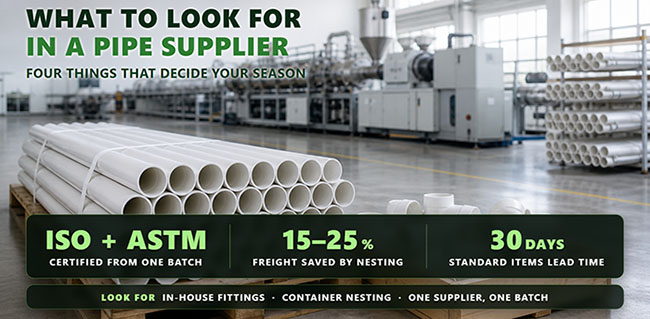
What to look for in an irrigation pipe supplier:
- Multi-standard certification: Your project might reference ISO for the mainline and ASTM for the laterals. Can the supplier certify to both from the same production batch? If not, you’re managing two suppliers.
- In-house fittings production: Pipes without fittings are half a system. A factory that makes both eliminates the finger-pointing when a fitting doesn’t match the pipe OD.
- Container optimization: Experienced irrigation pipe exporters know how to nest different diameters inside each other to maximize container utilization. This alone can save 15-25% on freight.
- 30-day lead time on standard items: SAM-UK’s standard delivery window. Custom molds and non-standard sizes may extend this, but the baseline matters when you’re coordinating with irrigation equipment delivery and planting seasons.
For projects in North America, Australia, and the Middle East, NSF, Watermark (WMK26376), and UPC certifications are non-negotiable. If your supplier can’t show the certificates, walk away — customs will reject the shipment or the local authority won’t approve the installation. SAM-UK maintains all three plus CE and ETL.
Frequently Asked Questions
Which pipe material is cheapest for a large farm irrigation system?
PVC-U wins on upfront material cost — typically 25-35% cheaper than HDPE per meter. But the total installed cost also depends on joint method and terrain. On flat, open farmland where rigid pipe lengths are easy to handle, PVC is the budget winner. On hilly terrain or where trenchless installation is required, HDPE’s ability to be pulled in long lengths can cut installation labor enough to offset the material premium.
Can I use the same pipe for drip and sprinkler irrigation?
Yes, for the mainline and submain — no, for the laterals. Drip laterals use thin-wall PE tubing (typically 12-20mm) with integrated emitters. Sprinkler laterals use rigid PVC or HDPE pipe with threaded risers. The mainline feeding both systems can be the same HDPE or PVC pipe — size it for the combined flow and pressure requirements.
What pipe diameter do I need for my irrigation mainline?
Diameter depends on flow rate and acceptable friction loss, not farm size. As a starting point: 10-20 L/s → 90-110mm, 20-40 L/s → 160mm, 40-80 L/s → 200-250mm. Always have an irrigation engineer run hydraulic calculations — undersizing the mainline is the single most expensive mistake in irrigation design because it increases pumping energy costs every day for the life of the system.
How do I prevent HDPE pipe from floating when buried in high water table areas?
Empty HDPE pipe will float in saturated soil. Solutions: keep the pipe full of water during backfill (hydrostatic weight prevents flotation), use concrete anchor blocks at regular intervals for large diameters, or install geotextile-wrapped gravel ballast above the pipe. For diameters above 315mm in high water table conditions, always include anti-flotation measures in the design.
What certifications do I need for irrigation pipe imported into Australia?
Australia requires Watermark certification for plumbing and water supply products, which covers irrigation pipe connected to the water supply network. SAM-UK holds Watermark license WMK26376 and products are certified to AS/NZS 1477 (PVC) and AS/NZS 4130 (PE). Without Watermark, your shipment won’t clear Australian customs for plumbing-related applications.
About SAM-UK
SAM-UK are a professional 20+ years manufacturer in producing vinyl building profile products and PVC , CPVC , PPH , PPR , PP pipes and pipe fittings, valves, taps and so on. We own the certificates of SGS\SONCAP\ISO9001\CE\NSF,support color /size customization. Welcome to consult for Catalog and Product. you can contact us at email [email protected]