MOQ and Lead Time: Benchmarking Pipe Orders from China Without Getting Burned
Container maths sets your MOQ, extrusion scheduling sets your lead time, and neither one shows up in the price column of the quotation. Buyers who learn that early stop arguing about dollars per kilo and start comparing the number that survives customs: cost per metre at a locked specification.
This is not a rate sheet: rates and resin move, so read every range as a shape, not a fact, and date-stamp anything commercial before it goes in a budget.
MOQ Is a Packing Question Before It Is a Price Question
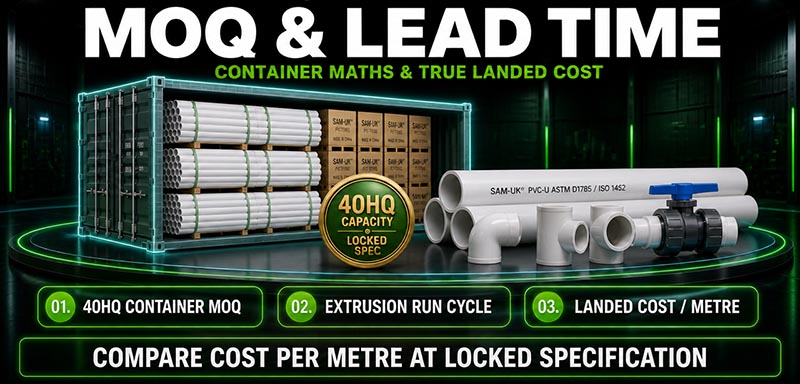
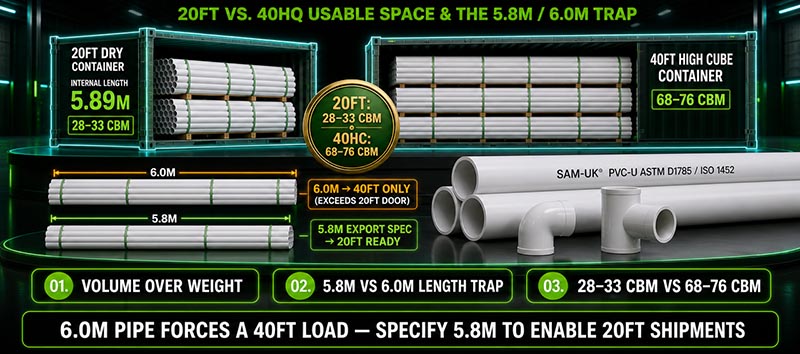
Pipe ships by volume, not weight. A 20ft dry container gives you roughly 28–33 cbm of usable space, a 40ft about 58–67 cbm, and a 40HC up to 68–76 cbm once you admit the theoretical figure is never fully reachable. Those numbers mean nothing until you know your length.
Here is the detail that kills more first orders than any negotiation. Six-metre pipe does not fit in a 20ft container — internal length is a shade under 5.9 m, so a 6 m spec forces you onto a 40ft whether you wanted one or not. Specify 5.8 m and the 20ft comes back into play.
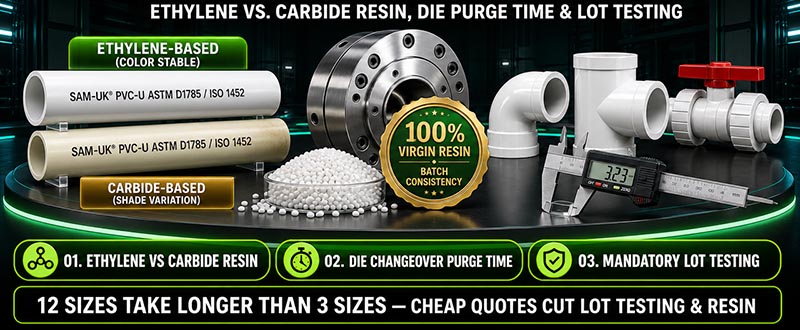
Nesting carries the other half of the maths, and factories plan it better than most buyers expect. Small diameters slip inside larger ones, hexagonal bundles beat square packing, and a well-planned 20ft of 20–63 mm pipe holds three or four sizes in one load. Load it badly and you ship air at resin prices.
Fittings ignore all that. They move by carton or pallet, minimum quoted per size per colour, which is why a distributor’s “small trial order” of forty fittings costs more per unit than a pallet and sometimes arrives with a handling charge attached.
New moulds carry a tooling charge — one-off or amortised across the first shipments — plus a higher minimum run, because a die change is hours of lost extrusion time. Amortisation is negotiable. So is mould ownership.
Market MOQ for standard PVC pipe commonly lands at one 20ft container, often mixed across sizes. That is a habit, not a law — it varies by product, factory, and how soft the month is.
What Actually Sets Lead Time — and What the Quote Leaves Out
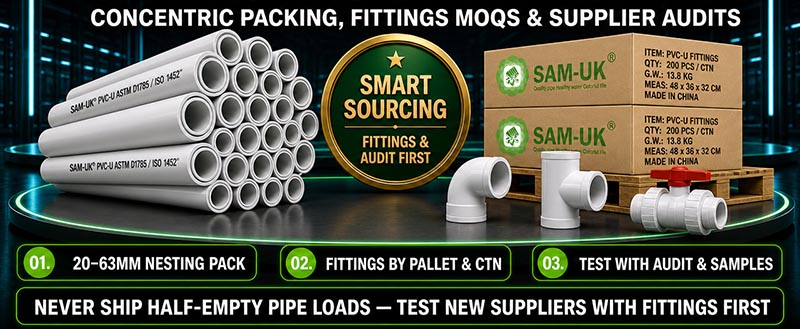
Standard programmes typically run 25–35 days after deposit and artwork approval. Read both conditions. A deposit landing on day zero with packing marks approved on day nine starts the clock on day nine, and first-time buyers lose that week without noticing it.
- Deposit received, packing marks approved — day 0 to day 10 in a bad month.
- Resin position taken against the order.
- Extrusion scheduled, dies changed, sizes batched.
- Lot testing and dimensional check. Sample retention.
- Booking, loading, VGM and SI cut-off.
- Ocean transit, which the factory does not control at all.
Transit sits on top and is not the factory’s to promise. China to the Gulf is often quoted at 15–30 days, China to Northern Europe around 30–40 days, and the US West Coast is shorter. Confirm it with your forwarder at booking; blank sailings rewrite that answer monthly.
Add it up and a first order with fresh artwork lands in roughly 8–11 weeks. A repeat order on approved artwork and stock resin is faster — which is the real argument for staying with a debugged supplier.
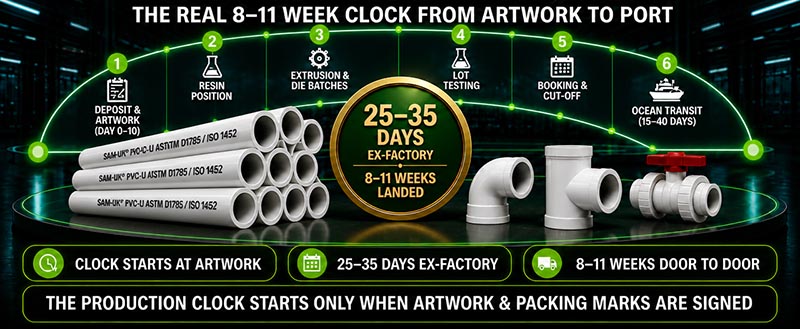
Resin position is where quotes quietly diverge. Chinese PVC comes off two routes: ethylene-based and calcium carbide-based. Carbide material is cheaper, it sits behind a lot of aggressive offers, and it varies more in colour stability. On white pipe that shows up as batch-to-batch shade difference — invisible in a photo, obvious in a bathroom.
Extrusion scheduling explains delays buyers usually blame on competence. A line runs flat out and every size change costs hours of purge. Twelve sizes take longer than three at identical tonnage.
Testing is the quiet line item. A quote that excludes lot testing ships without it. Ask what happens to a failed lot; the answer separates a process from a promise.
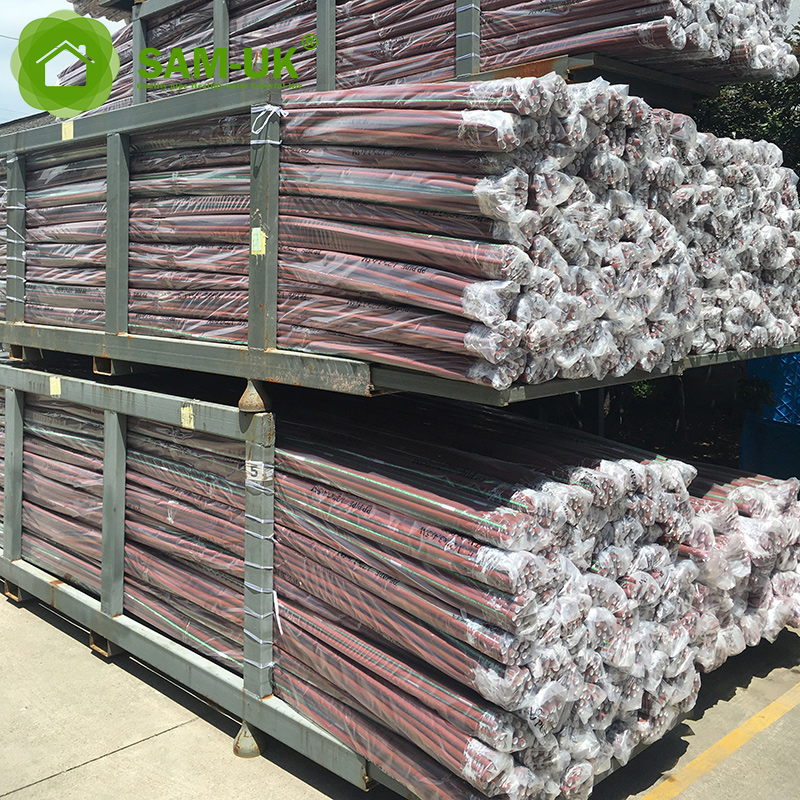
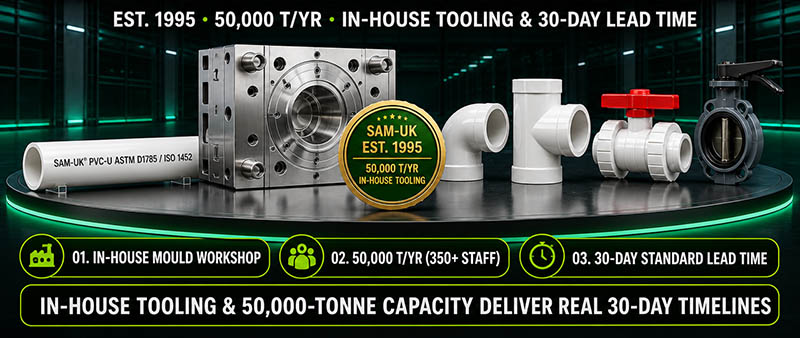
One practical check at this stage: ask how the factory handles a mixed-size order and whether mould work is in-house. SAM-UK, export brand of Taizhou Zhuoxin Plastics Co., Ltd., has made pipe and fittings in Taizhou, Zhejiang since 1995, runs 300–350 employees across roughly 50,000 tonnes a year, and keeps an in-house mould workshop — useful when a size change is the only thing between you and a sailing. Standard programmes carry a 30-day lead time, OEM work is routine, and the range covers PVC/uPVC, CPVC, PPH and PPR pipe and fittings plus PVC ball and butterfly valves.
Normalise to Dollars per Metre at a Fixed Specification
Resin is bought by the tonne, so suppliers quote by the tonne and buyers compare by the tonne. Wrong unit. Your project is measured in metres and rated in bar, and $1.05/kg on DN110 tells you nothing until you know the wall, the length tolerance and whether the socket is included.
Convert everything to USD per metre at a named OD, standard and pressure class, named length, plain or socketed, named colour. Then ask for kilos per container as a cross-check on the loading plan.
| Line item | Quote A | Quote B | Quote C |
|---|---|---|---|
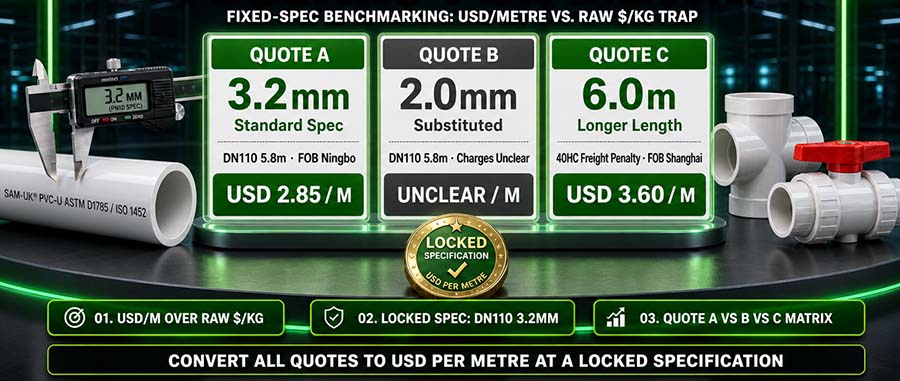
| Spec | DN110, 3.2 mm, PN10, 5.8 m, socketed | DN110, 2.0 mm, standard unstated, 5.8 m | DN110, 3.2 mm, PN10, 6.0 m |
| Price basis | USD/m plus USD/kg | USD/kg only | USD/m at 40HC quantity |
| Incoterm | FOB Ningbo | CIF, charges unclear | FOB Shanghai |
| Validity | 20 days | Blank | “Subject to resin” |
| MOQ | 1 × 20ft, 4 sizes | 1 × 20ft, single size | 1 × 40HC |
| Lead time | 30 days | 25 days | 35 days |
| Packing / load | Hex bundles, 4,200 m per 20ft | Not stated | 6 m needs 40ft |
| Payment | 30/70 before shipment | 100% advance | L/C at sight |
| Exclusions | Test report on request | No report offered | Marking extra |
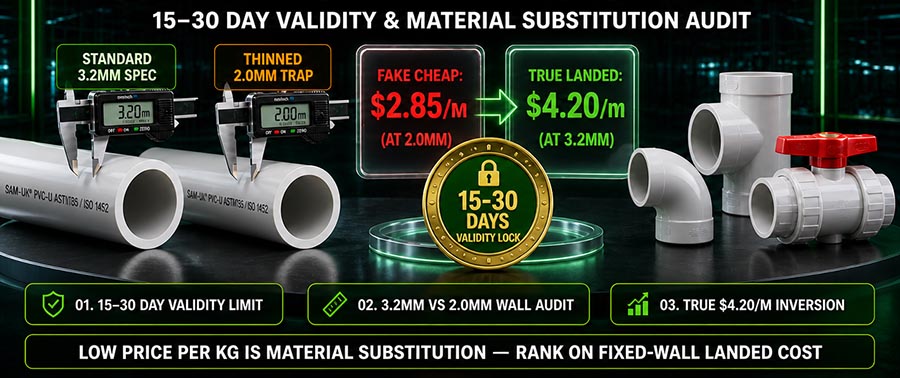
A quote with an empty validity column is not a benchmark, it is an opening position. Quotations here usually hold for 15–30 days, because PVC resin and container freight both move faster than that.
Now the inversion, which is the whole argument. Quote A returns at $2.85/m against Quote C at $3.60/m for what looks like the same pipe. A looks like the buy. Then inspection finds 2.0 mm of wall where the spec called for 3.2 mm. Re-quote A at the specified wall and it walks up to about $4.20/m — the low price per kilo was never commercial advantage, it was material substitution. Rank on landed cost at fixed wall and the list reorders. It usually does.
Where an Unusually Low Price Comes From
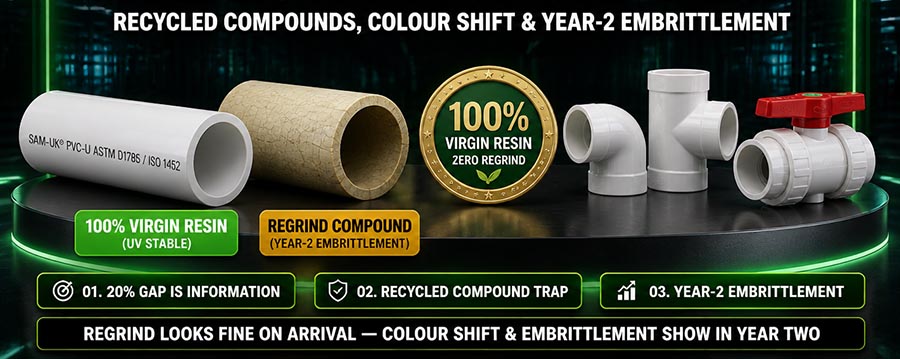
Nobody sells below cost for long, so a 20% gap is information rather than luck. The saving has to sit somewhere.
Recycled or off-grade compound is the biggest lever and the most common. Regrind looks fine on arrival and behaves differently after two summers — colour shift and embrittlement show up in year two, long after the invoice clears.
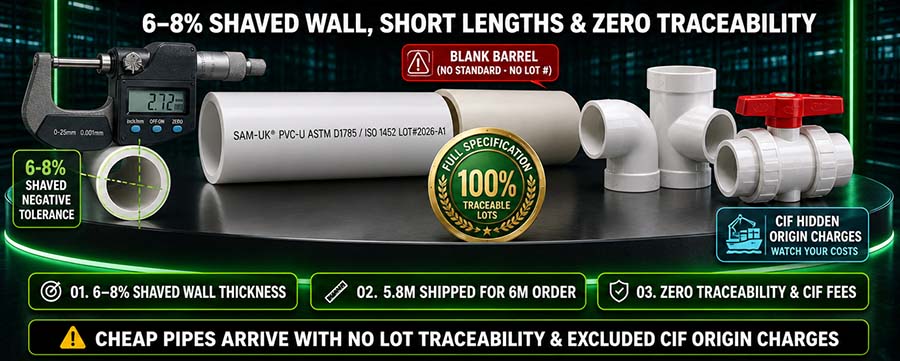
Wall thickness is second. Material is roughly two thirds of the cost of a metre, so shaving 6–8% off the wall, just inside a generous negative tolerance, is real margin. Invisible unless somebody puts a micrometer on it at the port.
Length is third and almost never caught. Random lengths averaged down, 5.8 m shipped against a 6 m order, “approximately” in the packing list — fewer installed metres at the same freight volume. And the cheapest pipes tend to arrive with no standard reference, no pressure class and no lot number on the barrel, which means no traceability when a joint fails on site.
Watch for freight excluded from a CIF figure that looked all-in, and origin port charges reassigned to the buyer.
Total Landed Cost, Built Line by Line
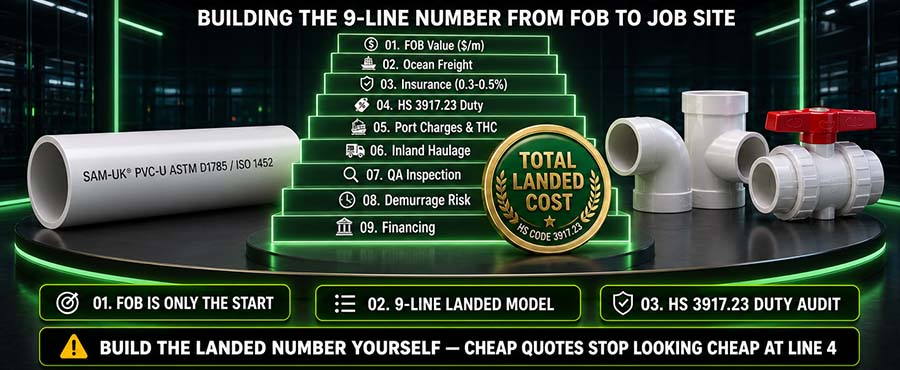
FOB is the start of the invoice, not the end of the cost. Build the landed number yourself and the cheap quote stops looking cheap around line four.
- FOB value — per metre, at fixed specification.
- Ocean freight — per container, not per tonne.
- Insurance — commonly 0.3–0.5% of CIF value; confirm with your broker.
- Duty — rigid PVC pipe sits under HS 3917.23; rates differ by destination, and US importers of Chinese-origin plastics must get the HTS line plus any additional tariff confirmed by a broker before signing the PI.
- Destination charges — THC, documentation, terminal fees.
- Inland haulage — 6 m pipe needs a longer trailer than a 40ft box suggests.
- Inspection — a few hundred dollars per day, cheap against a failed lot.
- Demurrage risk — free time at destination is short; pipe that needs a crane burns it fast.
- Financing — 30/70 ties up cash for the transit; an L/C adds bank charges.
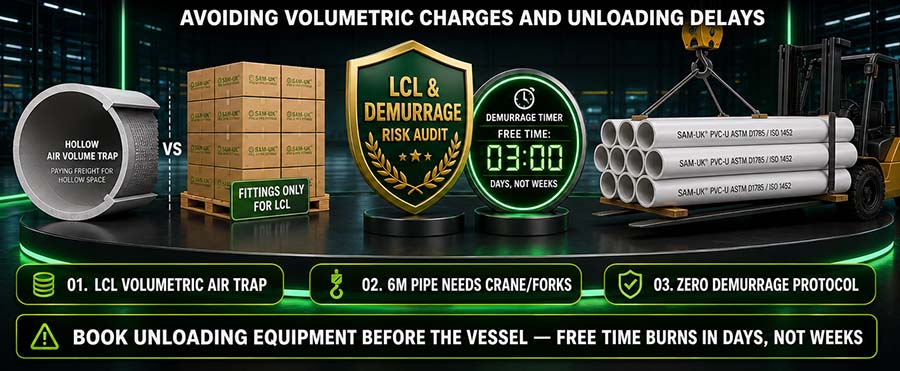
LCL is a trap for pipe specifically. Volumetric rules mean you pay for the air inside the bundle, and depots are not gentle with 5.8 m lengths. Under half a container, consolidate fittings; skip rigid pipe.
Demurrage deserves its own sentence because nobody budgets it. A container of 6 m pipe cannot be hand-unloaded by two men and a pallet truck, and if your yard’s forklift has short forks the box sits there while you hunt for a crane. Free time is counted in days. Book the unloading equipment before you book the vessel.
Running a Three-Quote Benchmark, and Terms Worth Insisting On
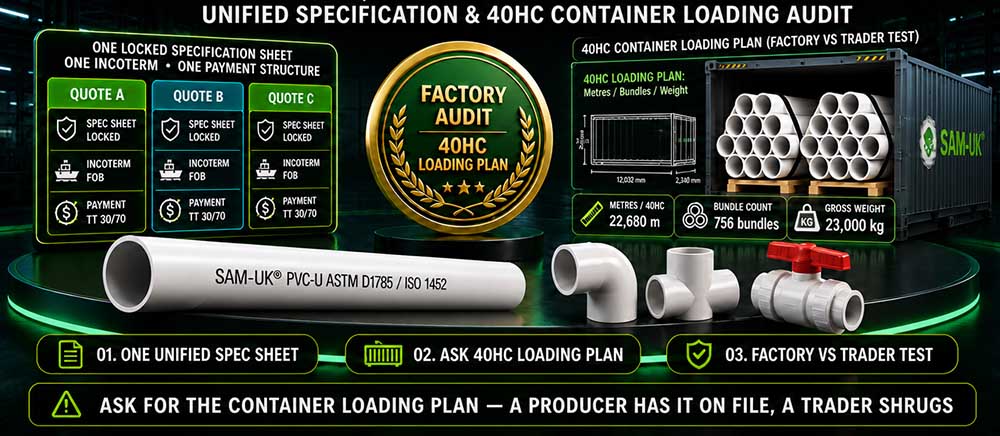
Three quotes only mean something if they answer the same question. One spec sheet, one Incoterm, one payment structure, one validity window. Then ask what a quotation never volunteers: resin route and grade, wall tolerance, and what the number excludes.
A fourth question separates traders from factories: ask for the container loading plan — metres per 40HC at that diameter, bundle count, gross weight. A producer running PVC/uPVC, CPVC, PPH and PPR pipe and fittings into North America, South America, Australia, Africa and the Middle East will have one on file for a standard size. A shrug is also an answer. Details sit at www.sam-uk.com if you want to test a range against your own spec sheet.
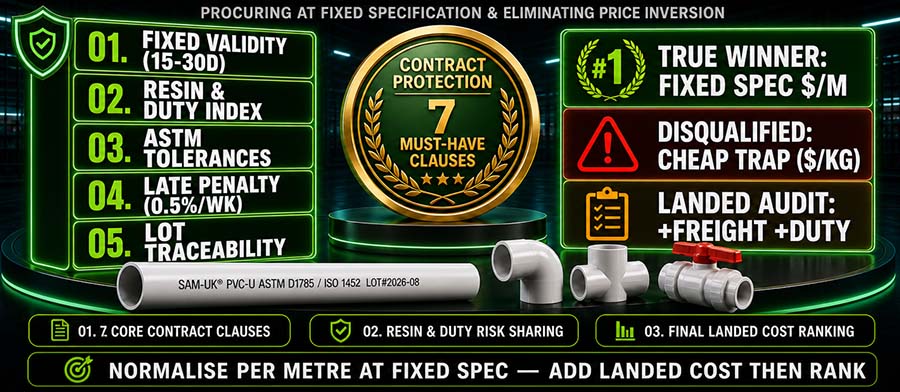
Then nail the contract. These clauses pay for themselves the first time something slips:
- Price validity of 15–30 days, expressed as a date, never “subject to confirmation”.
- A resin-index clause naming the index and reference period, so a spike is shared.
- A duty-change clause — who absorbs a tariff move between PI and shipment.
- A tolerance clause quoting the standard you buy to: wall, length, ovality.
- A late-delivery remedy — commonly 0.5% of order value per week, capped, with cancellation rights beyond.
- Inspection rights — reject a lot, delay the balance.
- Marking and traceability — standard reference, pressure class and lot number on every length.
Which brings it back to the core mistake. Benchmarking per kilogram makes cheap quotes look expensive and expensive quotes look cheap. Normalise per metre at fixed spec, add landed cost, then rank. The order inverts more often than not, and round two rarely resembles round one.
Frequently Asked Questions
What is the MOQ for PVC pipe from China?
One 20ft container is the market norm for standard PVC pipe, often mixed across three or four sizes. Fittings go by carton or pallet per size and colour. Custom profiles carry tooling and a higher run. Confirm it on the PI — every figure varies by product and factory.
How long does a first order take door to door?
Production runs 25–35 days after deposit and packing-mark approval, then transit: roughly 15–30 days to the Gulf, 30–40 to Northern Europe, less to the US West Coast. A first order realistically lands in 8–11 weeks.
Can I place a part-container trial order?
You can, but the economics are poor for rigid pipe — LCL is charged on volume, so you pay for the air in the bundle. Test with samples, an audit and a fitting order instead, then commit a container of pipe.
Why do two quotes for the “same” pipe differ by 30%?
Usually wall thickness, resin route, or what the number excludes. Carbide-based versus ethylene-based compound moves the cost base; a wall shaved inside a loose tolerance moves it further. Re-quote both at identical wall before assuming bad faith.
Who pays for a new mould?
The buyer, as a one-off tooling charge, sometimes amortised over the first shipments. Get amortisation, mould ownership and exit rights in writing — an unclear mould clause is the most expensive line in a custom order.
Is a 15-day quote validity normal?
Yes, and honest. Resin and freight move on shorter cycles than projects do, so 15–30 days is standard. What is not normal is no validity statement at all — that number has no commitment behind it and shouldn’t enter a benchmark.
About SAM-UK
SAM-UK are a professional 20+ years manufacturer in producing vinyl building profile products and PVC , CPVC , PPH , PPR , PP pipes and pipe fittings, valves, taps and so on. See our certification records and product-specific scope. We support color /size customization. Welcome to consult for Catalog and Product. you can contact us at email [email protected]