Introduction
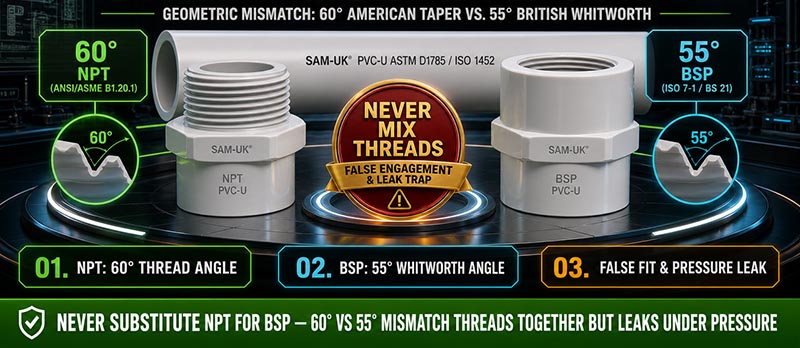
Never substitute NPT for BSP on a pressure line. The two will thread together — that is the trap — and then they leak.
On a fuel or gas line the same substitution isn’t an inconvenience, it’s a safety failure. The root cause is pure geometry. NPT cuts a 60° thread; BSP cuts a 55° Whitworth thread. At several sizes even the diameters differ. Buyers read “1/2 inch” on both and assume they match, because the labels look identical. Handle the two standards as one product and you’ll ship the wrong fitting to a customer who can’t tell until the joint weeps under pressure.
Thread Forms Compared
Three thread families matter for plastic fittings, and only one of them is North American. NPT is defined by ANSI/ASME B1.20.1, with a 60° thread form and a 1:16 taper. BSP splits into two variants: BSPT, the tapered version under ISO 7 / EN 10226, and BSPP, the parallel version under ISO 228. Both BSP types share the same 55° Whitworth form with rounded crests and roots, which is the first thing to separate them from NPT’s flatter, sharper profile.
| Parameter | NPT | BSPT (taper) | BSPP (parallel) |
|---|---|---|---|
| Thread form | 60° (Sellers) | 55° (Whitworth) | 55° (Whitworth) |
| Taper | 1:16 | 1:16 | None (parallel) |
| Governing standard | ANSI/ASME B1.20.1 | ISO 7 / EN 10226 | ISO 228 |
| Sealing method | Taper interference + sealant | Taper interference + sealant | Washer / O-ring / gasket |
| Main regions | North America | UK, Middle East, Australia, parts of Asia | UK, Europe, Middle East, Asia |
The sealing row is where most field mistakes begin. NPT and BSPT seal by taper interference with a sealant — the threads physically wedge together. BSPP cannot seal on its threads at all, because parallel threads never develop that interference. BSPP needs a bonded washer, an O-ring, or a gasket, and a joint assembled without one will leak no matter how much tape goes on it.
Why “1/2 Inch” Means Two Different Fittings
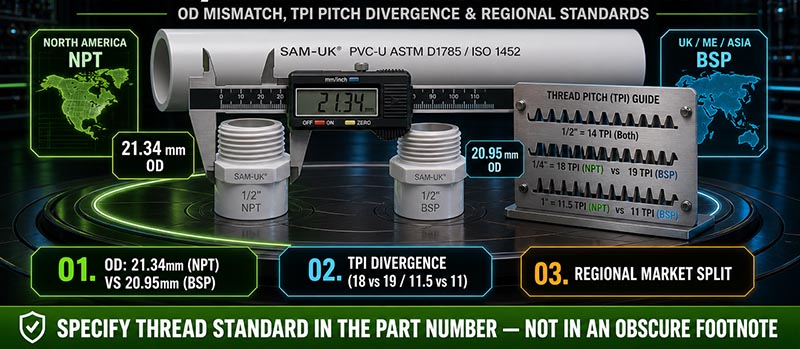
The label hides the difference. A 1/2″ NPT male and a 1/2″ BSP male are both sold as “half inch,” but their outside diameters don’t match. 1/2″ NPT measures about 21.34 mm OD; 1/2″ BSP measures about 20.955 mm. That’s close enough to fool a caliper check done in a hurry and different enough to matter at pressure.
Pitch adds a second layer of confusion. At 1/2″ and 3/4″, NPT and BSP both run 14 threads per inch, so the pitch looks identical. Move to other sizes and they diverge: 1/4″ is 18 TPI on NPT against 19 TPI on BSP, and 1″ is 11.5 TPI on NPT against 11 TPI on BSP. Same nominal size, different thread count. A distributor who stocks “1/4 inch fittings” without splitting by standard is one order away from a return.
North America runs on NPT almost exclusively. The UK, much of the Middle East, Australia, and parts of Asia run on BSP. Same product line, two standards — and the wrong one ships easily when a catalog lists only trade size. Thread standard belongs in the part number, not in a footnote the warehouse never reads.
The Partial-Engagement Trap — and How a Mixed Joint Leaks
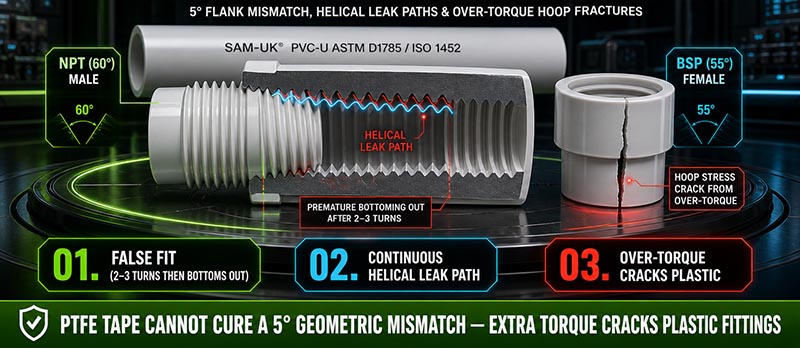
Here is why a mismatched joint is so dangerous: it feels like it fits. The 5° difference between the two flanks lets the threads start and spin for two or three turns, which feels reassuringly like a joint going together. Then they bottom out early. Full engagement never happens, because the crests and roots can’t seat against each other the way each design intends.
The result is a continuous helical gap running the length of the engagement — a spiral leak path that no sealant can close, because the sealant would have to fill a void that wraps around the thread. In the field this shows up as a joint that passes a quick pressure test, then weeps a bead at operating temperature, or drips only when the line cycles. Installers often react by wrapping on more PTFE tape and torquing harder. Neither fixes geometry, and on plastic fittings the extra torque is what cracks the body.
On compressed air, a 1/2″ or 3/4″ mismatch often limps along because the pitch is the same and low-risk systems tolerate a slow weep. Carry that habit onto a fuel or gas line and the “slow weep” is a leak of a flammable medium at a joint that was never mechanically sound. On gas, a mismatched thread is a safety failure, not a nuisance.
How to Identify a Thread on Site
When the label is missing — and it often is — you identify the thread by measuring, not guessing. Use a caliper on the outside diameter of the male thread and a thread pitch gauge or a ruler to count threads per inch. OD alone is rarely enough, because the near sizes sit within a millimetre of each other; check the diameters against the table, then confirm the angle by eye or gauge.
| Nominal size | NPT TPI | NPT OD (approx.) | BSP TPI | BSP OD (approx.) |
|---|---|---|---|---|
| 1/8″ | 27 | 10.29 mm | 28 | 9.73 mm |
| 1/4″ | 18 | 13.72 mm | 19 | 13.16 mm |
| 3/8″ | 18 | 17.15 mm | 19 | 16.66 mm |
| 1/2″ | 14 | 21.34 mm | 14 | 20.96 mm |
| 3/4″ | 14 | 26.67 mm | 14 | 26.44 mm |
| 1″ | 11.5 | 33.40 mm | 11 | 33.25 mm |
Read that table carefully and the trap is obvious: at 1/2″ and 3/4″ the TPI matches and only the OD and thread form differ. At 1/4″ and 1″ even the TPI differs. A tap or ring gauge settles it fastest: a correct gauge screws on with hand effort, while the wrong one won’t start or jams. If a gauge needs force, you have the wrong standard.
Sealing Practice by Thread Type
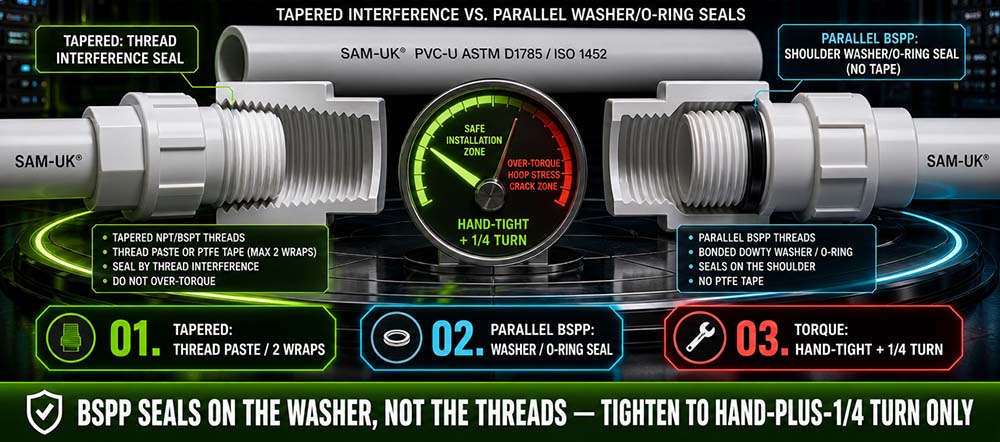
Sealing follows from the thread form, so match the method to the joint. Tapered threads — NPT and BSPT — rely on interference and need a sealant: PTFE tape or a thread paste. Paste is usually the better call on plastic fittings, because tape thickness varies and a heavy wrap can stress the female port as it’s driven in. Two wraps in the direction of the thread is the norm; more is not better.
Parallel threads are a different job entirely. BSPP cannot seal on the threads, so it uses a bonded washer, an O-ring, or a gasket at the shoulder, with the thread doing nothing but holding the parts together. Wrap tape on a BSPP joint expecting it to seal and you’ll be chasing the leak for weeks. The seal is the washer, plain and simple.
Two habits cause most plastic-fitting failures at the connection. The first is piling on extra tape to compensate for a mismatched thread — that treats a geometry problem as a filling problem and never works. The second is over-torquing. Threaded plastic ports crack from hoop stress, and the crack often shows up months later as a hairline leak with no obvious cause. Tighten to hand-plus-a-quarter-turn and back off if the fitting fights you.
Threads, Pressure Ratings, and a Distributor’s Stocking Plan
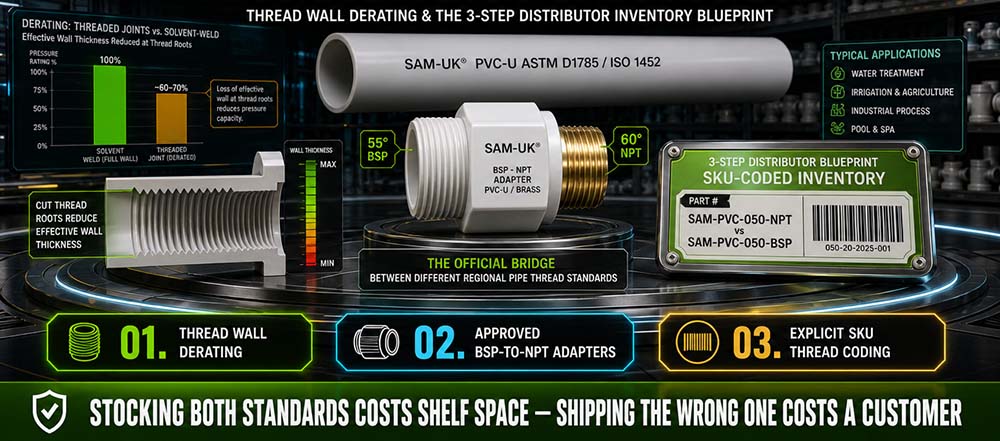
Threading a plastic fitting derates it. Cutting a thread removes wall material from the port, so a threaded connection holds less pressure than the same fitting joined by fusion or solvent cement. Never read a pipe’s pressure rating as the fitting’s rating at a threaded joint. Size the connection for the thread’s own limit, not the pipe’s.
For a distributor, the rule is never to stock a plastic fitting by trade size alone. Work the stocking plan in three moves:
- Split every threaded line by standard — NPT for North America; BSPT and BSPP for the UK, Middle East, Australia, and parts of Asia.
- Carry the right adapters. A BSP-to-NPT adapter is the only approved bridge, because it presents the correct thread form on each end.
- Put the standard in the part number, so the warehouse never ships the wrong one on a trade-size-only order.
Stocking both standards costs shelf space; shipping the wrong one costs a customer.
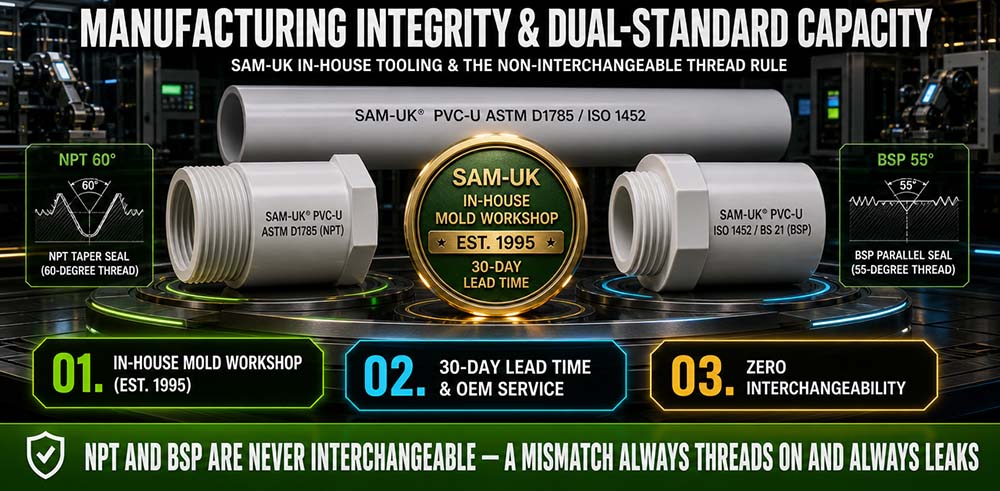
This is also where supplier capability gets tested, because a two-standard catalog demands both range and mold control. SAM-UK, the export brand of Taizhou Zhuoxin Plastics Co., Ltd., has produced pipe and fittings in Taizhou, Zhejiang since 1995, with an in-house mold workshop and a 30-day lead time on standard programs across PVC/uPVC, CPVC, PPH and PPR lines plus valves, exporting to North America, South America, Australia, Africa, and the Middle East. For distributors running NPT in one market and BSP in another, that in-house mold capacity and OEM service are what keep one product line stocked to two thread standards without a separate factory for each.
Frequently Asked Questions
Will 1/2″ NPT fit into 1/2″ BSP?
It may start to thread by hand — the pitch matches at 14 TPI — but it won’t seal. The 60° versus 55° forms and the slight OD difference mean the crests and roots never seat, leaving a spiral leak path. Never substitute one for the other on a pressure line.
What is the difference between NPT and BSP threads?
NPT (ANSI/ASME B1.20.1) uses a 60° thread form with a 1:16 taper and is standard in North America. BSP uses a 55° Whitworth form and comes as BSPT (tapered, ISO 7 / EN 10226) or BSPP (parallel, ISO 228). The thread angle and, at several sizes, the diameter and pitch all differ.
Can I seal NPT to BSP with PTFE tape?
No. PTFE tape fills small voids but cannot correct a mismatch in thread form — the threads still bottom out early, so there isn’t enough engagement for a reliable seal. The fix is a dedicated BSP-to-NPT adapter.
How do I tell NPT from BSP in the field?
Measure the outside diameter of the male thread with a caliper and count threads per inch, then compare against a standard table. A ring or thread gauge is faster: a correct gauge screws on with hand effort, while the wrong one won’t start or jams. If it needs force, it’s the wrong standard.
Does BSPP need sealant?
No tape on the threads. BSPP is a parallel thread and cannot seal on its threads at all — it needs a bonded washer, O-ring, or gasket at the shoulder. The threads only hold the parts together. Sealant on the threads of a BSPP joint will not stop it leaking.
Does threading a plastic fitting lower its pressure rating?
Yes. Cutting a thread removes wall material at the port, so a threaded connection holds less pressure than the same fitting joined by fusion or solvent cement. Size threaded joints for the thread’s own pressure limit, not the pipe’s rating, and avoid over-torquing plastic ports, which cracks them from hoop stress.
About SAM-UK
SAM-UK are a professional 20+ years manufacturer in producing vinyl building profile products and PVC , CPVC , PPH , PPR , PP pipes and pipe fittings, valves, taps and so on. See our certification records and product-specific scope. We support color /size customization. Welcome to consult for Catalog and Product. you can contact us at email [email protected]