Application
Construction pipeline system
Agricultural irrigation pipeline system
Pool pipeline system
Industrial pipeline system
Water treatment pipeline system
Fishery aquaculture pipeline system
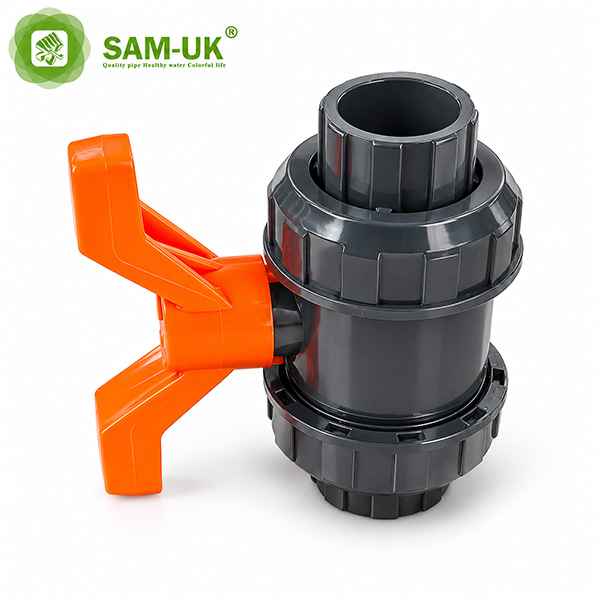
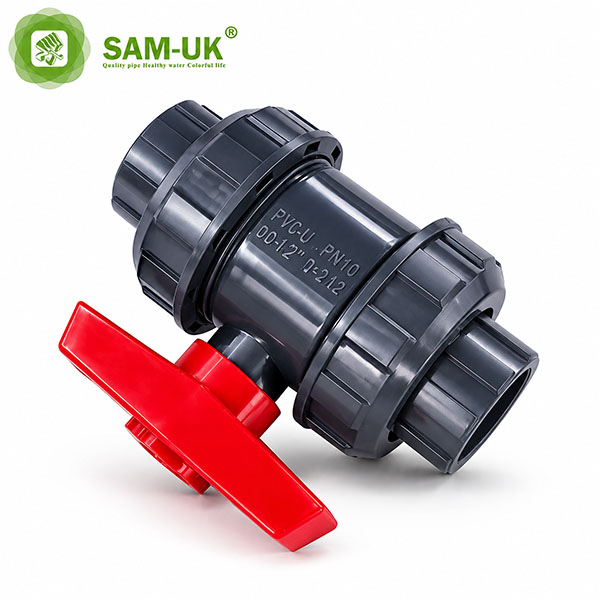
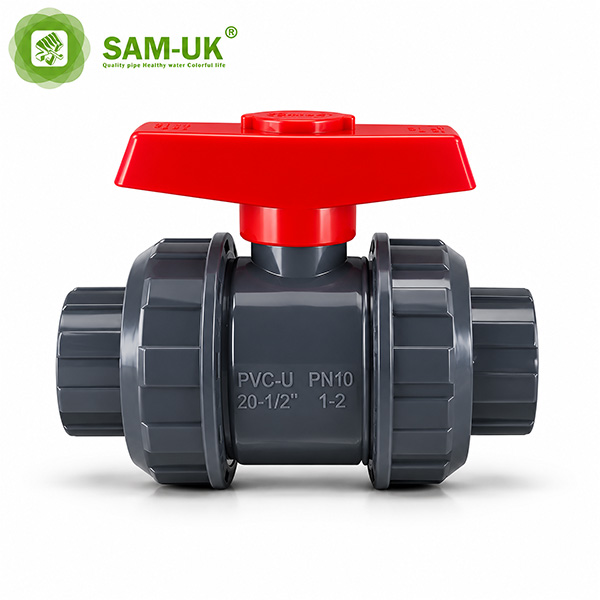
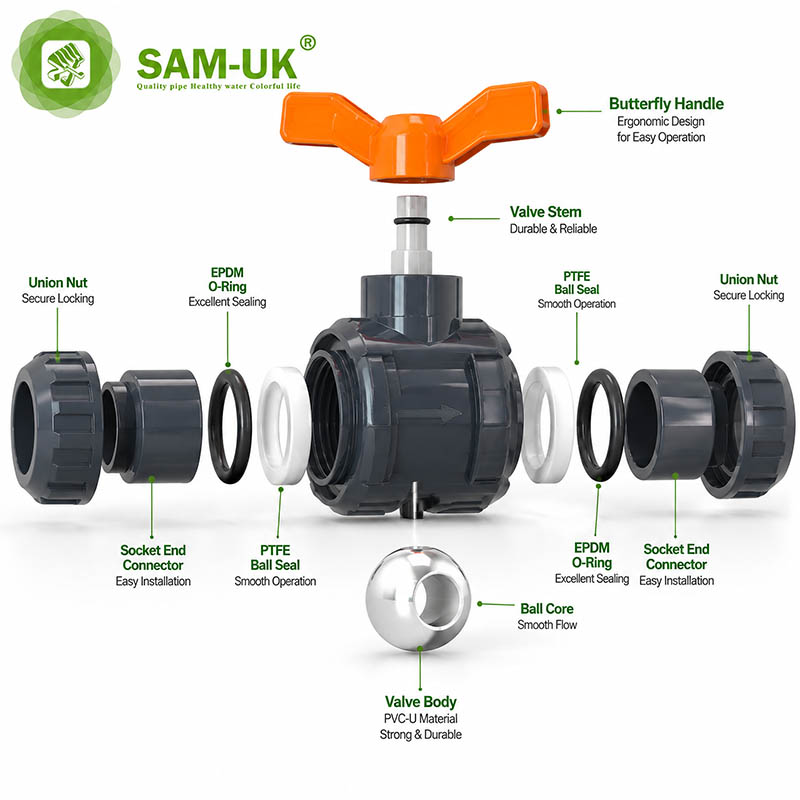
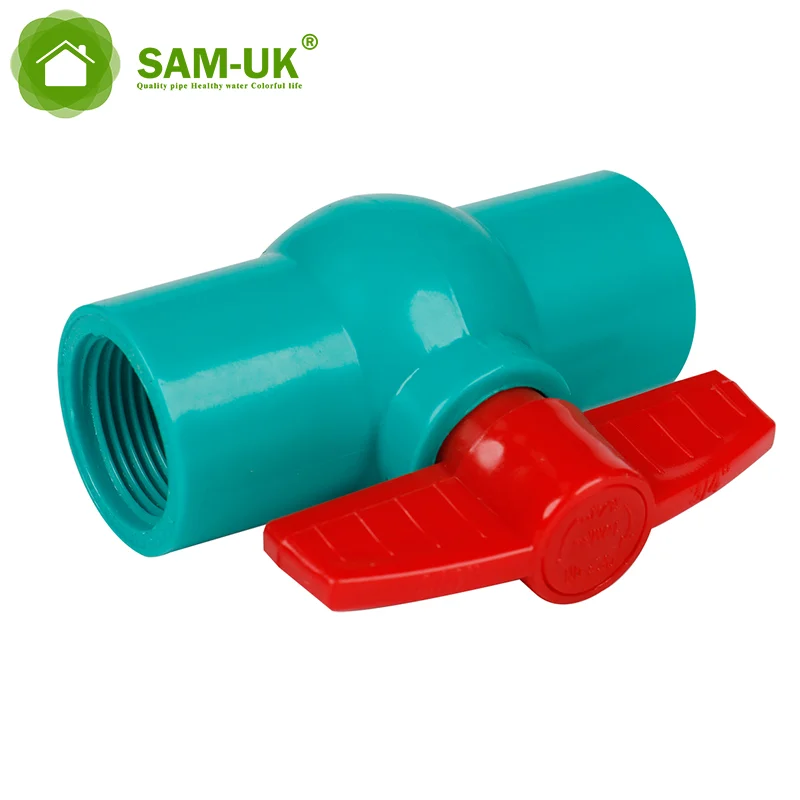
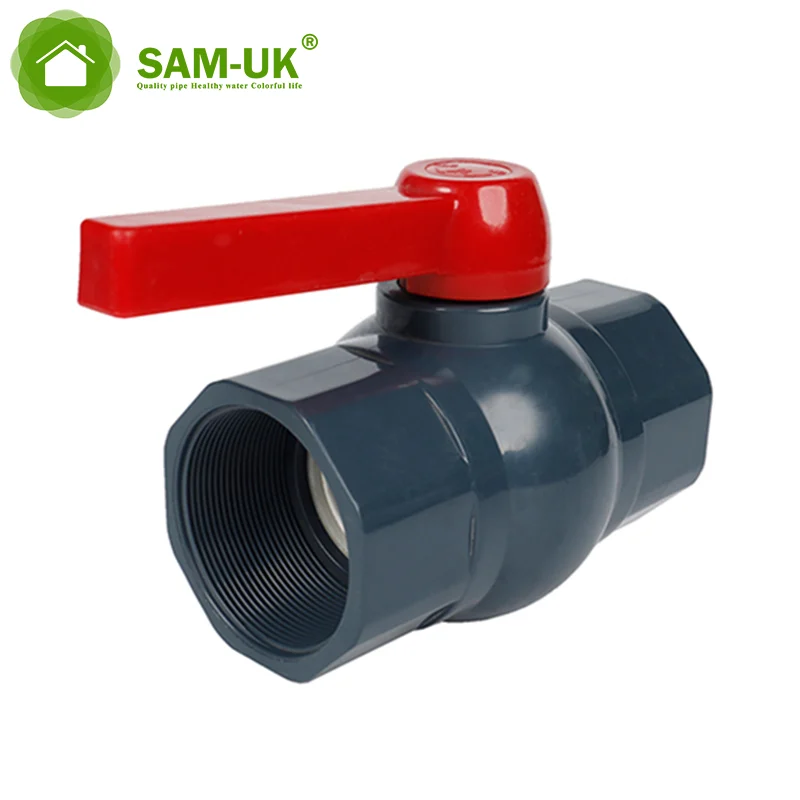
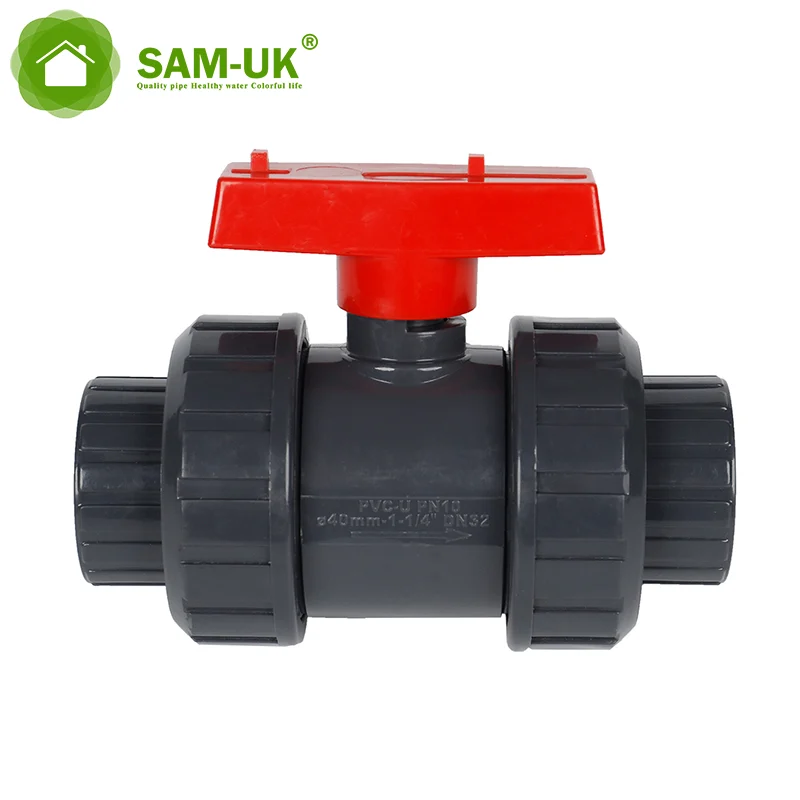
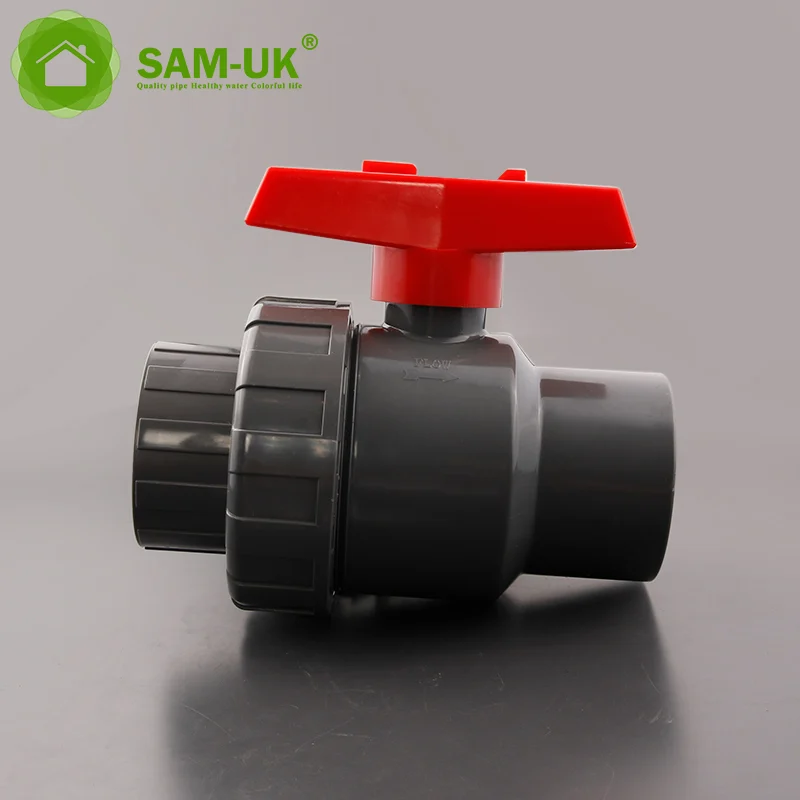
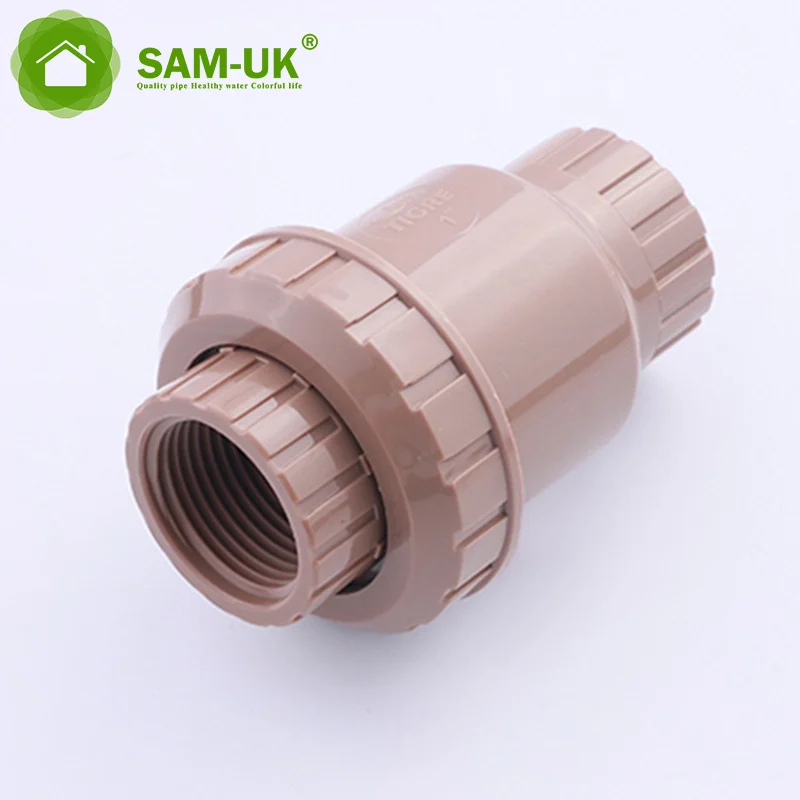
SAM-UK builds this PVC double union ball valve with a union nut on each end,
so the body lifts out of the line without a saw. Service a leaking seat on a
pool manifold or a dosing skid in minutes, not a shift. Socket ends
solvent-weld.
The seal in the union nut is what fails first, not the body,
which is why both parts come off our own moulds. OEM marking available.
Construction pipeline system
Agricultural irrigation pipeline system
Pool pipeline system
Industrial pipeline system
Water treatment pipeline system
Fishery aquaculture pipeline system
The characteristics of PVC material: stable physical properties, and not suitable for acid and alkali corrosion, relatively heat-resistant. By adding different additives, PVC materials can present different physical and mechanical properties
| Benefits |
| Long service life |
Electrical insulation |
Good impact elasticity |
Good chemical resistance |
Easy to operate |
light in weight |
A ball valve fails one of two ways: seat wear, or debris jamming the ball. Either way you
replace the body — and on a flanged or single-union valve, that means a saw and a shutdown. The
double union changes the arithmetic. Undo two nuts, the body drops out, a new one goes back in, and
the line stays full. On a pool circulation manifold, that is a fifteen-minute job instead of
a drained system. We have shipped these into irrigation headers where the alternative was
excavating a buried line to reach a valve that cost less than the digging.
Six parts, three materials, and only one of them sets the temperature limit. Body, ball,
stem, tail pieces and union nuts are PVC — the whole wetted path is one material. Seats are
TPV, O-rings are EPDM, the handle is ABS.
The 60 °C ceiling comes from the PVC, not the seals — TPV and EPDM both run far
hotter in service. That is why the temperature figure sits beside the pressure figure instead of in a
materials list.
One thing worth knowing: the union nut’s O-ring is a compression seal, not a gasket.
It seals because it sits in a groove under squeeze. Crank the nut down hard enough and the ring
deforms permanently, at which point it weeps — not at commissioning, but a season later. Hand-tight
plus a snug quarter turn is the whole specification.
Both ends are union type; the difference is how each meets the pipe.
Socket (solvent weld). Permanent, cheapest per joint, and the strongest joint in the system when done properly — primer, cement, a square-cut dry end, the full cure window. It never comes apart: fine on new build, miserable on a retrofit.
Threaded. Removable, and the right choice wherever a valve has to come out for
inspection. Two things kill threaded PVC joints: solvent cement, which should never touch a thread,
and over-tightening. A PVC male thread will crack before it stops turning, and the crack
shows up weeks later as a weep — long after the installer has left site.
The thread form is the other trap. BSP parallel (ISO 228) and NPT tapered (ASME B1.20.1)
are not interchangeable and do not seal the same way — NPT seals on the thread flanks, BSPP
needs a face seal or an O-ring. Mate the two and you get a joint that holds at low pressure and weeps
at test pressure, which is the worst possible timing. We mould to BSPP (ISO 228-1, G thread) —
parallel, not tapered. Check it against the pipe before the order, not after: a BSPP valve will
thread a turn or two onto an NPT nipple and then weep at every joint downstream of the mistake.
Socket and threaded versions share the same body — only the union tail piece changes. A mixed
order is still one valve design and one spare-parts list.

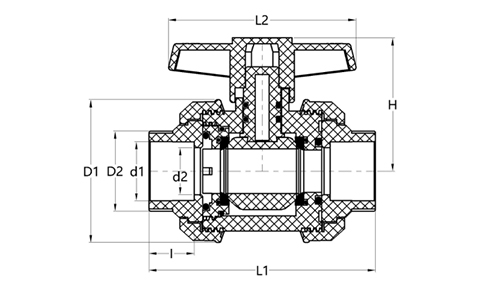
| Size | I | L1 | L2 | d1 | d2 | D1 | D2 | H |
|---|---|---|---|---|---|---|---|---|
| 20 (1/2″) | 17.5 | 87.7 | 65.7 | 21.54 | 15.0 | 50.0 | 29.0 | 47.5 |
| 25 (3/4″) | 18.3 | 95.2 | 79.0 | 26.87 | 20.0 | 60.7 | 34.0 | 56.7 |
| 32 (1″) | 22.3 | 105.3 | 82.9 | 33.65 | 24.4 | 68.0 | 42.0 | 66.3 |
All dimensions in mm. Read the table against the drawing above. Threaded ends are
BSPP: G1/2, G3/4 and G1 against the three sizes.
Pressure rating: PN16 (16 bar, 232 psi), quoted on water at 20 °C. Service
temperature runs to 60 °C maximum, and PVC loses allowable pressure as the line warms
— at 60 °C this body carries roughly half its cold rating, around 8 bar. A pressure
figure without a temperature attached is not a rating, it is a guess, which is why both belong in the
same sentence.
This model is CE marked and moulded under an ISO 9001 system. Those are the two
documents we can put in your inbox today.
It does not carry NSF/ANSI 14 or UPC listing. If the job needs potable-water
listing for the US or Canada, say so before the order — that is a different product with a different
test file, not a certificate we can print afterwards. Every claim on this page is limited to
what the listing actually covers, and on this valve that limit is CE plus ISO 9001.
Four failures account for nearly every return:
Taizhou Zhuoxin Plastics has been moulding pipe and fittings since 1995 — 300 to
350 staff, 50,000 tonnes a year, and a mould shop on the same site as the injection
lines. That is why a non-standard end configuration or a private-label marking is a drawing revision
rather than a tooling programme. Valve bodies and union nuts come off our own moulds, so the seal
face and the nut that loads it are matched by design, not by tolerance stacking.
Fittings, valves and pipe ship on one set of documents, in one container, on a
30-45 lead time. For a distributor building a mixed order, that usually beats a few points on unit price.
In North America the term is true union; in Asian export catalogues it is double union. Both
describe a body that lifts out of the line when you undo the two union nuts.
Yes — that is the whole point. Isolate the line, undo both union nuts, lift the body out, fit the replacement against the existing tail pieces.
No. Isolation only. Throttling a part-open ball erodes the seat, and PVC is not built to absorb that.
Water, most acids and alkalis are fine. Solvents, aromatics and chlorinated hydrocarbons —
acetone, toluene and their relatives — are not. Check the media against a chemical resistance
table before the order, not after.
① Pipe cutting: according to the use requirements, after measuring the appropriate length, the required pipe can be cut by hand or machine. When cutting, keep both ends vertical and flat, and use a file to cut Deburring and sharp edge, but the chamfer should not be too large.
② Bonding of pipes and fittings: before bonding, trial assembly must be carried out, installation position must be determined and marked, length of inserted pipe end (socket depth + 10mm) and inner wall of socket of pipe fittings shall be cleaned,Then wipe with cotton yarn stained with acetone. After acetone volatilizes, evenly brush the adhesive on the outside of pipe end and inside of socket. It should not be too thick, but it should not be missed. Insert after painting and rotate. To the ideal combination angle required for installation, make all the pipes inserted into the socket, fix them by themselves after about 2 to 3 minutes, and wipe off the excess adhesive overflowing from the bonding place to keep the pipe clean. Now cut.Do not force to open or rotate the direction, otherwise it will cause leakage. The adhesive component shall not be subjected to external force within 1 hour, and shall not be watered within 24 hours. The test can be conducted only after the curing time is completed.
③ The pipeline installation must have a reliable seal to ensure that there is no leakage in the process of use. Fixing devices (pipe clamps) shall be installed every 1.5m to 2.0m.
④ Because the plastic pipe has certain plasticity, when the horizontal pipe is installed, the bracket or elevator is set every 0.6m to prevent the plastic pipe from deformation and affect the use.
⑤ The water supply pipe shall be far away from the heat source, and the clear distance between the riser and the stove edge shall not be less than 400mm, and the clear distance between the riser and the heating pipe shall not be less than 200mm.
⑥ After construction, the pipe can be sealed with soil only after passing the pressure test.
⑦ Please refer to the relevant construction specifications of the Ministry of construction for specific installation and use.