Article Introduction
If you’re a plumber or enjoy DIY projects, it’s essential to understand the different products and materials you’re working with. For instance, it’s common with plumbing projects to run into situations where you must combine different materials. One of these most frequent occurrences is when you need to use PVC fittings with CPVC pipe. However, this begs the question of whether you can combine these two materials.
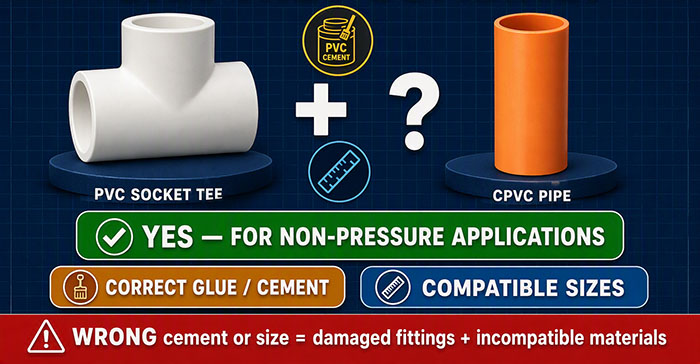
Although PVC and CPVC are two different types of pipe, they’re similar enough that for non-pressure applications, PVC pipe fittings are compatible with CPVC pipe. However, it’s essential to use the correct type of glue or cement and to use pipe and fittings that are compatible in size. Otherwise, you risk damaging your pipe and fittings, and the two materials won’t be compatible.
PVC vs CPVC What’s the Difference?
Every plumber eventually faces the question: can I use PVC fittings on CPVC pipe? The short answer is yes — for non-pressure applications, and only with the right cement and matching size systems. The longer answer involves temperature limits, code restrictions, and two ASTM standards most DIY guides skip. This article walks through all of it.
If you’re mixing materials on a job, read this before you glue anything. Getting the cement wrong is the difference between a joint that holds for decades and one that leaks at the first pressure test.

Considerations For Using PVC Fittings With CPVC Pipe
If you want to use PVC pipe fittings with CPVC pipe, here are a few things to keep in mind.
1. The Size Differentials
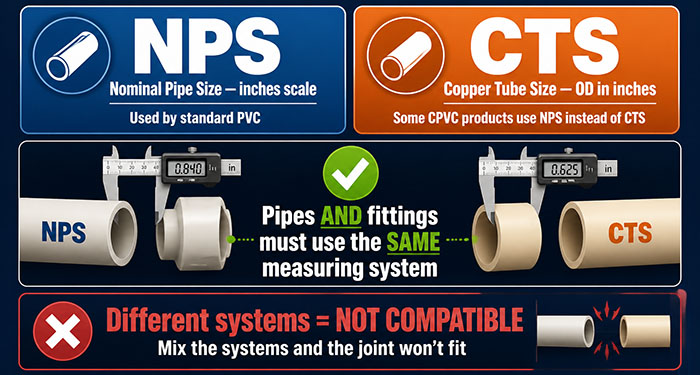
The fact that PVC and CPVC may use different measuring systems makes it very difficult to use the two materials together. However, because some CPVC products use the NPS system and not the CTS scale, it’s possible to combine materials. It’s essential, though, that your pipes and fittings use the same measuring system. Otherwise, they aren’t compatible.
2. Cement and Primer: The Part That Actually Matters
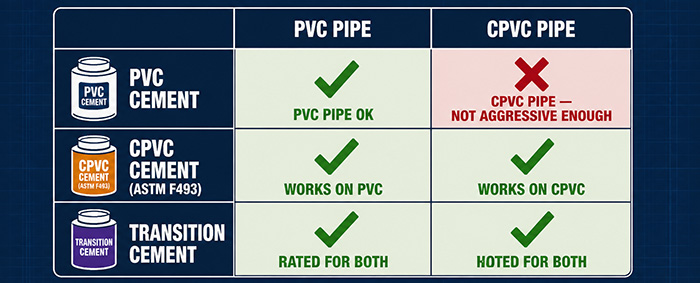
Never use PVC cement on CPVC pipe — PVC solvent cement isn’t aggressive enough to form a proper weld on chlorinated PVC. The reverse works: CPVC cement (per ASTM F493) can be used on both PVC and CPVC, and there are transition cements rated for joining the two materials. In all cases, read the cement label and use the grade the manufacturer specifies for your material combination.
3. Temperature Rating: The Hard Boundary
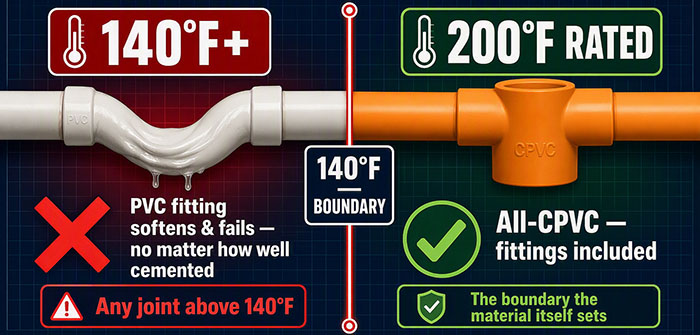
CPVC’s 200°F rating is why it exists. Any joint carrying water above 140°F must be all-CPVC — fittings included. A PVC fitting in a hot-water line will soften and fail, regardless of how well it was cemented. This isn’t a judgment call; it’s the boundary the material itself sets.
How to Use PVC Fittings with CPVC Pipe (Non-Pressure Only)
This procedure applies to non-pressure drain, vent, and condensation lines only. For pressure or hot-water service, use CPVC fittings throughout.
- Dry-fit first. Insert the CPVC pipe end into the PVC fitting — it should seat with a snug, uniform fit. If it’s loose, rattles, or bottoms out crooked, the sizes don’t match; stop here.
- Clean the outside of the CPVC pipe end and the inside of the fitting with CPVC primer or cleaner.
- Apply CPVC cement (ASTM F493) or a listed transition cement to both surfaces — not PVC cement.
- Insert the pipe into the fitting and give it a quarter turn to spread the cement evenly.
- Hold in place for 5–10 seconds, then let it rest for 30 seconds. Full cure takes 24 hours — keep the line dry and unpressurized overnight before any flow or test.

When Mixing Is Acceptable — and When It Isn’t
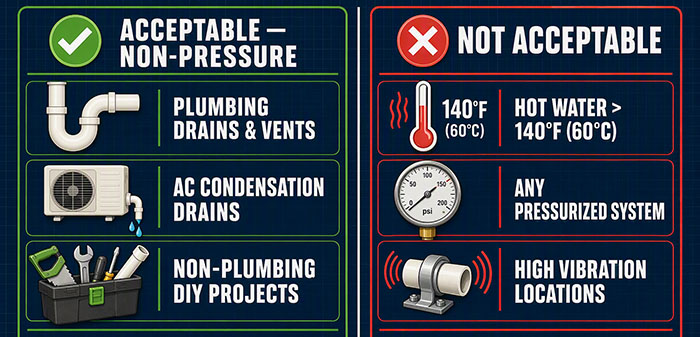
Acceptable (non-pressure): plumbing drains and vents, AC condensation drains, and non-plumbing DIY projects. Even here, check your local code — some jurisdictions require CPVC fittings on CPVC pipe, period.
Not acceptable: hot-water lines above 140°F (60°C), any pressurized system, and locations subject to high vibration. In those services, the mixed joint is a liability — use CPVC fittings with CPVC pipe, or transition properly with a listed fitting.
Frequently Asked Questions
1. Can I use PVC cement on CPVC pipe?
No. PVC cement (ASTM D2564) is not aggressive enough to weld CPVC — the joint will be weak and leak-prone. Use CPVC cement (ASTM F493) or a listed transition cement instead.
2. Is CPVC pipe the same size as PVC?
Both come in NPS sizes, so they can match — but CPVC also comes in CTS, which is smaller. Check the size system on both pipe and fittings, and dry-fit before gluing.
3. Can CPVC fittings be used on PVC pipe?
Yes, with the correct cement. CPVC cement welds both PVC and CPVC, so CPVC fittings on PVC pipe is a safer combination than the reverse.
4. How long does CPVC cement take to cure?
Initial set is a matter of minutes, but full cure takes 24 hours at room temperature. Keep the line dry and unpressurized overnight — “an hour” is not enough for a reliable joint.
About SAM-UK
SAM-UK are a professional 18+ years manufacturer in producing vinyl building profile products and PVC,CPVC, PPH,PPR,PP pipes and pipe fittings, valves, taps and so on. See our certification records and product-specific scope. We support color /size customization. Welcome to consult for Catalog and Product. you can contact us at email [email protected]