PVC Pipe Fitting Certifications Explained: NSF, Watermark, UPC & What They Mean for Your Market
Certifications are the supply chain’s version of a lie detector. Any manufacturer can claim their fittings meet ASTM standards. The ones who can prove it — with third-party lab reports, factory audit records, and current certificates — are playing a different game. Here’s what each certification actually means, which ones matter for your target market, and how to spot the difference between genuine compliance and paperwork.
Why Certifications Matter More Than the Product Spec Sheet
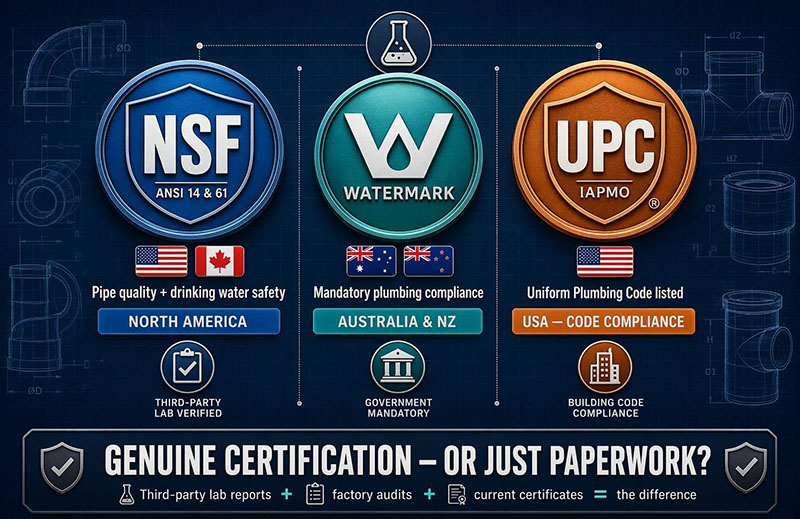
A PVC fitting specification sheet tells you the nominal dimensions and pressure rating the manufacturer claims. A third-party certification tells you someone independent actually tested it. The gap between those two things is where procurement disasters live.
The testing behind certifications like NSF and Watermark isn’t a one-time event. It involves initial product qualification — dimensional checks, material composition analysis, hydrostatic pressure testing, extraction testing for drinking water safety — followed by ongoing surveillance. The certifying body shows up at the factory unannounced, pulls samples from production, and tests them again. If the samples fail, the certification gets suspended. This ongoing monitoring is what makes certifications worth more than a manufacturer’s test report. A test report proves a sample passed once. A certification proves the manufacturer maintains quality consistently.
For B2B buyers, certifications serve three practical purposes. One: they pre-qualify suppliers for regulated markets. You can’t sell PVC fittings for potable water in North America without NSF/ANSI 61 listing. Two: they reduce your incoming QC burden. If the manufacturer is under ongoing third-party surveillance, you’re not the only one checking quality. Three: they provide documentation for your own customers. Municipalities, engineering firms, and government procurement officers routinely require certification proof before approving a supplier.
North America: NSF, UPC, and ETL
NSF/ANSI 61 — Drinking Water Safety
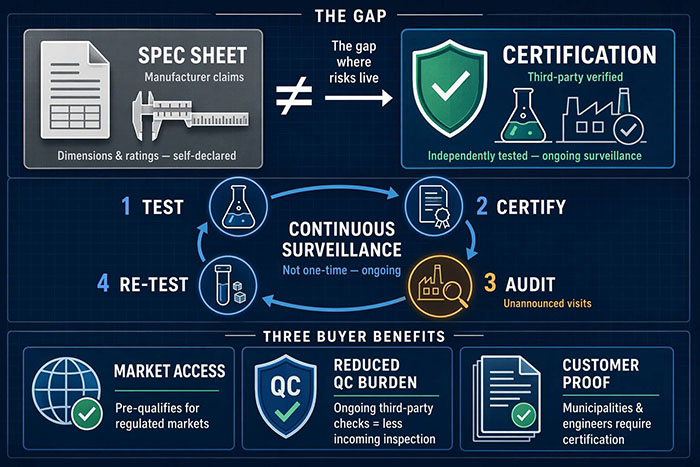
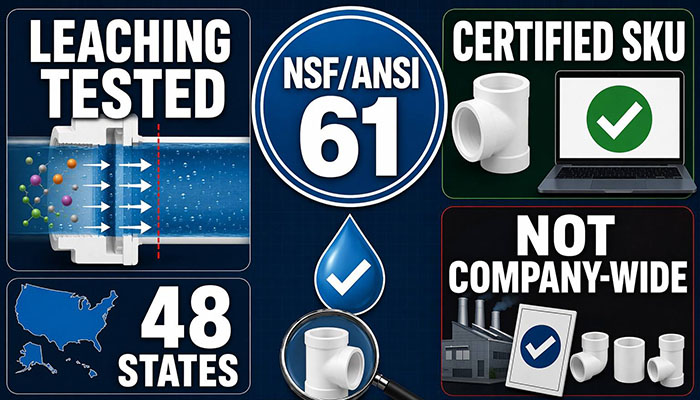
NSF/ANSI 61 is the non-negotiable standard for any PVC fitting that contacts drinking water in the United States and Canada. The testing measures what leaches out of the fitting into water — metals, organic compounds, and other potential contaminants — under standardized exposure conditions. A fitting that passes NSF/ANSI 61 has demonstrated that it does not impart harmful levels of contaminants to drinking water.
The standard is referenced by the U.S. Safe Drinking Water Act and is enforced at the state level through plumbing codes. Forty-eight states require NSF/ANSI 61 compliance for products in public water systems. If you’re supplying PVC fittings for municipal water, commercial plumbing, or residential potable water in North America, this certification isn’t optional.
One thing many buyers miss: NSF/ANSI 61 certification is product-specific, not company-wide. A manufacturer’s listing might cover certain fitting sizes and materials but not others. Always verify that the specific SKU you’re buying appears on the certifying body’s online listing database. “We have NSF certification” doesn’t mean every product they sell is certified.
UPC (Uniform Plumbing Code) — IAPMO Listing
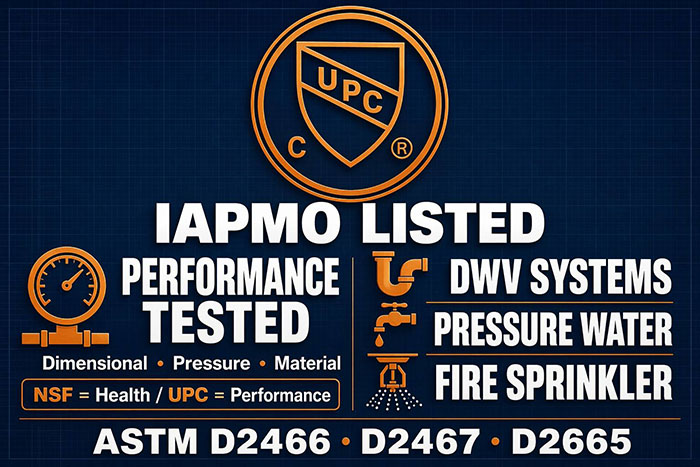
UPC certification, administered by IAPMO (International Association of Plumbing and Mechanical Officials), verifies compliance with the Uniform Plumbing Code adopted by many Western U.S. states and jurisdictions. While NSF focuses on health effects (what leaches into water), UPC focuses on product performance — does the fitting meet dimensional, pressure, and material requirements under the plumbing code?
UPC listing is particularly important for PVC fittings used in building plumbing systems — DWV (drain, waste, vent), pressure water distribution, and fire sprinkler applications. The certification references ASTM standards (D2466, D2467, D2665) but verifies compliance through independent testing rather than manufacturer self-declaration.
ETL — Electrical and Multi-Product Certification
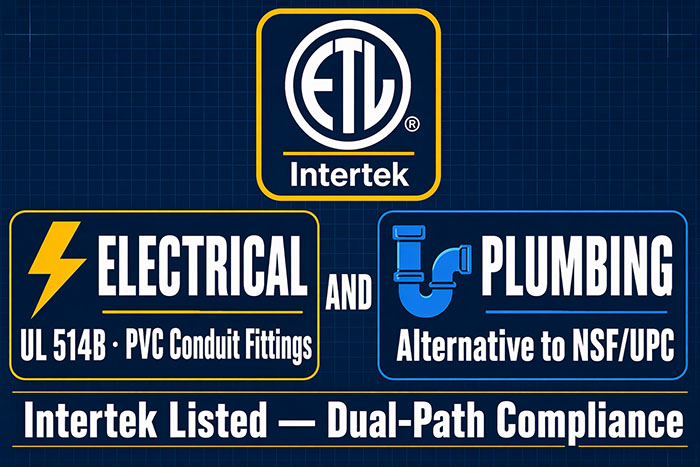
ETL certification, issued by Intertek, is most commonly associated with electrical products but also covers plumbing products including PVC fittings for electrical conduit applications. For PVC fittings used as electrical conduit bodies or accessories, ETL listing confirms compliance with UL 514B and related standards. For plumbing products, ETL provides an alternative path to demonstrating standards compliance alongside NSF and UPC.
CERTIFICATION COMPARISON
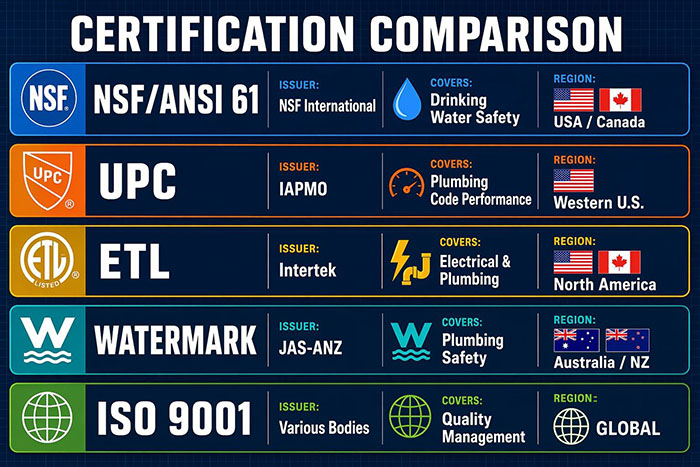
| Certification | Issuing Body | What It Covers | Required In |
|---|---|---|---|
| NSF/ANSI 61 | NSF International | Drinking water safety — contaminant leaching | U.S., Canada potable water |
| UPC | IAPMO | Plumbing code compliance — product performance | Western U.S. states, various jurisdictions |
| ETL | Intertek | Electrical conduit & plumbing product compliance | North America |
| Watermark | JAS-ANZ accredited bodies | Plumbing & drainage product safety | Australia, New Zealand |
| ISO 9001 | Various accredited bodies | Quality management system | Global — baseline requirement |
Australia & New Zealand: Watermark Certification
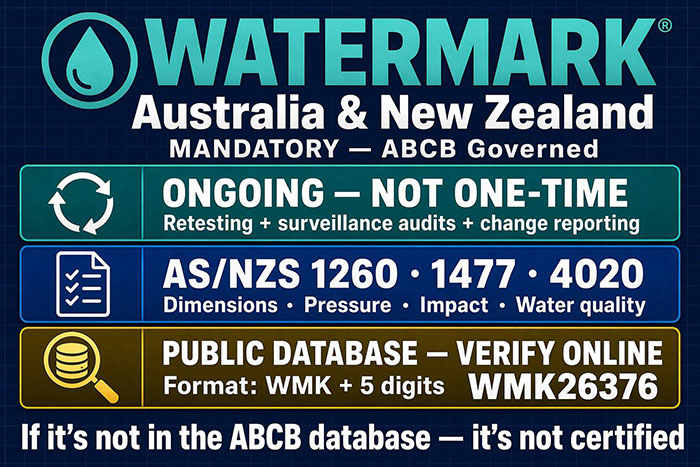
Watermark is Australia’s mandatory certification scheme for plumbing and drainage products, governed by the Australian Building Codes Board (ABCB) and administered by JAS-ANZ accredited certification bodies. AS/NZS 4020 is the testing standard for products in contact with drinking water — Australia’s equivalent of NSF/ANSI 61.
The Watermark certification process is rigorous. Products are tested to the relevant Australian/New Zealand Standard — for PVC fittings, that typically means AS/NZS 1260 for PVC-U pipes and fittings for pressure applications, or AS/NZS 1477 for PVC pipes and fittings for pressure and non-pressure applications. The testing covers dimensions, material properties, hydrostatic pressure performance, impact resistance, and effect on water quality (AS/NZS 4020).
What makes Watermark particularly demanding for international manufacturers is the ongoing conformity requirements. Certified products must be retested periodically, the manufacturer’s quality system undergoes regular surveillance audits, and any changes to product formulation, design, or manufacturing process must be reported and may require recertification. This is not a one-and-done certification — it’s an ongoing commitment that requires dedicated compliance resources.
For B2B buyers sourcing PVC fittings for the Australian market, Watermark license verification is straightforward: the ABCB maintains a public database of certified products. If a manufacturer claims Watermark certification but doesn’t appear in that database, the claim isn’t valid. A Watermark license number starting with “WMK” followed by five digits — e.g., WMK26376 — is the standard format.
What It Means When a Manufacturer Holds All of Them
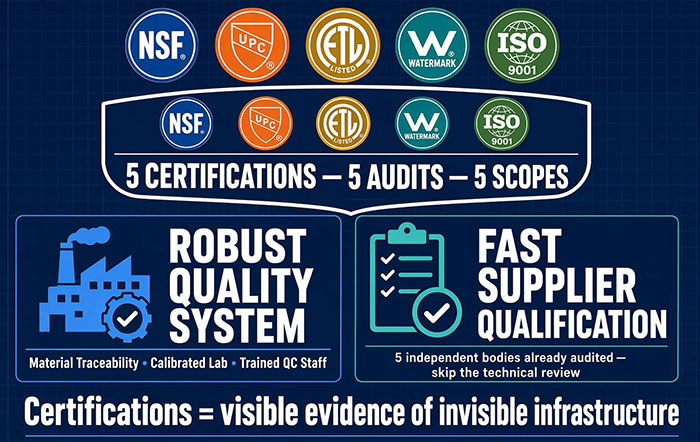
A PVC fitting manufacturer holding NSF, UPC, ETL, and Watermark simultaneously — plus ISO 9001 — has passed audits from five separate certifying bodies. Each audit covers different scope: NSF checks material safety, UPC checks plumbing code compliance, ETL checks electrical safety requirements, Watermark checks Australian plumbing standards, and ISO 9001 checks the quality management system itself.
The operational reality behind this is significant. A manufacturer maintaining five certifications is running an internal quality system robust enough to satisfy multiple auditors with different checklists and priorities. They have documented raw material traceability, calibrated testing equipment, trained QC staff, and corrective action procedures that work. The certifications are the visible evidence. The underlying infrastructure — the quality system, the testing lab, the documentation discipline — is what actually delivers consistent products.
For procurement teams, a multi-certification manufacturer reduces supplier qualification time. Instead of auditing the factory yourself to verify quality systems, you can rely on the fact that five independent bodies already have. That’s not a substitute for commercial due diligence — pricing, capacity, delivery reliability still need your own evaluation — but it shortcuts the technical qualification phase significantly.
How to Verify Certifications: A Practical Checklist
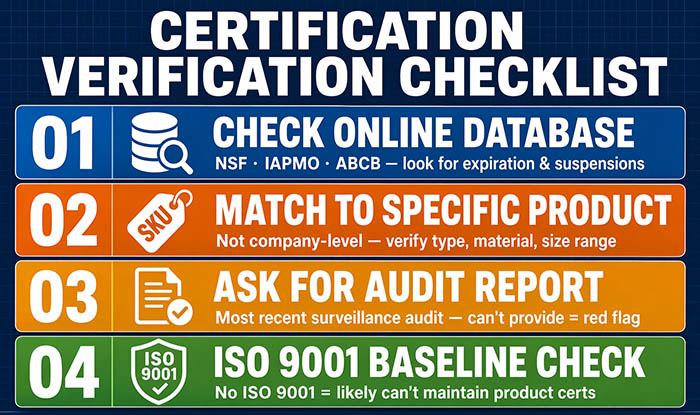
- Check the online database. Every major certifier maintains a searchable online listing of certified products. NSF, IAPMO (UPC), and ABCB (Watermark) all have public databases. Verify the certification is current — look for expiration dates and suspension notices.
- Match the certificate to the specific product. A company-level listing doesn’t cover all SKUs. Verify the exact product type, material, and size range you’re buying appears on the certificate scope.
- Ask for the most recent surveillance audit report. A legitimate manufacturer under ongoing certification should be able to provide their most recent audit summary. If they can’t or won’t, the certification may be expired or limited.
- Check for ISO 9001 as the baseline. ISO 9001 isn’t a product certification, but it’s the minimum quality management framework. A manufacturer without ISO 9001 almost certainly doesn’t have the systems in place to maintain product certifications.
Frequently Asked Questions
What’s the difference between NSF/ANSI 61 and NSF/ANSI 14?
NSF/ANSI 61 covers health effects — what leaches from the product into drinking water. NSF/ANSI 14 covers physical performance — dimensions, pressure ratings, material properties. Many PVC pipe and fitting products carry both certifications. For potable water applications, NSF/ANSI 61 is the health-effect standard referenced by plumbing codes.
Do I need Watermark certification to sell PVC fittings in Australia?
Yes — for plumbing and drainage applications. The Watermark Certification Scheme is mandatory under the National Construction Code (NCC) for plumbing products installed in Australia. Products without Watermark certification cannot be legally installed. The certification must cover the specific product, not just the manufacturer.
How often are PVC fitting certifications audited?
Most certifying bodies conduct annual surveillance audits at minimum, with some requiring semi-annual or quarterly follow-up testing depending on the product and risk profile. NSF typically requires annual unannounced facility audits plus periodic product retesting. Watermark requires regular surveillance audits and periodic retesting to the applicable standard.
Is ISO 9001 enough for PVC fitting quality assurance?
No. ISO 9001 certifies the quality management system — documentation, process control, corrective action — but does not test product performance against specific standards. ISO 9001 is the foundation. Product certifications like NSF, Watermark, and UPC build on that foundation by testing the actual products to specific performance and safety standards.
Can a manufacturer lose their certifications?
Yes — and it happens more often than buyers realize. Certifications can be suspended or revoked for failed surveillance tests, missed audit deadlines, unauthorized product changes, or failure to address non-conformances. Before placing a large order with a certified manufacturer, verify the certification status on the issuing body’s public database — not just the certificate the manufacturer provides.
About SAM-UK
SAM-UK are a professional 20+ years manufacturer in producing vinyl building profile products and PVC , CPVC , PPH , PPR , PP pipes and pipe fittings, valves, taps and so on. We own the certificates of SGS\SONCAP\ISO9001\ISO15874\CE\NSF\UPC\ETL\Watermark,support color /size customization. Welcome to consult for Catalog and Product. you can contact us at email [email protected]