Introduction
PVC pipe recycling is a real material-recovery programme with real tonnage behind it — and hard limits on where that recovered material is allowed to go.
Sustainability brochures all make the same move. A loop, a leaf, a percentage. What they leave out is the part that actually protects the buyer: which product line the recycled content sits in. That omission outweighs any badge on the cover. On a potable pressure main, the recycled content is almost never in the pipe you are ordering, and a supplier who hints otherwise is either confused or selling you something you did not ask for.
Why PVC pipe is a cleaner recycling story than mixed plastic
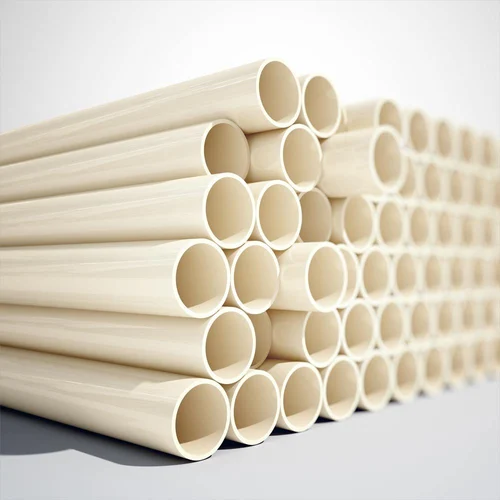
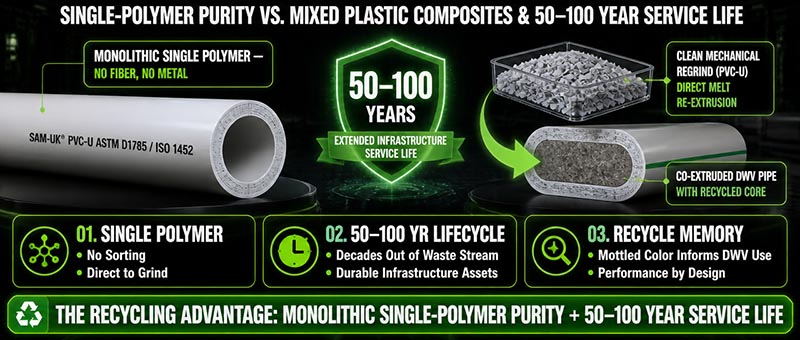
Construction plastics are a sorting nightmare. Cable, laminates, foils, fibre-reinforced composite — pull one stream out and you still fight the rest. PVC pipe is not that mess. A standard PVC pressure or drainage pipe is a single polymer with no fibre reinforcement and no metal core, so a demolition load can go straight to grind without a density-separation tank.
The advantage compounds. Pipe sections come back as one recognizable stream, and that consistency is what makes clean regrind possible at all. Compare it to a mixed-plastic bale, where the recycler burns more energy separating polymers than it ever recovers in value. That single-material geometry is the entire reason pipe recyclate is worth collecting in the first place.
Service life carries the same argument, though for a different reason. PVC pipe is commonly cited at a service life of 50 to 100 years — an industry figure, not a guarantee for every buried run. A pipe that lasts a century is not a recycling problem; it is a resource that stays out of the waste stream for a very long time. The credible claim for PVC pipe has never been recycled content. It is service life plus recoverability.
There is a practical catch worth knowing. Recycled PVC keeps some memory of its former job. UV-stabilised grey or white pipe that gets ground and reused in a new product tends to show up as mottling and a measurable drop in impact strength. That is why recycled-content drainage is so often supplied in a dark or natural colour. The colour is not a design choice — it is the material telling you where it came from.
What actually gets recycled — and into what
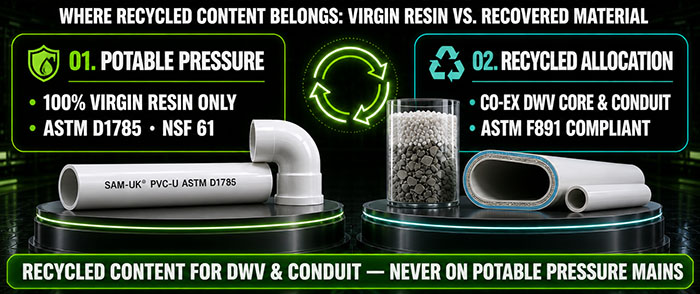
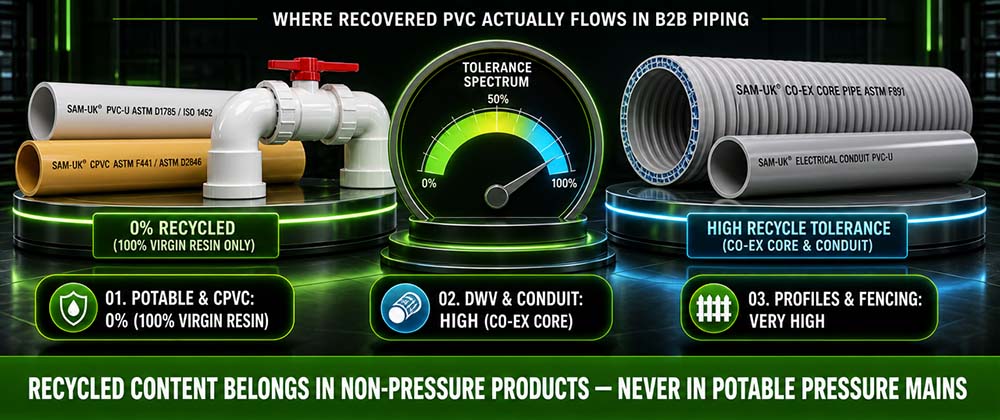
Recyclate does not flow into the entire PVC catalogue. It concentrates where hygiene is not a test criterion and pressure is not the job. Get this table wrong and a whole specification falls apart.
| Application | Recyclate tolerance | Constraint |
|---|---|---|
| Non-pressure drainage & sewer | High — up to 100% in some cores | Loss of impact strength and colour shift; must still meet ring stiffness |
| Electrical conduit | High | Impact and thermal duty still apply |
| Non-potable irrigation | Moderate | Lighter hygiene rules, but UV and pressure class unchanged |
| Profiles, fencing, flooring | Very high | No pressure duty, so recyclate is easy to place |
| Potable pressure pipe | Very low to zero | Hygiene and material-consistency tests; lot traceability |
| Hot-water pressure (CPVC) | Zero | Temperature duty plus hygiene rules exclude recyclate entirely |
Line five is where the honest conversation happens. Recycled content is genuinely difficult to use in potable pressure pipe because of hygiene rules and material-consistency requirements. You cannot blend a variable regrind into a line that must hold a fixed hydrostatic rating and pass a drinking-water test, lot after lot, year after year. The recyclate belongs in non-pressure and non-potable products, and that is precisely where it flows.
So when a datasheet shouts “100% recycled pipe,” read the fine print. Far more often than not, the recycled line is a drainage pipe, a conduit, or a profile — never the pressure main in your tender. That is not dishonesty in every case. It is a real claim that has been stretched to cover a product it was never meant for, and buyers who do not ask the product-line question pay for that gap.
The EU rulebook — and what it means for imported goods
Europe has moved faster than any other market, and its rules now shape what buyers everywhere request. The European PVC industry programme VinylPlus reported recycling more than 810,000 tonnes of PVC in 2023, as recorded in its 2024 progress reporting. The programme’s stated target is at least 900,000 tonnes per year by 2025, with an ambition in the region of one million tonnes per year by 2030. Treat those forward figures as targets, correct as of 2024–2025 reporting, not as results already banked.
Regulation has run alongside the voluntary programme. Over roughly the past decade, the EU’s REACH framework has progressively pushed lead-based stabilisers out of PVC and placed restrictions on certain phthalate plasticisers, with several of those restrictions taking effect through the mid-2020s. The direction of travel is one-way. Describe the trend rather than betting your compliance plan on one effective date you cannot confirm, because enforcement timetables keep moving.
For anyone importing pipe or fittings into Europe, the consequence is concrete. Substance-level compliance is now a procurement line item, not a footnote. Material declarations and substance documentation are routinely requested at tender stage, and a supplier who cannot produce them stalls the order before price is even discussed.
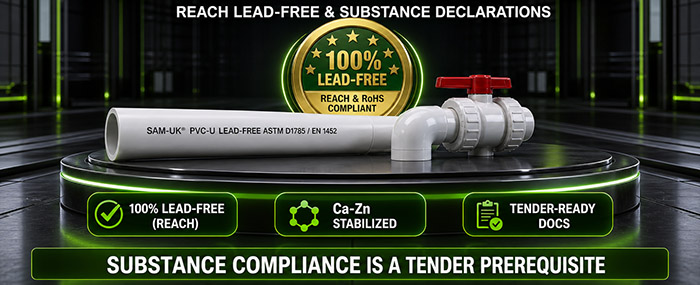
None of this changes when you buy from Asia. SAM-UK, the export brand of Taizhou Zhuoxin Plastics Co., Ltd. — producing pipe and fittings from Taizhou, Zhejiang since 1995, with OEM programmes and standard lines covering PVC and uPVC pipe and fittings, CPVC, PPH and PPR — fields the same recycled-content question as any European extruder. The only good answer names the product line first and the document second.
Telling a real claim from greenwash
You do not need a chemistry lab to separate a sustainability claim from a slogan. You need to ask where the recycled content lives, then ask for the paperwork that proves it.
- Which product line carries the recycled content — pressure or non-pressure?
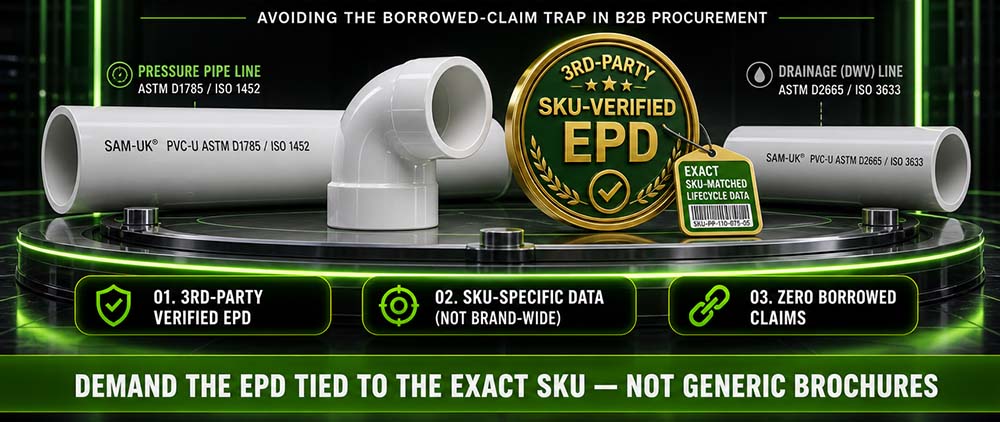
- Is there a third-party verified or published EPD for that exact product?
- Will the supplier provide a material declaration and chain-of-custody on request?
- Has the potable or pressure version been tested against a hygiene standard, or is the claim borrowed from a drainage product?
- Is the recycled percentage stated by weight or by unit — and across the whole product or only one layer?
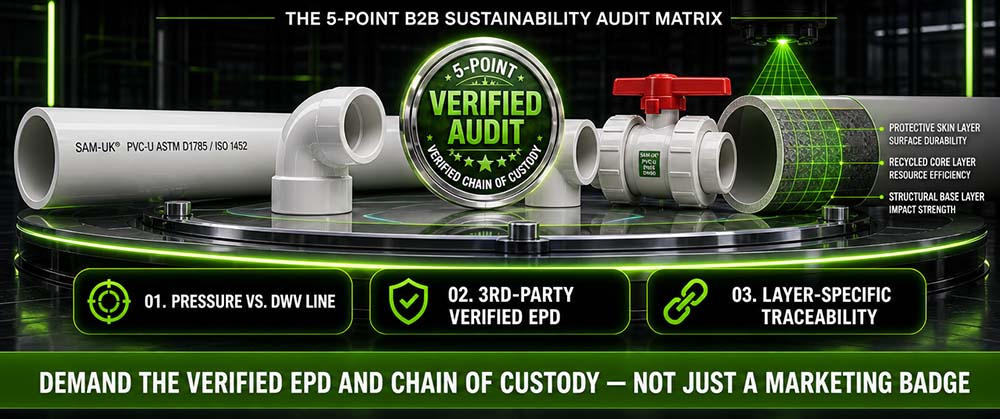
An EPD, or environmental product declaration, is the one document that pulls all of this into a comparable form. A third-party-verified EPD is worth more than any in-house green logo, because a verifier can be held to the numbers on the page. When a supplier declines to provide one and hands you a brochure instead, that refusal is your answer.
Watch for the borrowed-claim trick in particular. A maker advertises recycled content across its drainage range, then reuses the same line in the marketing of its pressure pipe. The percentage is real. It just belongs to a different product. Ask for the declaration tied to the exact SKU you are buying, not the brand family, and the trick stops working.
Long service life versus end-of-life recovery
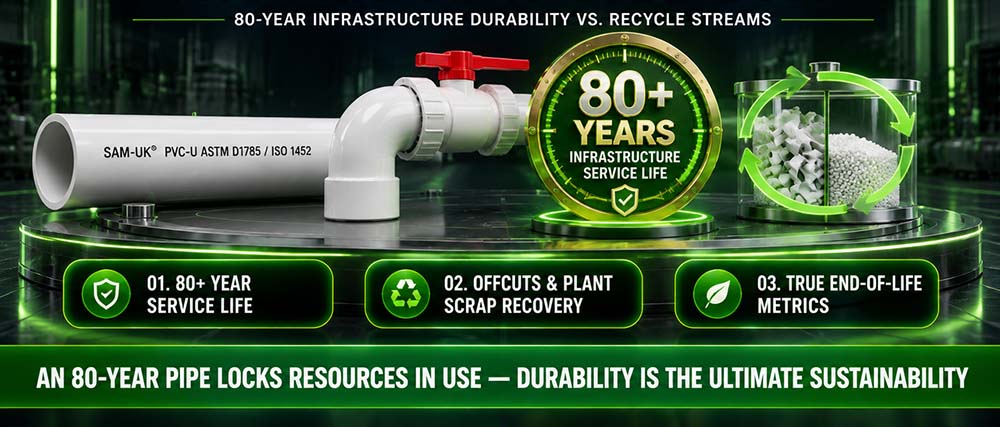
Here is the tension nobody prints on the label. A pipe that lasts 80 years is a fantastic product and a slow recycling contributor, because it delays its own recovery by nearly a century. That is not a defect in the material. It is the point of buying durable pipe — but it does mean recyclers cannot lean on a large, near-term volume of end-of-life pipe the way they lean on short-life packaging.
Most recovered pipe today arrives from construction offcuts, in-plant manufacturing scrap, and renovation strip-outs, not from pipe that reached the end of a full service life. The rate that matters is end-of-life recovery, not recycled content at the factory gate. Those two numbers get confused constantly, and the confusion usually favours whoever is selling.
Where the industry lands by 2030
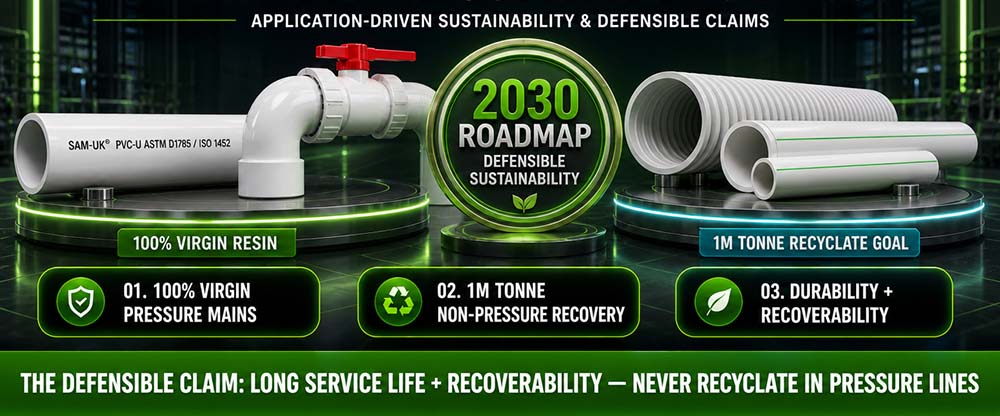
The trajectory is clear enough. Europe is pushing toward roughly a million tonnes of PVC recycled per year by 2030, and non-pressure applications will absorb most of the growth. Recyclate will keep consolidating in drainage, conduit, and profiles, because those products have no hygiene test standing in the way and no pressure rating to defend.
Pressure pipe will not flip to recycled content at any meaningful scale by 2030, and buyers should stop waiting for it to. The smarter move is to specify what is genuinely deliverable: durable virgin pressure pipe with a documented service life, and recycled material credibly placed in the non-pressure products built to use it.
Frequently Asked Questions
Is recycled PVC pipe safe for drinking water?
Recycled content is largely kept out of potable pressure pipe because of hygiene and material-consistency requirements. Drinking-water pipe is normally made from virgin compound that meets a defined hygiene standard; recycled material is placed in non-potable and non-pressure products instead.
Can 100% recycled PVC pipe be used for pressure applications?
Rarely, and never for potable or hot-water duty. A variable recycled blend cannot reliably hold a fixed hydrostatic rating lot after lot. Where a “100% recycled” claim appears, the product is almost always drainage, conduit, or a profile — not a pressure main.
How much PVC does Europe actually recycle?
The industry programme VinylPlus reported more than 810,000 tonnes recycled in 2023, against a target of at least 900,000 tonnes per year by 2025 and an ambition of around one million tonnes per year by 2030. Treat the 2030 figure as a target, not a result.
Why is PVC pipe easier to recycle than other construction plastics?
It is a single polymer with no fibre reinforcement and no metal core, so a demolition load can be ground without density separation. That consistency is what makes clean regrind possible.
How do I check a supplier’s recycled-content claim?
Ask which product line carries the recycled content, then request a third-party-verified EPD, a material declaration, and chain-of-custody for that exact SKU. A verified EPD is worth more than an in-house sustainability logo.
Does a long service life work against recycling?
It delays recovery, but that delay is the value of durable pipe. What matters is the recovery rate at end of life, not recycled content at the factory gate — the two numbers are routinely confused.
About SAM-UK
SAM-UK are a professional 20+ years manufacturer in producing vinyl building profile products and PVC , CPVC , PPH , PPR , PP pipes and pipe fittings, valves, taps and so on. See our certification records and product-specific scope. We support color /size customization. Welcome to consult for Catalog and Product. you can contact us at email [email protected]