PVC vs HDPE Pipe Comparison: Which Wins for Underground Water and Industrial Lines?
This is a working comparison for procurement managers, utility engineers and industrial project teams who have to pick between PVC and HDPE pipe and defend the choice in a tender review. It covers joining methods, pressure rating systems, buried behavior, cold-weather limits and honest cost signals — and it ends with a firm recommendation instead of a wishy-washy “it depends.” Short version: for most budget-driven municipal water mains in temperate ground, gasketed PVC wins on speed and price; for ground movement, cold climates, trenchless work and anywhere a fused leak-free joint matters, HDPE is the right call.
Quick Verdict: Who Wins, and Where
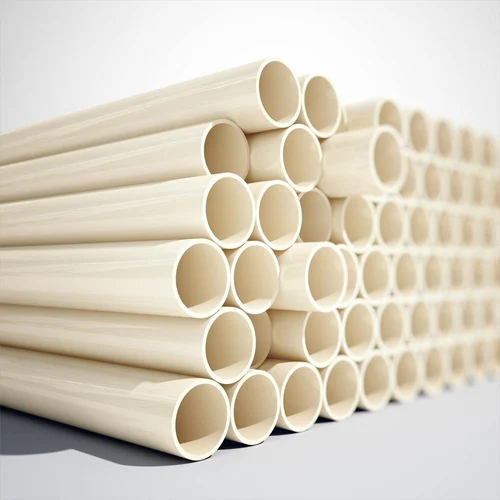
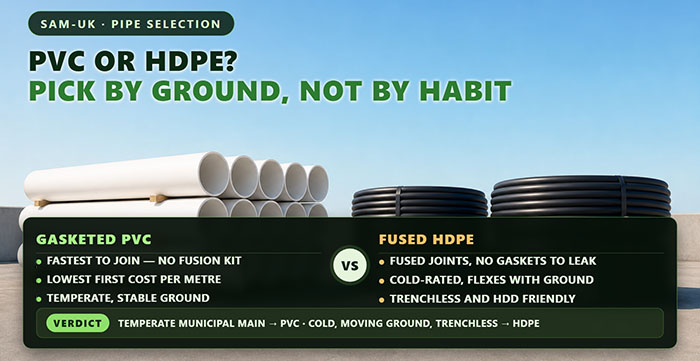
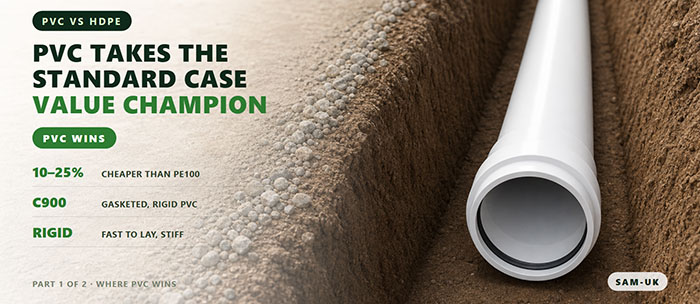
Stop reading here if you only want the answer. PVC (specifically AWWA C900 gasketed pipe) is the value champion for buried potable water distribution in normal soils — it is rigid, stiff, quick to lay, and almost always 10–25% cheaper on the pipe supply package than an equivalent PE100/PE4710 line.
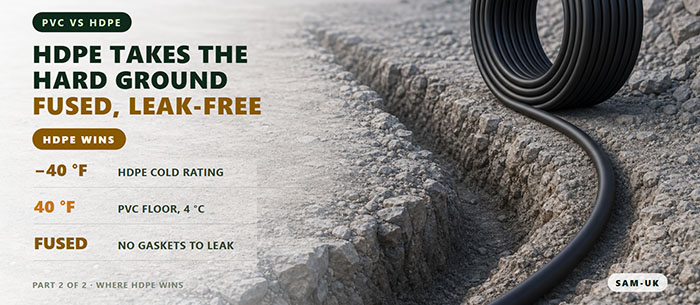
HDPE takes the project when conditions turn hostile. Expansive or settling ground, seismic zones, frost heave, rock trenches, directional drilling, pipe bursting — in those settings the fused HDPE joint is not a feature, it’s the whole argument. And no contractor should ever drop PVC below roughly 40°F (4°C) without accepting impact damage risk, while HDPE shrugs off cold to about -40°F (-40°C).
One more line, because someone always asks: neither pipe is “stronger” in absolute terms. PVC is stiffer and creep-resistant; HDPE is tougher and fatigue-resistant. They just fail differently, and you should pick based on what your site threatens to do to the pipe.
Material Properties Side by Side: PVC Pipe vs Polyethylene
Before the table, one physical fact that explains half of all field behavior: PVC resin has a specific gravity around 1.40, HDPE around 0.955. That means PVC sinks in water and HDPE floats. Sounds trivial until you build a line through a high water table and realize your empty PE main wants to surface like a submarine, while PVC sits there and behaves.
| Property | PVC (uPVC / C900 / sch 40-80) | HDPE (PE100 / PE4710) |
|---|---|---|
| Density (specific gravity) | ~1.40 — sinks, stable in high groundwater | ~0.955 — floats; needs ballasting if trench floods |
| Stiffness / modulus | High (~400,000 psi); rigid ring, carries load itself | Low (~110,000 psi); flexible, relies on soil support |
| Continuous service temperature | Max ~140°F (60°C), derate with pressure above 73°F | Pressure service derated above 73°F; PE4710 keeps 1,000 psi HDS up to 140°F |
| Impact & low temperature | Brittle below freezing; handle with care under ~40°F | Excellent impact to about -40°F (-40°C) |
| Bending / coiling | None — straight sticks, 20 or 40 ft | Coilable in smaller sizes; bends around obstacles |
| Joining | Solvent cement, gasket (push-on), threaded small sizes | Butt fusion, electrofusion, mechanical |
| Abrasion resistance | Good | Excellent — standard choice for slurry lines |
| UV exposure | Needs UV stabilizers; prolonged sun causes chalking/embrittlement | Needs 2–2.5% carbon black for outdoor service |
| Pressure rating basis | ASTM D1785 / D2241 / AWWA C900; HDB 4,000 psi @73°F | ASTM D3035 / AWWA C901-C906 / ISO 4427; MRS-based |
The table hides the detail that matters most: these are different structural philosophies. PVC is a rigid pipe — it carries the soil load through its own ring stiffness, and a mediocre backfill job still leaves you a working line. HDPE is a flexible pipe — it deflects and transfers load into the surrounding soil, which means compaction quality is not optional. Skip the sidefill compaction on PE and you get ovality, and ovality quietly eats pressure capacity.
On the other hand, HDPE creeps. That’s not a flaw, it’s physics — polyethylene relaxes under sustained load, which is exactly why its ratings are built on long-term hydrostatic strength (LTHS) extrapolated to 100,000 hours per ISO 9080 and ASTM D2837. PVC creeps far less, so a PVC wall thickness holds its geometry over decades. Design life for both is routinely taken at 50–100 years; just understand you’re buying two different long-term behaviors.
Connection Methods: Where Projects Succeed or Fail in the Field
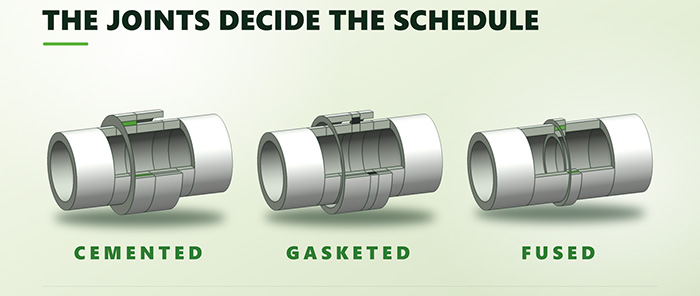
Ask any water utility contractor what drives schedule risk and they won’t say the pipe — they’ll say the joints. PVC solvent welding needs dry, clean surfaces, primer, and cure time before pressure testing; below about 60°F (15°C) cure stretches well beyond the printed 24 hours, and crews who pressure up too early learn the lesson through a sprinkler effect at every joint.
Gasketed push-on PVC — the Rieber-type joint with an elastomeric seal to ASTM F477, assembled per ASTM D3139 — is the workhorse answer: stab it home and you can pressure-test the same day. No cure time. That speed is why gasketed C900 dominates North American water main installation. The tradeoff: every fitting, bend, tee and valve on a gasketed line needs thrust blocking or mechanical joint restraint, because water pressure will otherwise blow the joint apart. Concrete thrust blocks at every change of direction is normal, accepted cost.
HDPE flips the picture. Butt fusion welds pipe into one continuous, monolithic string — no elastomers, no cement, no thrust blocks needed on fusion runs. A properly made fusion joint is stronger than the pipe wall itself. But that “properly made” is doing heavy lifting: fusion demands a clean machine, trained operator, and dry faces. We’ve seen fusion joints fail years later because the crew fused in rain or didn’t wipe the heater plate, and you cannot inspect a fusion weld afterward — it either holds for 40 years or lets go at 2 a.m. under full pressure.
Small-diameter field math is worth stating plainly. A 2-inch PVC line with socket joints: two guys, a brush and cement, minutes per joint, but you wait on cure. A 2-inch HDPE line: socket fusion tools and careful temperature control, or mechanical compression fittings that cost real money. Below about 4 inches, PVC’s labor advantage is genuine; above that, and especially on long straight runs, coiled HDPE laid out in 500–1,000 ft pulls drastically cuts joint count. Electrofusion fittings are the repair-and-tie-in specialist — expensive per fitting but no heavy machine and no trench-side welding, which is why every HDPE utility keeps a box of them in the truck.
Pressure Ratings and Standards: Don’t Mix Rating Systems
Here is where spec writers get burned, and I’ll be blunt: you cannot compare a “16 bar” PE pipe to a “235 psi” PVC pipe without knowing which rating philosophy produced each number.
PVC pressure pipe is rated from a hydrostatic design basis (HDB) of 4,000 psi at 73°F (23°C) for standard PVC 1120 compound. Three systems cover almost everything you’ll buy: ASTM D2466 (schedule 40 and schedule 80), ASTM D2241 (SDR dimension-ratio pressure-rated pipe), and AWWA C900 for gasketed water main — which today lists pressure classes of 165 psi at DR25, 235 psi at DR18 and 305 psi at DR14 in sizes up to 12 in (newer editions extend the range to 60 in with more classes).

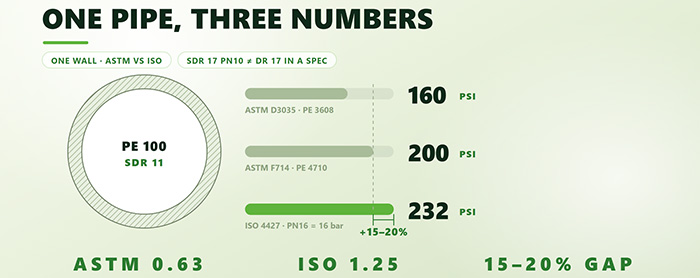
HDPE lives in a different alphabet: ASTM D3035 and F714, AWWA C901/C906, and ISO 4427 for PE water pipe. Resin grades matter first — PE80 carries a minimum required strength (MRS) of 8 MPa; PE100 carries 10 MPa, and in North America you’ll more often see PE3608 and PE4710 designations, where PE4710’s higher strength allows the same DR to carry more pressure. Concrete example: DR11 wall in PE3608 is rated around 160 psi, while DR11 in PE4710 reaches roughly 200 psi under ASTM methods.

Now the trap. That same SDR11 PE100 pipe sold to ISO 4427 is rated PN16 — 16 bar, about 232 psi — because ISO allows a more generous design factor. Same wall, same resin, three different numbers depending on which standard you cite. And the reverse trap: imported “SDR17 PN10” HDPE and American “DR17” HDPE are not automatically interchangeable in a spec, even though they sound identical. If you tender HDPE, state the standard explicitly. ASTM uses a 0.63 design factor for PE4710 in water service; ISO works on a safety factor of 1.25 (0.8 design factor) — that ~15–20% gap is real money and real risk.
Temperature derating deserves its own warning. Every pressure rating above assumes 73°F. Push PVC toward its 140°F ceiling with pressure in the line and you must consult the manufacturer’s derating table — the curve falls off steeply. HDPE behaves better at elevated temperature because PE4710 maintains its 1,000 psi hydrostatic design stress up to 140°F, but both materials still derate. Hot water above 140°F is CPVC or PPR territory, full stop.

Buried Performance: Rigid Pipe vs Flexible Pipe
Underground, the two materials stop competing on chemistry and start competing on mechanics. PVC’s high ring stiffness means the pipe itself resists the soil load; bedding still matters, but minor compaction sins rarely kill a PVC line. That stiffness is also why PVC can’t follow ground movement — when a trench settles unevenly or a tree root or frost jacking pushes, PVC resists until it cracks.
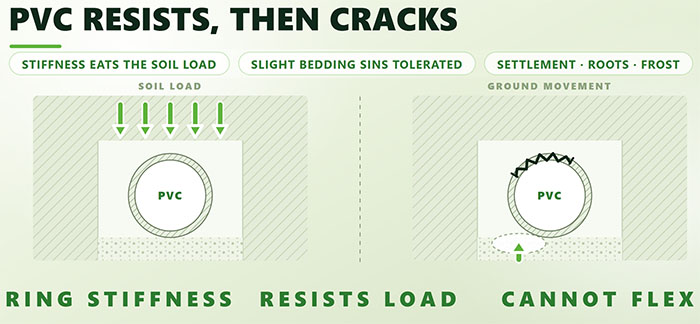
HDPE is a flexible conduit. Installed per ASTM D2321, with proper embedment and compaction — typically 90–95% of standard Proctor on the sidefill — it deflects under load and lets the soil arch carry the weight. Design deflection limits run around 5% long-term, with 7.5% as an absolute cap in most guidance. Get the compaction wrong and the pipe ovalizes; severe ovality reduces flow area and can drop the pipe’s pressure capacity below what the label claims.

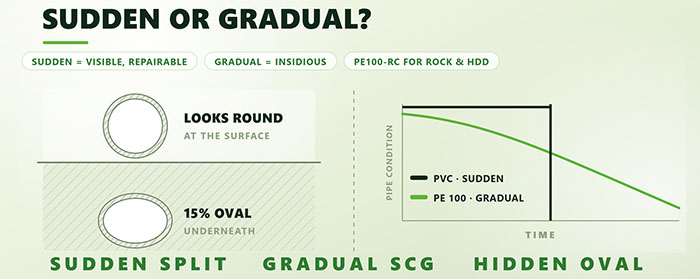
Which failure is worse? Honest answer: a PVC line fails suddenly (brittle crack), an HDPE line fails gradually (slow crack growth or excessive deflection). Sudden is dramatic but visible and repairable; gradual is insidious — utilities have dug up PE lines that looked round at the surface and were 15% oval underneath. Slow crack growth (SCG) resistance is precisely why modern PE100/PE4710 resins exist, and PE100-RC grades take it further for point-loading situations like rocky trenches and directional drilling.
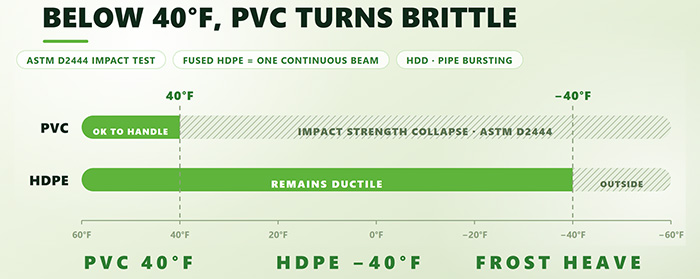
Cold climates settle the matter fast. PVC loses impact strength as mercury drops; standard handling guidance says don’t drop, ship or roughly handle it below about 40°F, and impact tests (ASTM D2444) show the fracture energy collapse. HDPE remains ductile to roughly -40°F. Frost heave and differential settlement also favor the flexible pipe — fused HDPE is effectively one continuous beam that bends instead of breaking, which is why seismic-conscious utilities and operators on expansive clay spec it. And for trenchless installation — horizontal directional drilling and pipe bursting — HDPE is essentially the only sane choice; you can’t pull a rigid, non-fusible PVC string through a borehole.
Cost: HDPE vs PVC Over the Full Lifecycle
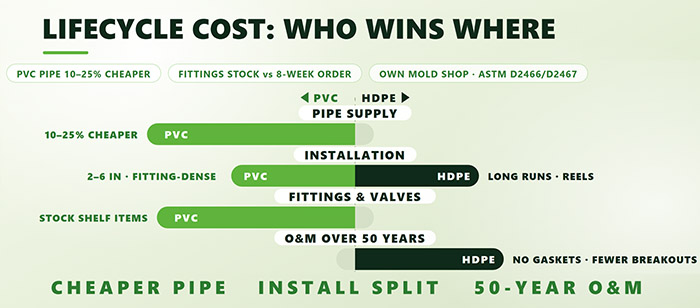
Let’s talk money without pretending to quote your local market. On the pipe supply alone, PVC routinely undercuts HDPE — commonly by 10–25% on equivalent pressure-rated water main in North American and European tenders. PVC compound is cheaper per kilo and, at comparable pressure classes, PVC walls are not dramatically thicker than PE walls. That gap is real and it’s why so many municipal buyers default to PVC.
Installation cost bends the curve both ways. Gasketed PVC installs fast and needs no fusion equipment — on small-diameter work (2–6 in), the labor and equipment advantage is squarely PVC’s. On large long runs, coiled HDPE delivered on reels cuts joint count and trucking, and fusion crews, though more expensive per hour, produce fewer joints overall. Rule of thumb we use in the field: the bigger and longer the job, the more HDPE’s logistics win back; the smaller and more fitting-dense the job, the more PVC’s simplicity wins.
Operations and maintenance over 50 years favors the fused PE line in one specific way: it has no elastomeric gaskets to age and no cement joints to creep. PVC gaskets are proven over decades, but they are still a maintenance item in aggressive soils or with poor installation. Conversely, PE’s flexibility means fewer ground-movement breakouts — and every avoided repair on a buried main pays for a lot of pipe.
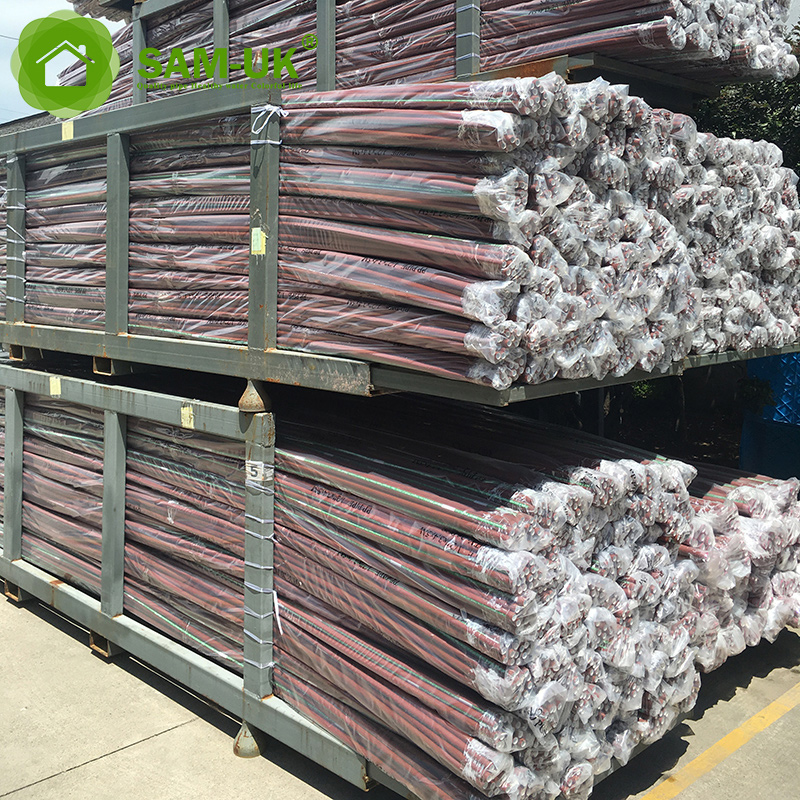
One cost item most comparisons skip: fittings and valves. PVC fittings — sockets, gasketed couplings, elbows, tees, and true-union valves — are stock items in every supply house, in sch 40, sch 80 and C900 classes. HDPE needs fusion fittings or electrofusion couplings, which are pricier and thinner on the shelf in smaller towns. If your project timeline is six weeks and the HDPE electrofusion fitting order is eight, that’s a cost no spreadsheet predicted. This is where a full-line PVC manufacturer earns its keep — a supplier that molds its own fittings and valves to ASTM D2466/D2467 with consistent geometry (SAM-UK in Taizhou has run its own mold shop since 1995, at 50,000 tons a year capacity, NSF/UPC/ETL and ISO 9001 certified) removes the sourcing risk from the critical path.
ecision Framework: Matching Pipe to Project Conditions
Use this as a working matrix, not gospel. It condenses what we’ve covered into project conditions → recommendation, because underground pipe material selection is a conditions game.
| Project condition | Recommendation | Why |
|---|---|---|
| Municipal water main, normal soil, budget-driven, temperate climate | PVC (AWWA C900, gasketed) | Lower material cost, same-day pressure test, rigid pipe tolerates ordinary compaction |
| Settlement-prone, expansive clay, seismic zone, frost heave | HDPE (butt fused) | Continuous flexible string bends instead of cracking; fused joints hold through movement |
| Cold-climate install, winter construction below 40°F | HDPE | Ductile to -40°F; PVC impact risk in cold handling |
| Trenchless: HDD, pipe bursting, river crossings | HDPE | Fusible, coilable, pullable; PVC cannot be fused or realistically pulled |
| High water table / flood-prone trench | PVC (or ballasted HDPE) | PVC sinks (SG 1.40); empty HDPE floats and must be anchored |
| Abrasive slurry, mining, industrial process lines | HDPE | Superior abrasion and chemical resistance; fusion joints leak-free |
| Hot water >140°F continuous | Neither — CPVC or PPR | Both derate hard above 140°F; PVC’s ceiling is 140°F (60°C) |
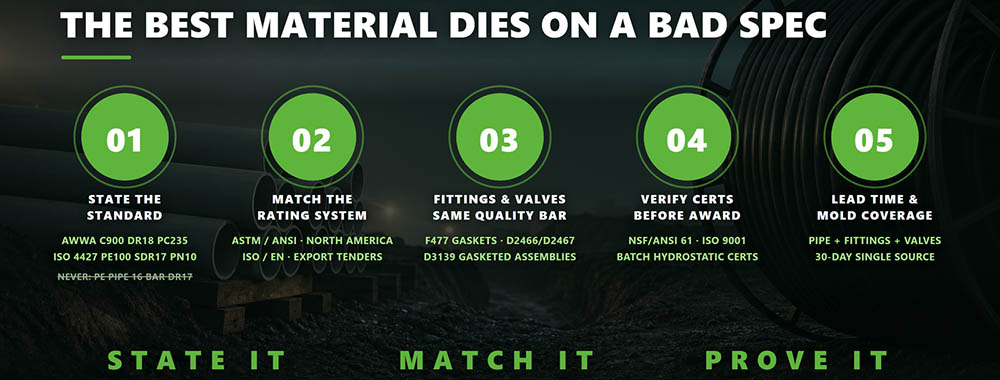
And the procurement checklist, because the best material choice dies on a bad spec:
- State the standard explicitly — AWWA C900 DR18 PC235, or ISO 4427 PE100 SDR17 PN10; never “PE pipe, 16 bar, DR17.”
- Match the rating system to the market — ASTM/ANSI for North America, ISO/EN for export tenders; a DR number alone is meaningless.
- Specify fittings and valves from the same quality bar — gaskets to ASTM F477, fittings to ASTM D2466/D2467 or D3139 for gasketed assemblies.
- Verify certifications before award — NSF/ANSI 61 for potable contact, ISO 9001 for the factory, and batch hydrostatic test certificates.
- Ask about lead time and mold coverage — a 30-day, single-source supply (pipe + fittings + valves) beats a cheaper line that strands the crew waiting on fittings.
Final position, stated without hedging: if your site is ordinary ground and your budget is real, buy gasketed PVC and pocket the difference. If your site moves, freezes hard, floods, or demands trenchless installation, buy fused HDPE and stop second-guessing. And if a supplier offers both well and can document it — that’s a shortlist. On the PVC side, manufacturers like SAM-UK (sam-uk.com, est. 1995, in-house molds, 30-day lead times, NSF/UPC/ETL/ISO 9001/CE/Watermark) are the kind of benchmark a buyer should hold any contender against.
Frequently Asked Questions
Can you solvent weld PVC pipe to HDPE pipe?
No. Solvent cement welds by dissolving the pipe surface — HDPE won’t dissolve in PVC cement and PVC won’t fuse. Connections between the two materials need a mechanical transition: a compression coupling, flanged adapter, or a purpose-made transition fitting rated for both materials.
Which pipe is stronger, PVC or HDPE?
Different kinds of strong. PVC is stiffer with higher ring stiffness and better short-term tensile performance; HDPE has far better impact toughness, fatigue and slow-crack-growth resistance, and keeps strength at low temperature. At the same DR, pressure ratings are comparable — pick by site conditions, not by the word “stronger.”
Is HDPE pipe more expensive than PVC?
Usually yes on the pipe supply itself — PVC commonly undercuts equivalent HDPE by 10–25% on water-main tenders. Installed cost narrows that: coiled HDPE cuts joint count on long runs, while PVC joins faster on small fitting-dense jobs. Fusion equipment and electrofusion fittings also add HDPE cost on short projects.
How long do PVC and HDPE pipes last underground?
Both are engineered on hydrostatic design lives of 50–100 years. PVC’s rating derives from a 4,000 psi HDB at 73°F; HDPE’s from long-term strength extrapolated to 100,000 hours. Field track records for both now exceed 50 years in water service when installed and bedded correctly.
Is HDPE pipe safe for drinking water?
Yes, when certified. Look for NSF/ANSI 61 (and NSF/ANSI 14) listing for potable contact, and for pipe meeting AWWA C901/C906 or ISO 4427. Black HDPE with 2–2.5% carbon black is the standard outdoor potable configuration. PVC potable pipe carries the same NSF/ANSI 61 certification requirement.
Which pipe handles freezing and cold climates better?
HDPE, clearly. It stays ductile to about -40°F and flexes with frost heave instead of cracking, which is why northern utilities favor fused PE. PVC turns brittle as it approaches freezing — handle, store and install it above roughly 40°F, and protect buried PVC with proper depth and bedding.
About SAM-UK
SAM-UK are a professional 20+ years manufacturer in producing vinyl building profile products and PVC , CPVC , PPH , PPR , PP pipes and pipe fittings, valves, taps and so on. We own the certificates of SGS\SONCAP\ISO9001\CE\NSF,support color /size customization. Welcome to consult for Catalog and Product. you can contact us at email [email protected]