Introduction
Most winter pipe failures are preventable, and the money spent on heat trace and proper burial depth in autumn is trivial next to one burst line inside a finished wall.
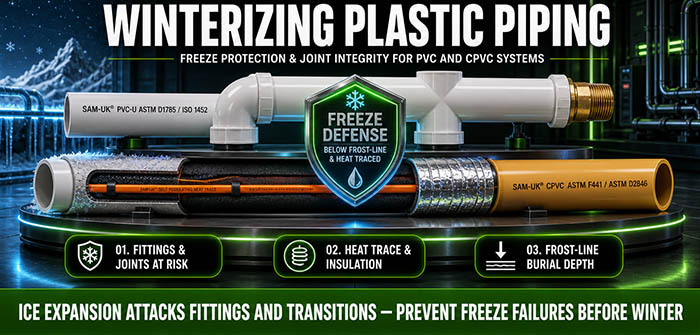
Plastic pipe does not crack like steel when the temperature drops. It gets brittle, and brittle pipe under frozen-water pressure lets go at its weakest point — which is almost never the long straight run you can see. The failures cluster at fittings, solvent-cemented joints, and threaded transitions, and they show up as a small weep or a full split depending on how fast the freeze and thaw moves. Plan for it in October and the February call-out never happens.
Why plastic pipe fails in winter
Two things go wrong at once, and it helps to keep them separate. First, PVC and CPVC lose impact strength as the temperature falls, so a material that shrugs off a hammer blow at 25°C can shatter from the same contact near freezing. That brittleness, not the internal pressure alone, is what turns a small fault into a burst.
Second comes the ice. Water expands as it freezes, and a line that is closed at both ends has nowhere to push. But here is the honest caveat: ice expansion is not the only mechanism. Restraint and geometry matter just as much — a short, well-supported section can hold where a long unsupported run between two fixed points cannot, because the pipe has no room to move and the stress lands on a fitting. Precision beats folklore here.
The pipe wall is usually tougher than people assume. In one published short-term hydraulic test, a solvent-cemented CPVC joint held pressure up to 1,895 psi before the test fixture itself failed, conducted to ASTM D1599 and reported by the manufacturer Lubrizol/FlowGuard. That is on the order of thirty times ordinary household line pressure. It is exactly why field failures show up at joints and fittings rather than mid-wall, and exactly why the pipe is rarely your problem.
Field reality adds a wrinkle the lab cannot reproduce. A line installed with a sloppy fall or a low spot in the trench collects water at exactly the wrong place, and that pooled slug freezes first while the rest of the run stays clear. The pipe is not defective — the bedding is. Which is why the person who graded the trench matters more on a cold night than the pipe’s datasheet ever will.

Where failures actually happen
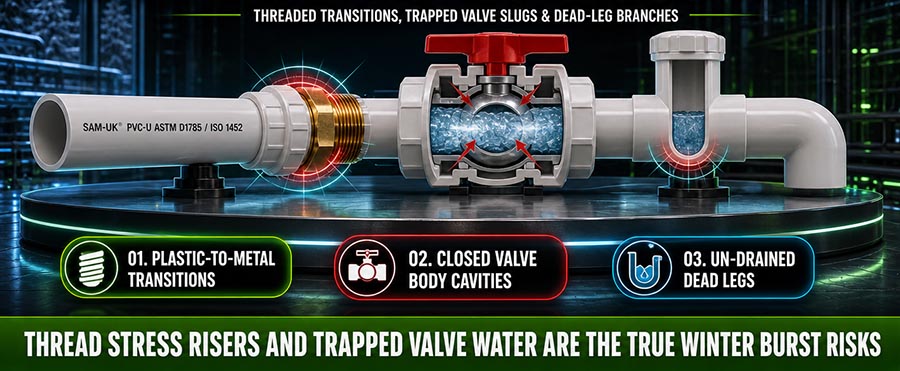
Trace a winter failure back and you almost always land on a fitting, a valve, or a transition. A threaded plastic-to-metal connection is the single most common freeze-failure point, because the two materials expand at different rates and the thread adds a stress riser. Solvent-cemented sockets fail when the cement was applied thin, in cold weather, or with too little cure time before the line was charged.
Valves deserve their own warning. A ball valve that traps water in the closed position gives the ice nowhere to go, so the body splits while the pipe on either side looks untouched. Any valve that can trap a slug of water is a freeze risk, even on a line you think stays warm. The same goes for dead legs — capped branches and abandoned stubs that never drain and never see flow.
Burial depth and the frost line
The most reliable freeze protection is depth. Bury the line below the local frost line and ground temperature does the work for free. The problem is that the frost line is a local number, not a national one — it can swing more than 60 inches across a single country.
| Region (representative) | Typical maximum frost depth | Notes |
|---|---|---|
| US Gulf Coast / Deep South | ~6–12 in (150–300 mm) | Rare deep freezes, but hard snaps still burst lines |
| Mid-Atlantic (Virginia, Maryland) | ~24–36 in (600–900 mm) | Varies sharply from north to south within one state |
| Pennsylvania / Ohio Valley | ~36–48 in (900–1,200 mm) | Code values often sit at the top of the range |
| Upper Midwest (Minnesota, N. Dakota) | ~48–72 in (1,200–1,800 mm) | Snow cover shifts real depth year to year |
| Northern New England / Canada | ~60–96 in (1,500–2,400 mm) | Design to the local code, never to a regional average |
Those figures are indicative only. For a real job, pull the maximum frost depth from the local building code, or from the USDA/NRCS and NOAA soil-temperature records for the specific county. Designing to a national average instead of the local number is how lines end up frozen two winters in five. Where depth is not possible, you move to insulation and heat trace.
Insulation and heat trace — and what not to do
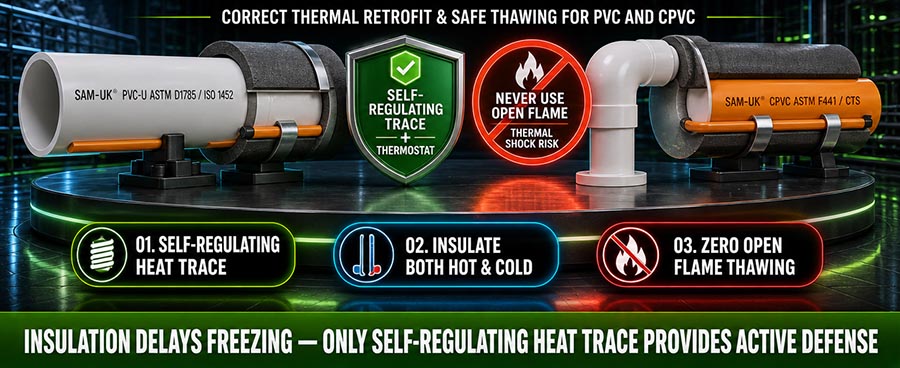
Insulation alone slows heat loss; it does not add heat. On a buried or slab-exposed run, pipe insulation buys you time but will not save a line that sits below freezing for a week. For genuine protection, pair insulation with self-regulating heat trace controlled by a thermostat, and insulate the trace with the pipe so the warmth goes into the water, not the air.
Run heat trace on CPVC hot lines as well as cold lines, which surprises people. A hot-water line loses its internal heat once the building is shut down for a weekend or a holiday, and then it freezes like any other line — often with worse consequences because CPVC cracks differently, developing long longitudinal splits rather than a clean break. Insulate the hot line for the outage, not for the occupied condition.
Heat trace selection trips people up as often as thawing does. A cheap constant-wattage cable can overheat a small-diameter plastic line and soften it, so specify self-regulating trace and match the wattage to the pipe size. Tape the cable to the bottom of the pipe, run it straight or spiralled, then insulate over both — cable laid on top of the insulation does nothing useful.
The thawing mistake is worth stating outright, because it damages more pipe than the freeze does. Never thaw a frozen plastic line with an open flame or by pouring boiling water on it. The thermal shock shatters cold, brittle PVC instantly. Use warm air from a heat gun on a low setting, heat tape rated for plastic pipe, or a controlled warm-water bath applied to the outside of the line only. Slow beats fast, every time.
Drain-down and seasonal commissioning
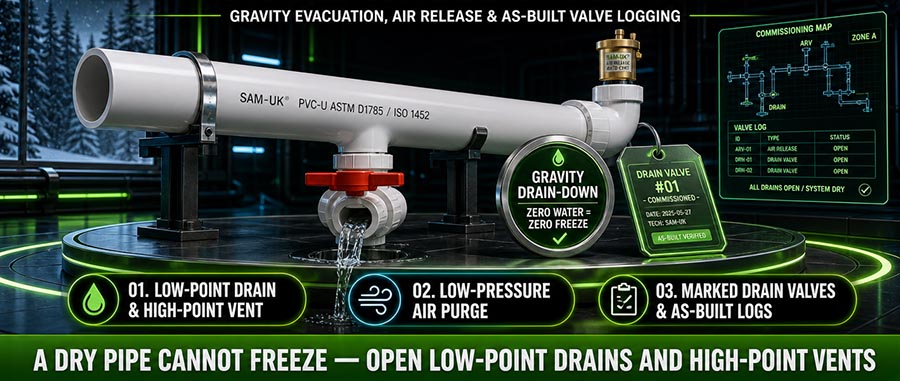
For any line that can be taken out of service, drain-down is the cheapest freeze protection there is. A dry line cannot freeze. Open the low-point drain and every high-point vent, let gravity do the work, and blow the residual with low-pressure air if the geometry traps water.
Three details decide whether a drain-down actually works. Fit air release where lines are drained and refilled, or trapped air pockets will hammer the system on restart. Confirm the low point is genuinely the lowest point — a sag in the trench that leaves a slug behind freezes first. And keep a minimum flow on any line that cannot be drained, because moving water resists freezing far better than still water.
Document the drain points on a drawing. Two people each assuming the line is already drained is how a slug gets left behind, and the freeze finds the one low point nobody flagged. A marked valve and a signed commissioning sheet beat a verbal handover every single winter.
A pre-winter checklist for facility managers
Work this list in autumn, before the first hard freeze, not after the first leak.
- Map every exposed run and every line that can trap water — dead legs, closed valves, capped stubs.
- Verify burial depth against the local frost line for the actual site.
- Insulate exposed runs, and insulate CPVC hot lines as well as cold.
- Test self-regulating heat trace and its thermostat before you need them.
- Drain and vent seasonal lines; confirm air release points are fitted.
- Check that threaded plastic-to-metal transitions are sound and not over-tightened.
- Walk the line after the first thaw and inspect every joint, valve, and connection.
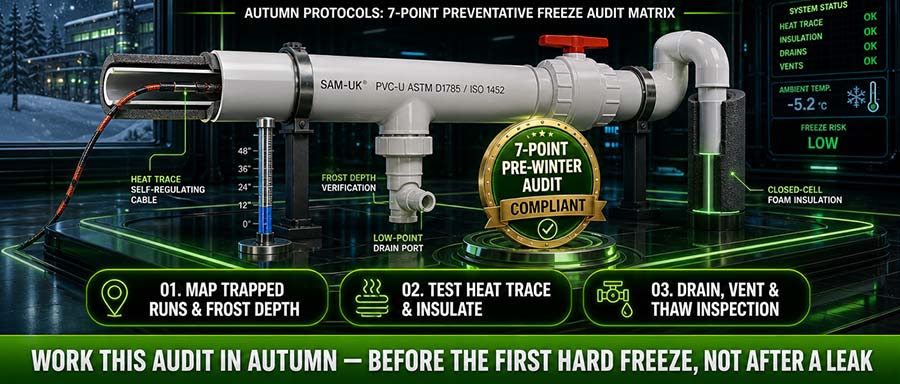
One caveat on the checklist — a thaw walk is not optional. Freeze damage often shows up in the thaw, not the freeze, so a joint that held through the cold can weep the moment the ice lets go. A fifteen-minute inspection after each cold snap catches the hairline split before it becomes a ceiling.
Frequently Asked Questions
At what temperature does PVC pipe freeze or become brittle?
Water freezes at 0°C (32°F), but PVC and CPVC become increasingly brittle well before that, losing impact strength as temperatures fall. Combine brittleness with a frozen, restrained line and a fitting can let go even though the pipe wall itself is intact.
Can I pour hot water on a frozen PVC pipe?
No. Boiling water or an open flame causes thermal shock that shatters cold, brittle PVC. Thaw with low-setting warm air, heat tape rated for plastic, or a controlled warm-water bath on the outside of the line only.
Does insulating a pipe stop it freezing?
Insulation slows heat loss but adds no heat. On a line exposed to sustained sub-zero temperatures, insulation should be paired with self-regulating heat trace and a thermostat to actually prevent freezing.
Do I need to insulate CPVC hot-water lines?
Yes. A hot line loses its internal heat when a building sits idle over a weekend or holiday, and it can then freeze like any other line. CPVC also cracks differently, forming long longitudinal splits rather than a clean break.
How deep should plastic water pipe be buried?
Below the local frost line, which varies widely — roughly 6–12 inches on the US Gulf Coast up to 60–96 inches in northern New England and Canada. Confirm the maximum frost depth in the local building code or USDA/NRCS and NOAA records for the site, not a national average.
Can a dry pipe freeze?
No — a drained line cannot freeze, which is why drain-down is the cheapest protection available. Fit air release where lines are drained and refilled, and confirm the low point truly drains so no slug of water is left behind.
About SAM-UK
SAM-UK are a professional 20+ years manufacturer in producing vinyl building profile products and PVC , CPVC , PPH , PPR , PP pipes and pipe fittings, valves, taps and so on. See our certification records and product-specific scope. We support color /size customization. Welcome to consult for Catalog and Product. you can contact us at email [email protected]