Growth Is Real — But the Raw Material Story Is Complicated
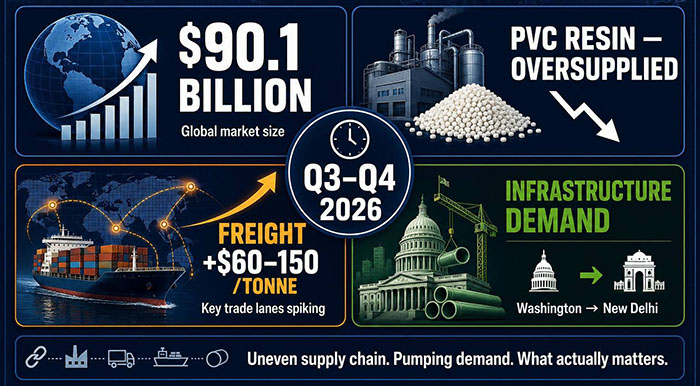
The global plastic pipe market just hit $90.1 billion. But if you’re a procurement manager booking Q3 and Q4 orders, that headline number isn’t what keeps you up at night. What matters is this: PVC resin is structurally oversupplied, freight costs on key trade lanes just spiked $60–150 per tonne, and infrastructure budgets from Washington to New Delhi are pumping demand into an already uneven supply chain. Let’s unpack what actually matters for the second half of 2026.
The Numbers: A $90 Billion Market That Hasn’t Peaked
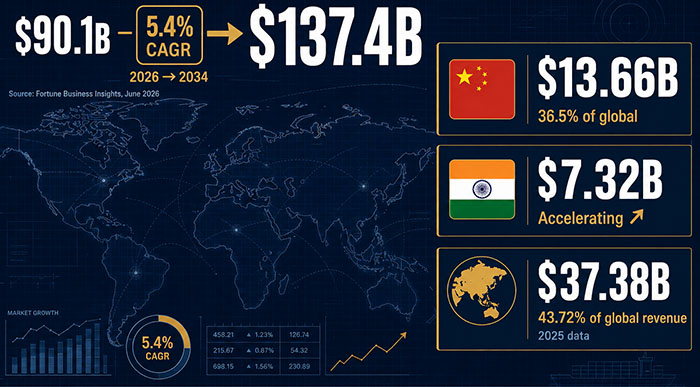
Let’s get the macro picture straight. According to Fortune Business Insights’ June 2026 report, the global plastic pipes market is projected to grow from $90.10 billion in 2026 to $137.36 billion by 2034 — a 5.4% CAGR. That’s not speculative hype. That’s infrastructure replacement cycles, urbanization in developing markets, and the steady migration from metal and concrete to plastic piping systems.
Asia Pacific dominates. No surprise there. The region accounted for 43.72% of global revenue in 2025 at $37.38 billion, with China alone representing roughly 36.5% of the worldwide total at $13.66 billion. India isn’t far behind at $7.32 billion, and it’s accelerating fast.
But here’s the thing. Market size numbers make great slide decks. They don’t tell you whether your next container of PVC fittings will arrive on time or cost 12% more than last quarter’s shipment.
| Region | 2025 Market Size | Key Demand Driver |
|---|---|---|
| Asia Pacific | $37.38B | Urbanization, water infrastructure, residential construction |
| Europe | $19.84B | Building renovation, wastewater upgrades, pipeline replacement |
| North America | $16.67B | Aging water/sewer replacement, municipal projects |
| Latin America | $6.54B | Infrastructure development, agricultural irrigation |
| Middle East & Africa | $5.04B | Desalination, urban development, oil & gas |
PE pipes led material consumption in 2025 — water supply and gas distribution are the structural backbone of that demand. PVC is projected to grow at 5.2% CAGR, driven by plumbing and drainage where cost and ease of installation still beat everything else on the market.
Raw Material Reality: Why PVC Resin Is Cheap — and Why That’s a Problem
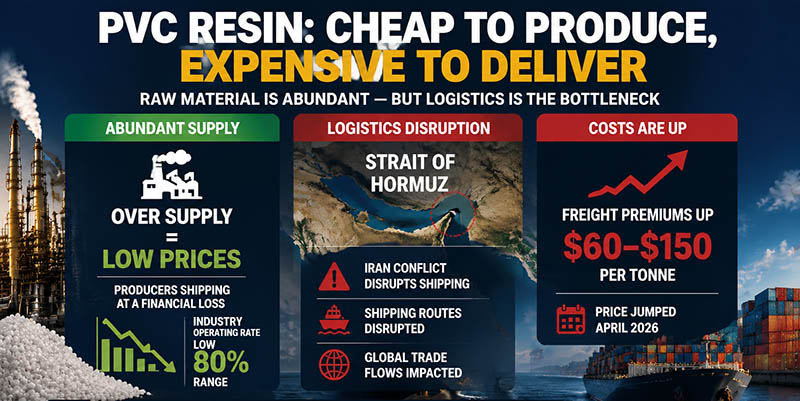
PVC resin prices hit 20-year annual average lows in 2025. S&P Global Commodity Insights confirmed it bluntly: many producers are shipping at a financial loss. Operating rates across the industry have slipped into the low 80% range. When you’re running at 82% capacity utilization, you’re absorbing fixed overhead across fewer tonnes — and your margins are getting crushed.
And yet.
In April 2026, prices jumped. Why? The Strait of Hormuz. The Iran conflict disrupted shipping routes through one of the world’s most critical petrochemical transit corridors. Plastics Technology reported that the disruption “dramatically disrupted shipping routes and global resin trade flows,” adding an estimated $60 to $150 per tonne in freight premiums on affected trade lanes.
Here’s the procurement paradox buyers are living through right now: raw material is abundant — structurally oversupplied, even. But getting it from origin to factory gate costs more than it did six months ago because logistics, not production, is the bottleneck.
Key takeaway: An FOB price from a Chinese or Middle Eastern supplier does not equal your landed cost. If you’re not modeling current freight rates for your specific trade lane, you’re systematically underestimating what you’ll actually pay.
China’s export surge adds another layer. From January to November 2025, China exported 3.5 million tonnes of PVC — a 47% year-on-year increase. That’s not demand-driven export growth. That’s domestic oversupply looking for an outlet at any price. For buyers in Vietnam, India, and Southeast Asia, cheap Chinese supply looks like a gift. The catch? When a supplier is exporting at a loss, that supply isn’t permanent. Capacity rationalization is coming — S&P Global called it “the most likely price support mechanism entering 2026.” When Chinese producers start cutting capacity, the buyers most dependent on those loss-making export volumes will feel it first.
Infrastructure Spending: The Demand Engine That Doesn’t Care About Housing Cycles
Residential construction is soft. North American single-family housing starts are lackluster. China’s newly started residential construction area declined 19.9% year-on-year through November 2025, and even in 2026, SunSirs projects the decline will only narrow to within 10%.
But infrastructure? Infrastructure doesn’t care about mortgage rates.
The U.S. Infrastructure Investment and Jobs Act continues allocating multi-billion-dollar funding for lead pipe replacement — a program that directly drives PVC and HDPE pipe demand for municipal water systems. India’s Jal Jeevan Mission has connected 15.76 crore rural households to tap water, all of which required plastic piping. China’s 15th Five-Year Plan targets roughly 5% growth in infrastructure-sector demand, partially offsetting the residential construction weakness.
What this means for procurement: if your customer base leans toward residential developers, Q3 and Q4 look cautious. If you’re supplying municipal water, wastewater, or agricultural irrigation projects, demand is steadier and less sentiment-sensitive. Infrastructure budgets are committed years in advance. They don’t evaporate when consumer confidence dips.
The agriculture segment deserves its own mention. Fortune Business Insights projects 6.6% CAGR for agricultural plastic pipe applications through 2034. Irrigation modernization — drip systems, sprinkler networks, water-efficient distribution — is a global trend that isn’t slowing down. Latin America, India, and Africa are where the volume growth is happening.
Three Procurement Mistakes B2B Buyers Are Making Right Now
I’ve talked to enough procurement teams this year to spot the patterns. Here’s what keeps going wrong.
Mistake 1: Chasing the Lowest FOB Price Without Modeling Landed Cost
This is the big one. Chinese-origin PVC at $700/tonne FOB looks unbeatable on a spreadsheet. Then you add freight — and on routes affected by the Hormuz disruption or Red Sea security concerns, that freight premium can hit $150/tonne. Suddenly the “cheap” option isn’t cheap. Meanwhile, a North American or European supplier at $850/tonne with shorter, more predictable shipping might actually be cheaper delivered. The freight market is too volatile right now to treat shipping as a rounding error.
Mistake 2: Building Single-Origin Dependency on Loss-Making Suppliers
When Chinese producers are exporting PVC at financial losses, the supply looks endless. It isn’t. Westlake has already announced North American capacity reductions. Vynova closed European facilities. When the rationalization wave accelerates — and it will, because no industry runs at negative margins forever — buyers with single-origin supply chains will face sudden shortages and price spikes. Diversify your supplier base now, while the market is loose. Trying to do it during a supply crunch is infinitely harder.
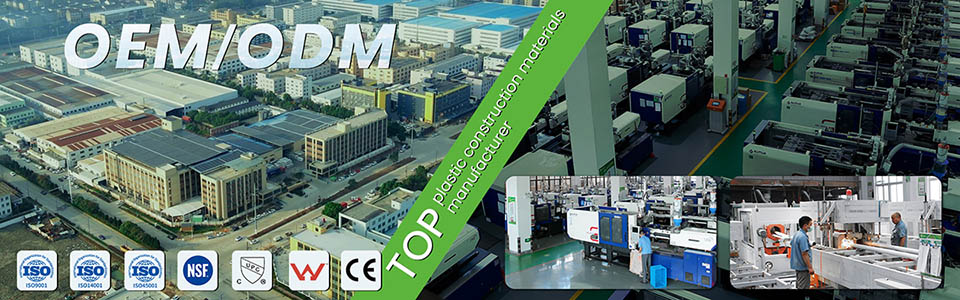
This is where a manufacturer’s track record becomes your insurance policy. A supplier that’s been running continuous operations since 1995 — surviving multiple resin price cycles, the 2008 downturn, the COVID supply chain meltdown, and now the Hormuz disruption — has demonstrated something a 3-year-old trading company simply hasn’t: resilience. When you’re evaluating suppliers in 2026, ask how many market shocks they’ve lived through. The answer tells you more about reliability than any price quote.
Mistake 3: Treating All PVC Pipe as a Commodity
The shift toward lifecycle-cost procurement isn’t a buzzword — it’s actually happening. Buyers are increasingly selecting pipes based on pressure ratings, chemical resistance, and long-term durability rather than just upfront material cost. A specification that lets you substitute a cheaper grade might save 8% on materials today and cost 300% more in replacement labor five years from now. We’ve seen socket fusion joints fail because the heating plate wasn’t cleaned between welds — a $2 maintenance step that destroys a $50,000 pipeline installation when skipped. Cheap pipe is the most expensive pipe if the spec is wrong.
Certifications are the easiest shortcut here — but only if you know which ones carry weight. NSF/ANSI 61 for drinking water safety carries real enforcement teeth in North America. Watermark certification (AS/NZS 4020) is non-negotiable for Australia and New Zealand. UPC and ETL listings matter for U.S. code compliance. A supplier that holds all four isn’t just checking boxes — they’ve invested serious capital in third-party testing and factory audits. That investment separates manufacturers who take quality seriously from those who treat certifications as paperwork.
Key takeaway: In 2026, the smartest procurement teams aren’t asking “what’s the cheapest pipe that meets the spec?” They’re asking “what’s the spec that actually matches the application, and which supplier consistently delivers it?”
Where Things Are Heading: Second Half 2026 and Beyond
A few signals worth watching as we move into H2.
Capacity rationalization will accelerate. With operating rates in the low 80s and producers bleeding cash, the industry can’t sustain current production levels indefinitely. Expect more facility closures, particularly from mid-tier producers without the balance sheet to ride out the margin compression. This is ultimately bullish for pricing, but the timing is unpredictable — it could start in Q3 or drag into 2027.
The tariff landscape is shifting. June 2026 brought a White House modification reducing metal import tariffs that lower equipment costs for plastics manufacturing facilities — a small but real positive for North American producers. On the other side, Brazil’s antidumping duties on U.S. PVC, imposed in mid-2025, continue redirecting trade flows. Every tariff change reshuffles which origins are competitive in which markets.
Smart pipe technology is graduating from pilot to deployment. Sensor-enabled pipe linings with embedded monitoring are moving beyond water utility trials into actual specification documents. In January 2026, a major U.S. water infrastructure program announced multi-billion-dollar funding that explicitly includes advanced pipeline monitoring. For pipe manufacturers, the practical question is: does your product portfolio include solutions that integrate with these systems, or are you purely in the commodity pipe business?
Sustainability isn’t optional anymore — but the economics are still messy. The plastics industry’s April 2026 fly-in on Capitol Hill tackled tariffs, microplastics, and recycling policy head-on. The regulatory direction is clear: more recycled content requirements, more scrutiny on microplastic shedding, more focus on end-of-life pipe disposal. The commercial reality is that recycled-content pipe still costs more to produce, and buyers aren’t consistently paying the premium. That gap will close — either through regulation or through manufacturing efficiency gains — but it hasn’t closed yet.
How to Pick a Supplier That Won’t Let You Down When Supply Chains Buckle
All the market intelligence in the world won’t save you if your supplier can’t deliver. Here’s what actually matters when you’re vetting a pipe and fittings manufacturer in 2026.
Depth, Not Just Volume
A manufacturer handling 50,000 tonnes per year with 300-plus workers is a different animal from a trading company that buys from three factories and resells. The difference shows up when things go wrong. The trading company can’t control production schedules. The manufacturer can. The trading company can’t prioritize your order when capacity gets tight. The manufacturer can — and will, if you’re a regular buyer.
One specific signal: in-house mold development. When a factory has its own mold workshop, it means they control the tooling that shapes every fitting. If a mold wears out mid-production run, they fix it in hours, not weeks. If you need a custom fitting dimension for a specific project, they don’t outsource the mold to a third-party shop with a 60-day lead time. This capability separates integrated manufacturers from assemblers.
Certification Breadth Tells You Which Markets They Actually Serve
Here’s a procurement shortcut that works: look at a manufacturer’s certification portfolio and you’ll know exactly which markets they’re built for. NSF certification means they’ve invested in the North American drinking water market. Watermark tells you Australia and New Zealand are core markets, not afterthoughts. UPC and ETL listings confirm U.S. code compliance for plumbing applications. ISO 9001 is table stakes — every serious manufacturer has it — but the regional certifications tell the real story.
A manufacturer holding NSF, UPC, ETL, Watermark, and ISO 9001 simultaneously has passed audits from five separate certifying bodies. Each audit covers different standards: ASTM D2466 and D2467 for PVC threaded fittings, ASTM D2665 for DWV systems, AS/NZS 1260 for the Australian market, ISO 15874 for PPR systems. That’s not marketing. That’s documented compliance with the specs your project engineers are writing into tender documents right now.
Product Range and What It Actually Means for Procurement
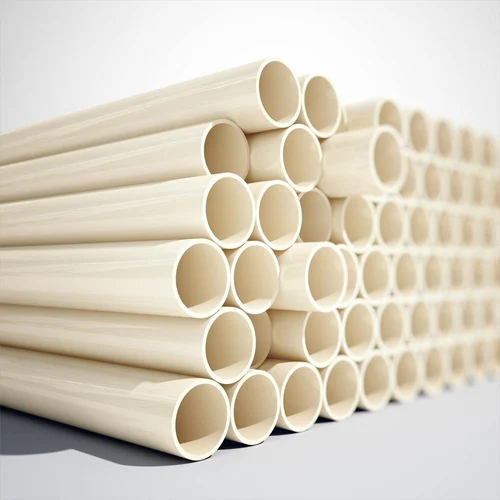
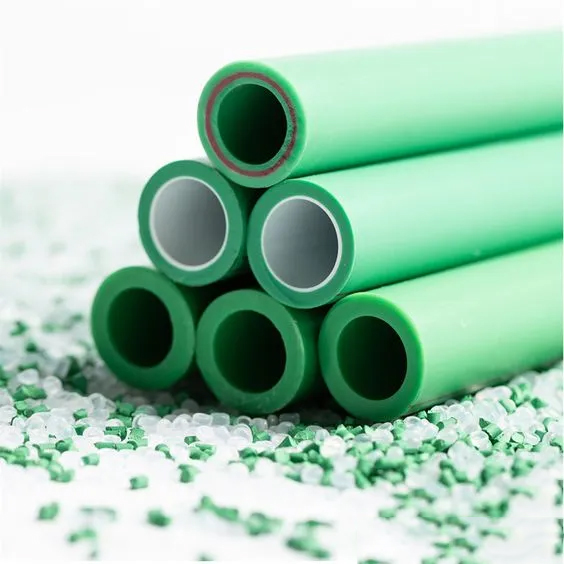
A supplier that does PVC fittings, CPVC, PPH, PPR, ball valves, and butterfly valves under one roof solves a procurement headache most buyers don’t think about until it bites them: split shipments. When your PVC DWV fittings come from one factory, your PPR hot water system from another, and your valves from a third, you’re managing three sets of shipping documents, three quality inspections, three payment schedules. Miss one container and your project stalls.
Consolidating across categories — PVC, CPVC, PPR pipe systems, and valves — with a single manufacturer simplifies logistics and gives you leverage. A manufacturer processing your combined order of PVC fittings, PPR pipes, and butterfly valves treats you differently than a supplier filling a single SKU order. The difference usually shows up in lead time priority and pricing flexibility.
The 30-Day Delivery Benchmark
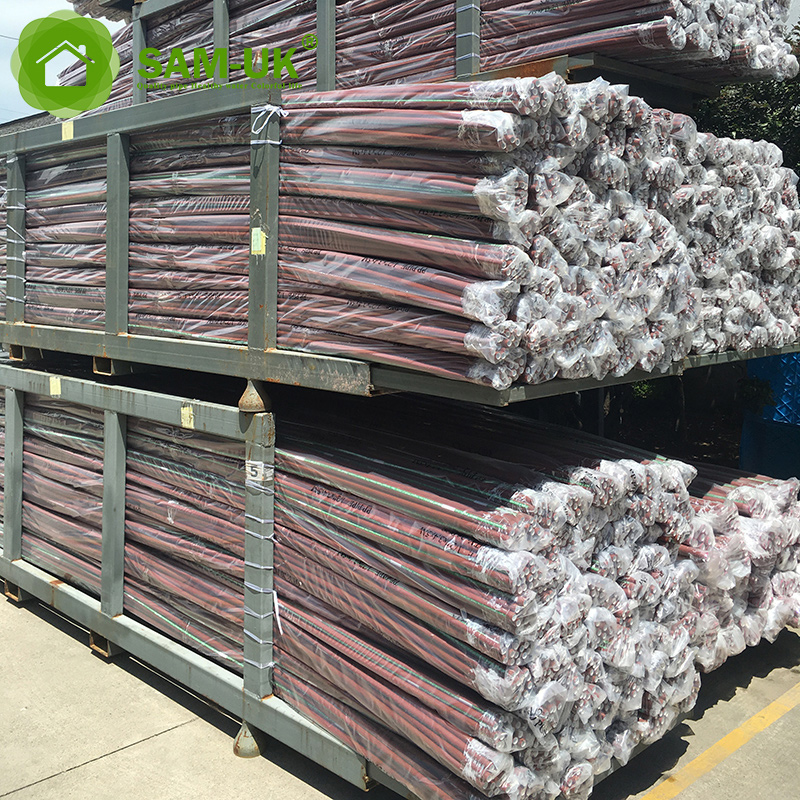
In a market where Hormuz disruptions are adding weeks to transit times on affected routes, consistent 30-day delivery from order confirmation to shipment is a real operational capability — not a marketing promise. It means the manufacturer maintains raw material inventory buffers, runs predictable production scheduling, and has enough extrusion and injection molding capacity to absorb order fluctuations without slipping into 45- or 60-day lead times.
Ask any manufacturer for their average order-to-ship time over the last 12 months, not their best-case estimate. The honest ones will give you a range. The ones who claim “always on time” without showing data are guessing.
What This Means for Your Sourcing Strategy
If you’re placing orders for Q3 and Q4 2026, here’s what a defensible procurement plan looks like:
- Model landed cost, not FOB price. On affected trade lanes, freight is the largest single variable in your total cost. Get current rate quotes for your specific route before comparing supplier offers.
- Diversify origins. If 80% of your PVC pipe or fittings come from one country, you’re carrying concentration risk you don’t need. Split volumes across at least two regions with independent logistics routes.
- Lock in contracts now if you can. The current oversupply keeps prices depressed in most markets. When capacity rationalization starts, prices move fast. Long-term contracts signed during a supply glut age well.
- Audit your specifications. Are you buying the right grade for the application, or just the grade you’ve always bought? A specification review takes a few days. Getting it wrong costs years of maintenance headaches.
- Watch India. The removal of BIS certification requirements for PVC imports in late 2025 has redirected massive volumes there. India’s demand growth will shape regional pricing across all of Asia.
- Evaluate supplier depth, not just price. In-house mold development, multi-certification portfolios (NSF + UPC + Watermark + ISO 9001), and 30-plus years of operational stability are the signals that separate manufacturers who deliver
Frequently Asked Questions
What is the current size of the global plastic pipe market in 2026?
- The global plastic pipes market is valued at $90.10 billion in 2026, with projections to reach $137.36 billion by 2034 at a 5.4% CAGR, according to Fortune Business Insights’ June 2026 report.
Why are PVC resin prices low in 2026 despite strong pipe demand?
- Structural oversupply. Global PVC production capacity has grown faster than demand absorption. China alone exported 3.5 million tonnes of PVC in the first 11 months of 2025 — a 47% increase — much of it at loss-making prices. Operating rates across the industry are in the low 80% range, indicating significant unused capacity.
How is the Strait of Hormuz disruption affecting plastic pipe supply chains?
- The Iran conflict has disrupted shipping through one of the world’s most critical petrochemical transit corridors, adding an estimated $60 to $150 per tonne in freight premiums on affected trade lanes. This particularly impacts buyers in the Middle East, South Asia, and East Africa whose supply routes transit through or near the affected waters.
Which region is driving the most growth in plastic pipe demand?
- Asia Pacific leads with 43.72% of global market share. However, the fastest-growing application segment is agriculture at 6.6% CAGR, driven by irrigation modernization across developing markets including India, Latin America, and Africa.
Should B2B buyers lock in long-term PVC pipe contracts now or wait?
- The current oversupply environment favors locking in contracts. When capacity rationalization accelerates — and industry analysts expect it to — prices could rise quickly. Long-term agreements signed during the current supply glut typically provide better value than spot purchasing during a tightening market.
How are tariffs impacting plastic pipe procurement in 2026?
- Multiple tariff regimes are reshaping trade flows: Brazil’s antidumping duties on U.S. PVC redirect exports to other markets, the U.S. has modified metal tariffs reducing equipment costs for domestic manufacturers, and ongoing U.S.-China tariff structures continue affecting resin and finished pipe pricing across North American and Asian markets.
What certifications should I look for when sourcing PVC and PPR pipe fittings?
- At minimum, look for ISO 9001 as the baseline quality management credential. Beyond that, match certifications to your target market: NSF/ANSI 61 for North American drinking water applications, UPC for U.S. plumbing code compliance, Watermark (AS/NZS 4020) for Australia and New Zealand, and ETL for electrical conduit and related applications. A manufacturer holding all of these simultaneously has invested significantly in third-party testing and factory audits — which translates to fewer quality surprises in the field.
Why does in-house mold development matter for pipe fitting procurement?
- In-house mold capability means the manufacturer controls tooling directly rather than outsourcing to third-party mold shops. This reduces lead times for custom fittings, enables faster mold repair when tooling wears, and gives the manufacturer the ability to develop new fitting dimensions for specific project requirements without 60-day external lead times. For distributors and project buyers, this translates to faster turnaround on non-standard orders and fewer production bottlenecks.
What’s the advantage of sourcing PVC fittings, PPR pipes, and valves from a single manufacturer?
- Consolidating across product categories simplifies logistics — one set of shipping documents, one quality inspection process, one payment schedule. It also gives you more negotiating leverage with the supplier and reduces the risk of project delays from split-container arrivals. A manufacturer with integrated production across PVC, CPVC, PPR, and valve categories can typically offer better lead time consistency than coordinating across multiple single-category suppliers.
About SAM-UK
SAM-UK are a professional 20+ years manufacturer in producing vinyl building profile products and PVC , CPVC , PPH , PPR , PP pipes and pipe fittings, valves, taps and so on. See our certification records and product-specific scope. We support color /size customization. Welcome to consult for Catalog and Product. you can contact us at email [email protected]