The Correct Selection of CPVC and PVC Applications
CPVC is PVC that’s been through an additional chlorination process — and that chemical difference buys you roughly 33°C of extra temperature headroom. For hot water systems, it’s the difference between a pipe that works and a pipe that softens. For chemical processing, it means resistance to substances that would attack standard PVC within months. But that performance comes at a price. Here’s when CPVC is worth it — and when PVC is the smarter call.
Where PVC pipe Stops and CPVC pipe Keeps Going
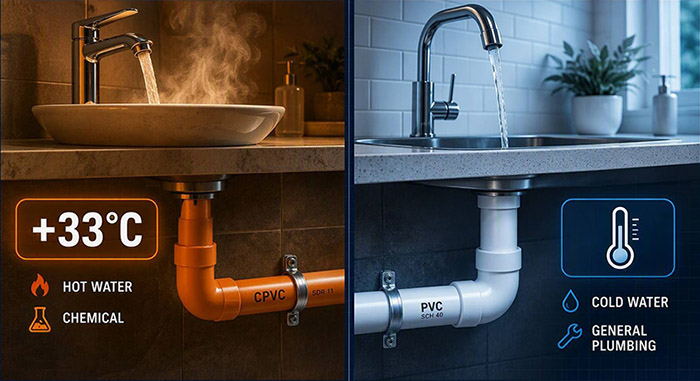
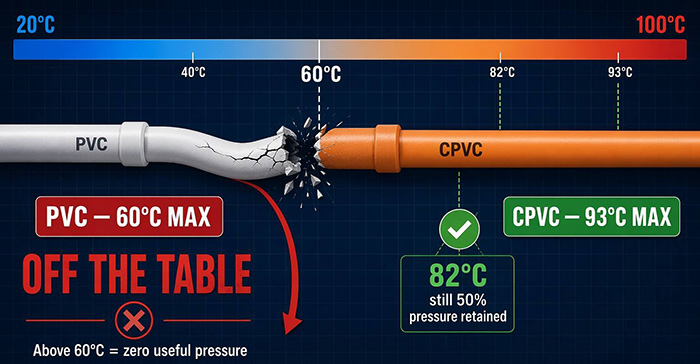
PVC pipe & fittings:maximum continuous service temperature is 60°C (140°F). Above that, the material softens, pressure ratings derate sharply, and long-term structural integrity becomes unreliable. For cold water, drainage, and ambient-temperature industrial fluids, that’s fine — most of those applications never see 50°C.
CPVC pipe & fittings:continuous rating is 93°C (200°F). That extra 33°C opens up a whole category of applications that PVC pipe simply can’t handle: hot water distribution in commercial buildings, industrial hot water return lines, low-pressure steam condensate, and hot chemical processing. At 82°C — typical commercial hot water supply temperature — CPVC pipe still retains roughly 50% of its pressure rating. At that same temperature, PVC pipe has derated to essentially zero useful pressure capacity.
The practical implication for specifiers:if the fluid temperature ever exceeds 60°C under normal operating conditions, PVC is off the table. Not “less ideal.” Off the table. We’ve seen PVC hot water lines installed by contractors who figured “it’s just warm water, it’ll be fine.” The pipes bowed within weeks and burst at the joints within a year. The material science doesn’t negotiate.
| Factor | PVC | CPVC |
|---|---|---|
| Max continuous temp | 60°C (140°F) | 93°C (200°F) |
| Chlorine content | ~57% | ~67% |
| Key ASTM pipe standard | D1785 (sch 40/80) | D2846 (CTS hot/cold) |
| Key ASTM fitting standard | D2466 / D2467 | D2846 / F439 |
| Solvent cement | PVC cement (clear/blue/gray) | CPVC cement (orange — do NOT use PVC cement) |
| Cost vs PVC | Baseline | ~2-2.5x material cost |
| Thermal expansion | ~0.05 mm/m/°C | ~0.06 mm/m/°C |
| Flame/smoke rating | Not plenum-rated typically | Available in plenum-rated grades |
| UV resistance | Degrades unless protected | Slightly better but still needs UV protection |
Chemical Resistance: When Chlorine Content Changes the Game
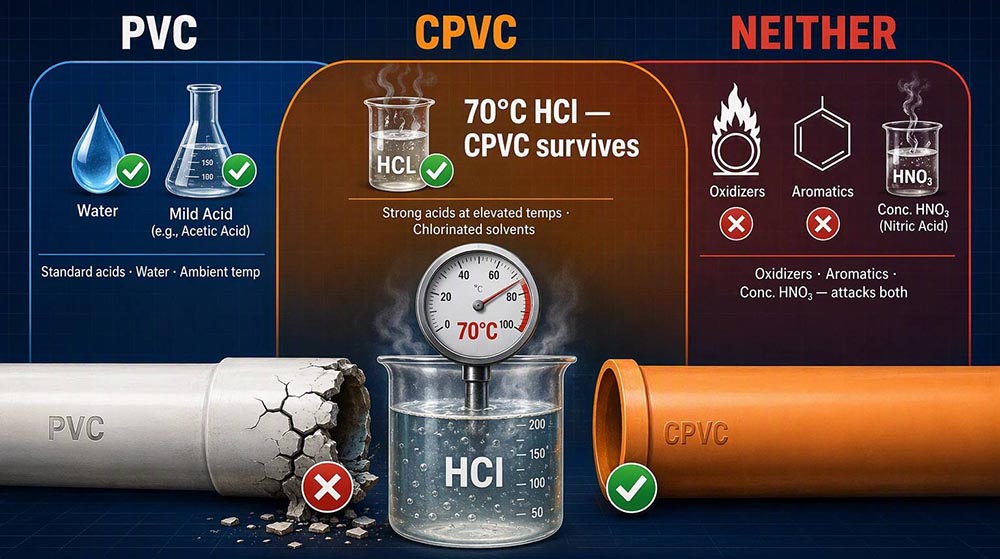
CPVC pipe & fittings aren’t just PVC with more chlorine on paper. The extra chlorine atoms fundamentally alter the polymer chain’s chemical resistance profile. CPVC pipe & fittings handle certain aggressive media that would degrade standard PVC pipe & fittings within months — strong mineral acids at elevated temperatures, some chlorinated solvents, and specific industrial process fluids. In a chemical processing plant running hydrochloric acid at 70°C, PVC won’t survive. CPVC will.
But the resistance isn’t universal. Some chemicals that PVC handles fine will attack CPVC. Strong oxidizing agents, certain aromatic hydrocarbons, and concentrated nitric acid are problems for both. The rule for B2B buyers: don’t assume CPVC covers all your chemical needs just because it handles heat better. Every chemical application needs its own compatibility check — concentration, temperature, exposure duration, all three variables shift the outcome. A manufacturer’s chemical resistance chart — even one backed by NSF and ASTM D2846 testing — is a starting point, not a warranty. We tell every client the same thing: send us your exact fluid spec, and we’ll run it against our test data. General charts get you in the ballpark. Specificity keeps you out of trouble.
For standard water service, the chemical angle is mostly noise. Municipal water chemistry doesn’t challenge either material in normal operation. Unless your water source has something unusual going on, the material choice between PVC pipe & fittings and CPVC pipe & fittings should be driven by temperature and code requirements — not chemical compatibility.
Key takeaway: CPVC pipe chemical resistance advantage is real but application-specific. Use it for hot aggressive media where PVC pipe can’t survive. Don’t assume it handles everything — run the compatibility check.
Installation Differences That Trip Up Contractors
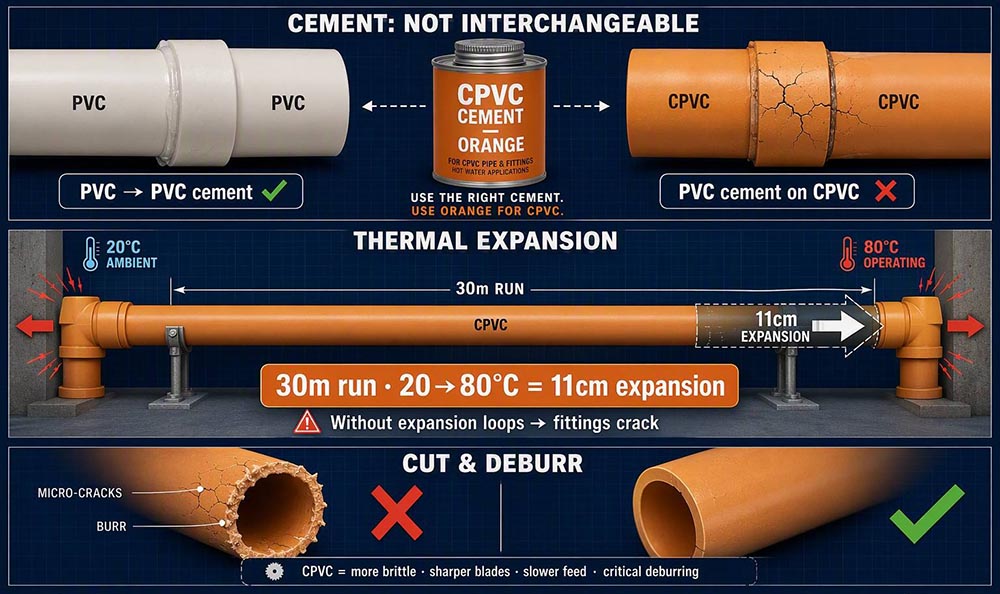
CPVC pipe & fittings and PVC pipe & fittings look similar — both are rigid thermoplastic pipes — and that visual similarity has caused expensive installation errors. The solvent cements are not interchangeable. PVC cement on CPVC produces weak joints that fail under thermal cycling. CPVC cement is typically orange for deliberate visual differentiation, but in a dimly lit mechanical room with a hurried crew, mistakes happen.
CPVC pipe & fittings also require different cutting and deburring practices than PVC fittings. The material is slightly more brittle than PVC, which means rotary cutters need sharper blades and slower feed rates to avoid micro-cracking at the cut edge. Deburring is more critical with CPVC because any sharp edge or notch concentrates stress when the pipe expands and contracts under temperature cycling — and CPVC does a lot of that.
One installation detail most spec sheets skip: CPVC’s thermal expansion coefficient is roughly 20% higher than PVC’s. That makes expansion compensation genuinely more demanding. A 30-meter straight CPVC hot water run going from 20°C ambient to 80°C operating temperature expands about 11 centimeters. Without expansion loops or compensators at the right spacing, that expansion pushes directly on the fittings at both ends. Given enough thermal cycles, the fittings crack. PVC cold water lines rarely need expansion loops. CPVC hot water lines almost always do — and the people writing installation specs need to know that before the first joint is glued.
Cost: When the Premium Pays for Itself
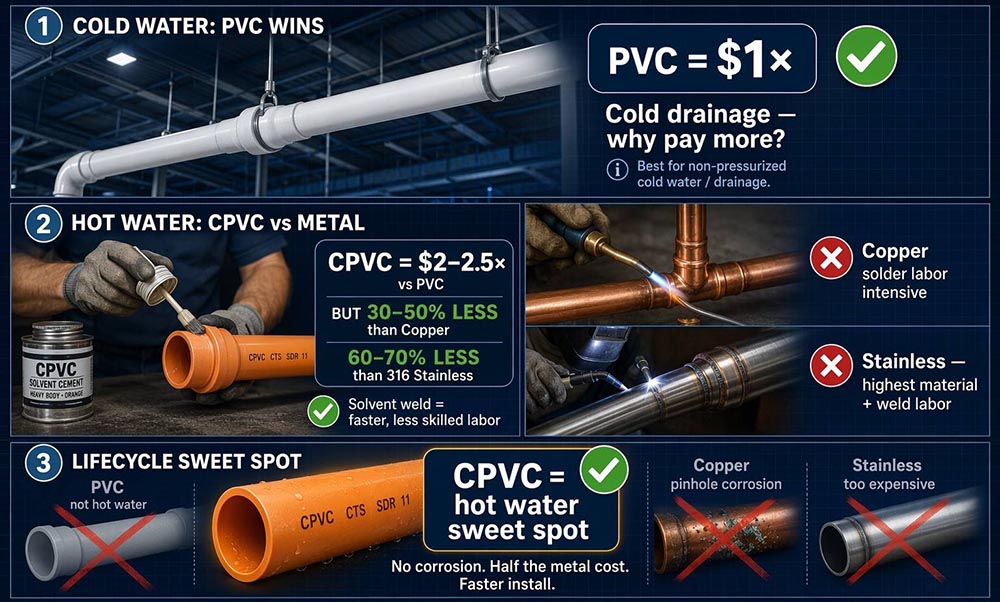
CPVC pipe & fittings material costs roughly 2 to 2.5 times what equivalent PVC pipe & fittings cost. For a cold-water drainage system in a warehouse, that premium is money wasted — PVC handles the application perfectly at half the price. For a commercial building’s hot water riser where PVC would fail, the CPVC premium isn’t a cost — it’s the price of using a material that actually works.
The cost comparison gets more interesting when you compare CPVC pipe & fittings to metal alternatives. CPVC hot water pipe costs 30–50% less than copper for the same diameter and pressure class. Against stainless steel for chemical applications, the savings are even larger — CPVC can be 60–70% cheaper than 316 stainless for compatible chemical services. The installation labor savings amplify the difference: CPVC solvent welding is faster and requires less skilled labor than copper soldering or stainless welding. For a contractor bidding a commercial hot water project, the labor delta alone can swing the decision.
Lifecycle cost tilts further in CPVC’s favor for hot water applications. Copper develops pinhole corrosion in aggressive water conditions — a problem CPVC simply doesn’t have. Stainless steel handles the temperature but costs multiples more and still requires expensive welded or mechanical joints. For the specific niche of hot water distribution and moderate-temperature chemical processing, CPVC pipe & fittings hit a sweet spot that neither PVC nor metal alternatives occupy.
ASTM Standards: Which One Applies to Your Application?
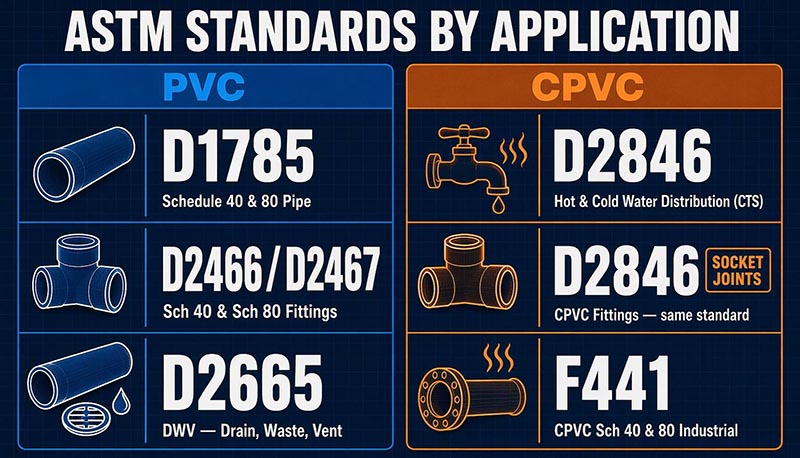
PVC pipe & fittings and CPVC pipe & fittings are covered by different ASTM standards, and using the wrong standard is a fast path to a rejected submittal.
- PVC pressure pipe: ASTM D1785 for schedule 40 and 80 PVC pipe. PVC fittings under ASTM D2466 (sch 40) and D2467 (sch 80).
- PVC DWV pipe & fittings: ASTM D2665 for drain, waste, and vent pipe and fittings.
- CPVC hot/cold water pipe & fittings: ASTM D2846 for CPVC plastic hot- and cold-water distribution systems (CTS — copper tube size). CPVC fittings also under D2846 with socket-type joints.
- CPVC industrial pipe & fittings: ASTM F441 for schedule 40 and
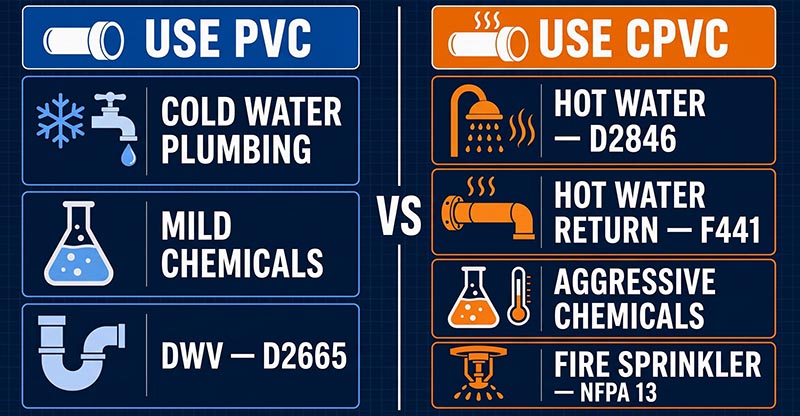
Decision Framework: When to Use CPVC vs PVC Pipe & Fittings
Cold water plumbing: PVC pipe & fittings — CPVC offers no advantage below 60°C.
Hot water distribution (commercial/residential): CPVC pipe & fittings under ASTM D2846. PVC cannot handle hot water. Period.
Industrial hot water return lines: CPVC pipe & fittings under ASTM F441. The continuous 70–90°C return water is beyond PVC’s capability.
Chemical processing (ambient temp, mild chemicals): PVC pipe & fittings — economical and adequate for most mild chemicals below 40°C.
Chemical processing (elevated temp or aggressive media): CPVC pipe & fittings — the extra 33°C and improved chemical resistance justify the premium.
DWV systems: PVC pipe & fittings under ASTM D2665. DWV applications rarely see elevated temperatures, making CPVC’s premium unnecessary.
Fire sprinkler systems: CPVC pipe & fittings — specifically listed products under NFPA 13. PVC is not approved for fire sprinkler use.
Frequently Asked Questions
Can I use PVC cement on CPVC pipe?
No. PVC and CPVC require different solvent cements. PVC cement will not properly bond CPVC, and CPVC cement will not properly bond PVC. The cements are chemically formulated for their respective materials. CPVC cement is typically orange for visual identification. Using the wrong cement produces joints that may hold initial pressure but fail under thermal cycling.
What’s the maximum temperature CPVC can handle?
CPVC is rated for continuous service up to 93°C (200°F) with appropriate pressure derating. At 82°C, CPVC retains about 50% of its 23°C pressure rating. Above 93°C, CPVC softens and loses structural integrity — it is not suitable for steam lines or high-temperature industrial processes exceeding this threshold.
Is CPVC more brittle than PVC?
Yes, slightly. CPVC has lower impact resistance than PVC, particularly at low temperatures. This makes proper handling and installation more important — avoid dropping fittings, use sharp cutting tools, and deburr all cut edges thoroughly. The brittleness difference is minor enough that it doesn’t affect most normal service conditions, but it does affect installation practices.
Can I mix CPVC and PVC fittings in the same system?
Not recommended. CPVC and PVC have different thermal expansion rates and slightly different chemical compatibility profiles. Transition fittings designed for CPVC-to-PVC connections exist, but mixing them arbitrarily within a system creates stress points at the joints and complicates maintenance — crews need to carry both cement types. Design the system for one material throughout unless specific transition points are engineered.
Do I need expansion compensation for CPVC hot water lines?
Almost always yes. CPVC expands roughly 0.06 mm per meter per degree Celsius. A 30-meter CPVC run cycling between 20°C and 80°C expands about 11 cm. Without expansion loops, offsets, or compensators, this movement creates high stress at fixed points and fittings. The expansion compensation design depends on pipe diameter, run length, and temperature swing — consult the manufacturer’s expansion design guide for specific spacing requirements.
About SAM-UK
SAM-UK are a professional 20+ years manufacturer in producing vinyl building profile products and PVC , CPVC , PPH , PPR , PP pipes and pipe fittings, valves, taps and so on. We own the certificates of SGS\SONCAP\ISO9001\ISO15874\CE\NSF\UPC\ETL\Watermark,support color /size customization. Welcome to consult for Catalog and Product. you can contact us at email [email protected]