Introduction
Pick the wrong joint method and you’re creating a future leak. Pick right and the system never needs attention. I’ve seen a single bad solvent weld joint flood a mechanical room and I’ve seen threaded connections hold for 20 years without a drip. The difference? Knowing which method to use — and the details that matter during installation.
By reading the following guide, you can learn about PVC pipe joining methods—such as solvent welding, threaded connections, and flanged connections—as well as the appropriate applications for each method.
Solvent Weld Joints — The Permanent Bond
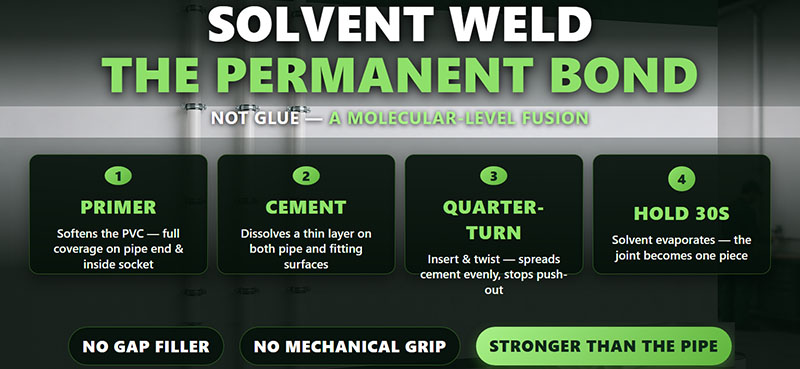
Solvent welding is not glue. Let’s get that straight right now. The cement and primer chemically fuse the pipe and fitting at the molecular level — the joint literally becomes one piece of PVC. A properly executed solvent weld joint is stronger than the pipe itself, which is why this method dominates pressure systems from potable water to chemical processing.
How it works: the primer softens the PVC surface, then the solvent cement dissolves a thin layer on both pipe and fitting. When you push them together, the dissolved material intermingles and then hardens as the solvent evaporates. No gap filler. No mechanical grip. Pure fusion.
The technique matters more than most installers realize. Apply primer aggressively — a quick dab won’t cut it. You need full coverage on the pipe end and inside the fitting socket. Then cement goes on both surfaces: a medium coat on the pipe, a thin coat inside the fitting. Insert with a quarter-turn twist and hold for 30 seconds. That twist is non-negotiable — it spreads the cement evenly and prevents push-out. Skip it and you’re gambling.
Cure Times: Temperature Changes Everything
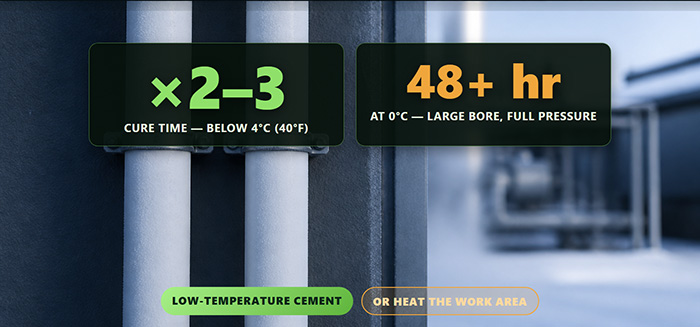
Here’s where most jobsites go wrong. People treat cure time like a fixed number. It’s not. Temperature is the dominant variable.
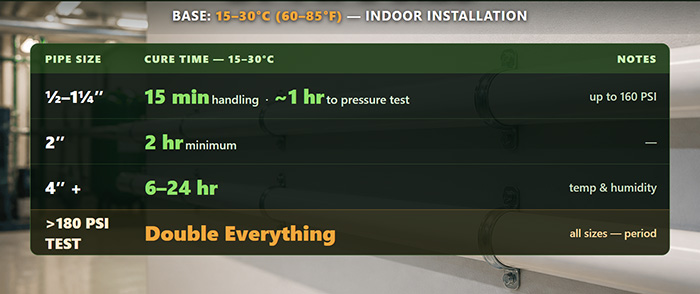
For pipe sizes ½” to 1¼” at 15-30°C (60-85°F), you’re looking at 15 minutes of cure time before handling and roughly 1 hour before pressure testing up to 160 PSI. Jump to 2″ pipe and that becomes 2 hours minimum. At 4″ and above? You need 6-24 hours depending on temperature and humidity. And if you’re testing above 180 PSI, double all cure times. Period.
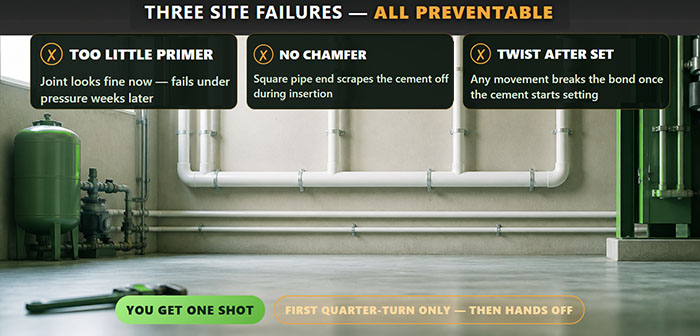
Common mistakes I’ve seen on site: using too little primer (the joint looks fine, fails under pressure weeks later), not chamfering the pipe end (it scrapes the cement off during insertion), and the classic — twisting the fitting after the initial quarter turn. Once that cement starts setting, any movement breaks the bond. You get one shot.
ASTM Standards for Solvent Weld Systems
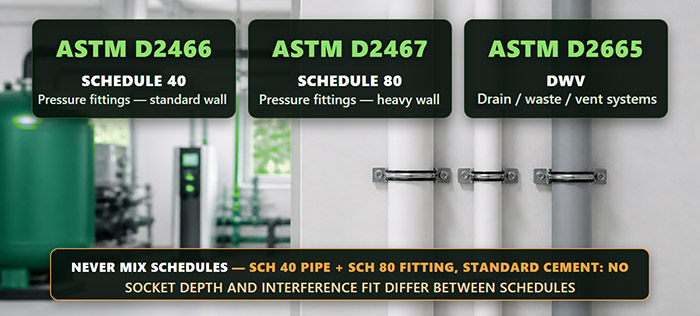
SAM-UK PVC fittings for solvent weld comply with ASTM D2466 (Schedule 40) and ASTM D2467 (Schedule 80). For drainage applications, ASTM D2665 governs DWV systems. Always match the pipe and fitting schedules — never solvent weld Sch 40 pipe into Sch 80 fittings with standard cement. The socket depth and interference fit differ.
Threaded Joints — Serviceable but Tricky
Threaded joints give you one thing solvent welds don’t: the ability to disassemble. That matters for valve connections, equipment tie-ins, and any point where future maintenance is likely. But there’s a trade-off, and it’s significant.
Rule number one: only thread Schedule 80 pipe. Never thread Schedule 40. Threading removes wall thickness. Schedule 40 PVC lacks the material needed for safe thread depth — the remaining wall is too thin and will crack under pressure. In fact, industry standards apply a 50% pressure de-rating to threaded Schedule 80 pipe to account for the wall reduction. A Sch 80 pipe rated for 200 PSI unthreaded drops to 100 PSI when threaded. Let that sink in.

Sealant: Tape, Dope, or Both?
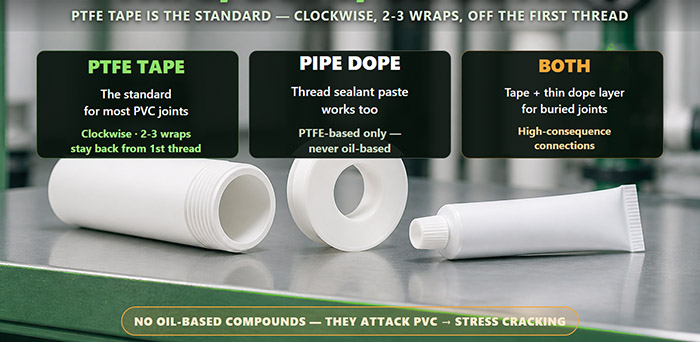
The debate gets heated on jobsites. Here’s the practical answer: PTFE tape is the standard for most PVC threaded connections. Wrap it clockwise (looking at the male end), 2-3 wraps, covering the threads but staying back from the first thread — material pushed into the pipe bore can contaminate the system.
Pipe dope (thread sealant paste) works too, and some installers swear by tape plus a thin layer of dope over the tape for buried or high-consequence joints. The key with any sealant on PVC threads: never use oil-based compounds. They can attack the PVC and cause stress cracking over time. Use PTFE-based, plastic-compatible sealants only.
Torque: Finger Tight, Then Stop
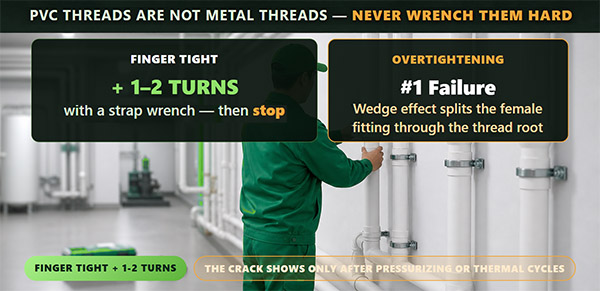
This is where plastic and metal diverge completely. Metal threads you can wrench down hard. PVC threads? Finger tight plus 1 to 2 turns with a strap wrench — no more. Overtightening is the #1 cause of threaded PVC failures. The tapered threads create a wedge effect; crank too hard and you’ll split the female fitting through the thread root. The crack might not show until the system pressurizes or goes through a few thermal cycles.
Here’s a torque reference for threaded PVC Sch 80 fittings:
- ½” diameter: 7-10 ft-lbs — about what you can achieve with one hand on a small wrench
- ¾” diameter: 10-14 ft-lbs
- 1″ diameter: 14-18 ft-lbs
- 1½” diameter: 20-25 ft-lbs
- 2″ diameter: 25-35 ft-lbs
If you’re using a pipe wrench with a cheater bar, you’ve already gone too far. Use a strap wrench.
Flanged Joints — For Equipment Connections
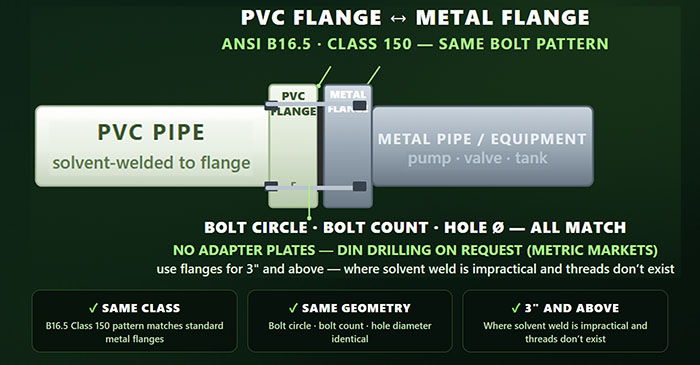
Flanged connections are your go-to when you need to connect PVC pipe to pumps, valves, tanks, or metal piping. They’re also the right call for larger diameters (3″ and above) where solvent welding becomes impractical and threaded connections don’t exist.
SAM-UK PVC flanges follow the ANSI B16.5 Class 150 bolt pattern, which means they mate with standard metal flanges in the same class. The bolt circle, number of bolts, and bolt hole diameter all match — no adapter plates needed. For metric markets, DIN-compatible drilling is available on request.
Gasket Selection: EPDM vs FKM
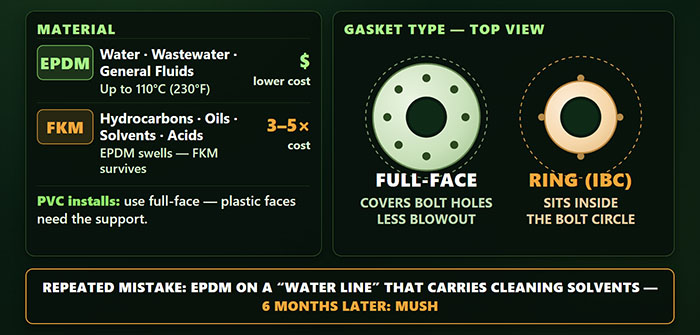
This decision catches a surprising number of specifiers off guard. EPDM (ethylene propylene diene monomer) is the standard for water, wastewater, and most general industrial fluids. It handles temperatures up to 110°C (230°F) and costs less.
But if your system carries hydrocarbons, oils, solvents, or concentrated acids, EPDM swells and fails. You need FKM (Viton®) gaskets. They cost 3-5x more but survive chemical environments that would destroy EPDM in hours. The mistake I see repeated: specifying EPDM gaskets for a “water line” that periodically carries cleaning solvents. Six months later, the gaskets are mush.
Full-face vs ring gaskets: full-face gaskets cover the entire flange face including bolt holes — they’re easier to align and less prone to blowout. Ring gaskets (IBC — inside bolt circle) sit inside the bolt pattern. Use full-face for most PVC installations; the plastic flange face needs the distributed support.
Bolt Torque and Tightening Sequence
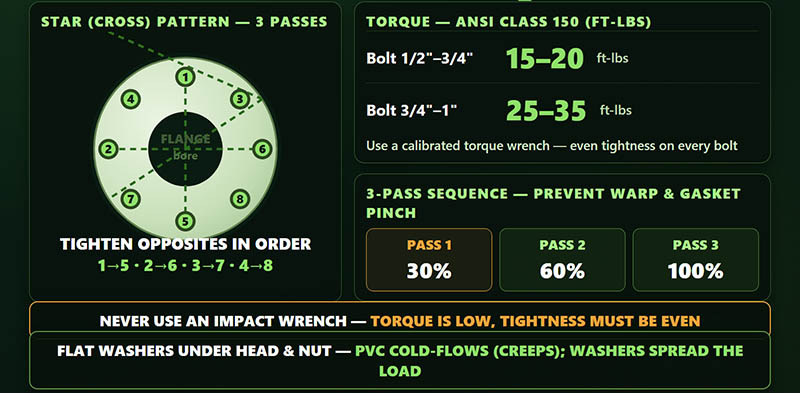
Never use an impact wrench on PVC flanges. The torque values are low and bolt tightness must be even. Follow a star-pattern (cross) tightening sequence in 3 passes: first pass to 30% of target torque, second to 60%, third to full torque. This prevents flange warping and gasket pinching.
Typical bolt torque values for ANSI 150 PVC flanges: 15-20 ft-lbs for ½”-¾” bolts, 25-35 ft-lbs for ¾”-1″ bolts. Use a calibrated torque wrench. And one more thing — flat washers under both bolt head and nut. PVC flange faces will cold-flow (creep) under point loading. Flat washers spread the load and prevent the bolt head from embedding into the plastic over time
Mechanical Couplings — The Flexible Alternative
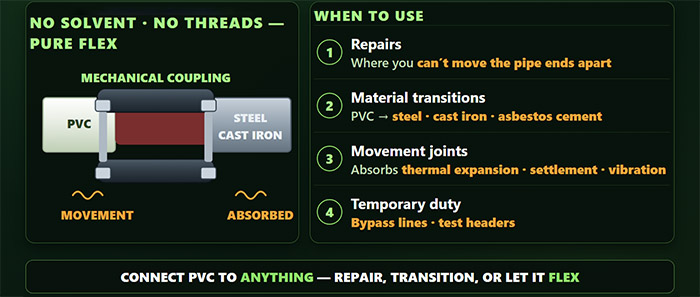
Mechanical couplings (also called compression couplings or repair couplings) grip the outside of the pipe with a rubber gasket and metal housing. They’re not a permanent fusion joint — and that’s exactly their advantage.
When to use mechanical couplings:
- Repair situations where you can’t move the pipe ends apart
- Connecting PVC to other materials (steel, cast iron, asbestos cement)
- Joints that need to absorb thermal expansion, ground settlement, or vibration
- Temporary bypass or test headers
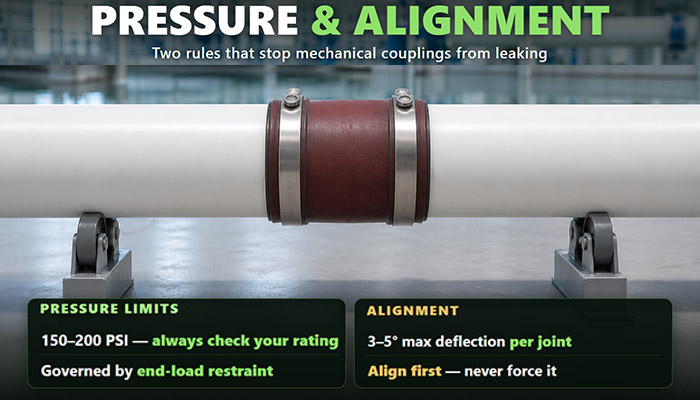
Pressure limits: standard mechanical couplings for PVC typically rate to 150-200 PSI, but always check the manufacturer’s rating for the specific coupling and pipe material combination. The coupling’s pressure rating is usually governed by its end-load restraint capability — without thrust blocks or tie rods, internal pressure will push the pipes apart.
Alignment is critical. Mechanical couplings tolerate minor angular deflection (typically 3-5° per joint), but if you’re using that deflection to force misaligned pipes together, you’re storing stress that will eventually cause a leak. Get the pipes aligned first, then install the coupling.
Joint Method Selection Matrix
| Factor | Solvent Weld | Threaded | Flanged | Mechanical Coupling |
|---|---|---|---|---|
| Permanent/Serviceable | Permanent — cannot disassemble | Serviceable — can unscrew | Serviceable — unbolt and remove | Serviceable — remove housing |
| Pressure Rating | Full pipe rating (joint stronger than pipe) | 50% of pipe rating (thread cut reduces wall) | Full pipe rating (flange matched to pipe class) | 150-200 PSI typical (check manufacturer) |
| Diameter Range | ½” to 12″ (larger requires special equipment) | ½” to 2″ (Sch 80 only; larger rarely threaded) | 2″ to 24″+ | ½” to 24″+ (any diameter with correct coupling) |
| Skill Required | Moderate — technique-sensitive | Low — but torque control is critical | Moderate — proper bolt torque and sequence | Low — alignment and torque wrench only |
| Leak Risk Over Time | Very low if properly installed | Moderate (thermal cycling loosens threads) | Very low (gasket replacement may be needed) | Low (gasket aging, but replaceable) |
| Best Applications | Buried pressure lines, process piping, plumbing | Valve connections, instrument ports, small headers | Pump connections, tank nozzles, large valves | Repairs, material transitions, expansion joints |
Frequently Asked Questions
Can I solvent weld PVC and CPVC together?
No. PVC and CPVC have different chemical compositions and softening temperatures. PVC solvent cement won’t properly fuse CPVC, and vice versa. Use a transition cement specifically rated for PVC-to-CPVC joints, or better yet — use a mechanical coupling or flanged connection. The risk isn’t worth the shortcut.
Why did my threaded PVC joint start leaking after 6 months?
Three likely causes: overtightening during installation (the crack took time to propagate), thermal cycling (hot/cold cycles loosened the threads), or wrong sealant (oil-based compounds attack PVC). If the leak is at a threaded joint in a hot water line, thermal cycling is almost certainly the culprit — switch to CPVC or flanged connections.
What’s the minimum cure time before pressure testing a 4″ solvent weld joint?
At 21°C (70°F) and below 160 PSI: minimum 6 hours. At 10°C (50°F): minimum 12 hours. Below 4°C (40°F): minimum 24 hours. Above 160 PSI, double these times. For critical systems, waiting 24 hours regardless of temperature is cheap insurance.
Do PVC flanges need a gasket on both sides?
No — one gasket between the flange faces. The gasket sits between the raised faces of the two mating flanges. Using two gaskets (one on each side) will almost certainly leak because there’s no way to achieve uniform compression. Match the gasket material to your fluid — EPDM for water, FKM for chemicals and hydrocarbons.
Can I use mechanical couplings on buried PVC pipe?
Yes, but with caveats. Use stainless steel housing and hardware (304 or 316 SS — carbon steel will corrode). The coupling must be rated for below-grade use with a full-wrap gasket. Most importantly, thrust restraint is essential — without it, internal pressure will push the pipes apart at the coupling joint. Use tie rods, thrust blocks, or restrained-joint couplings.
About SAM-UK
SAM-UK are a professional 20+ years manufacturer in producing vinyl building profile products and PVC , CPVC , PPH , PPR , PP pipes and pipe fittings, valves, taps and so on. We own the certificates of SGS\SONCAP\ISO9001\CE\NSF,support color /size customization. Welcome to consult for Catalog and Product. you can contact us at email [email protected]