Introduction
→ Click to view the high-resolution diagram ←
The difference between Schedule 40 and Schedule 80 PVC is one thing: wall thickness. Same outside diameter, same solvent-weld installation, same resin chemistry. Everything else — pressure rating, flow capacity, weight, threading ability, installed cost — flows from that single dimensional change. This guide gives you the verified numbers per size, the threading rule most installers learn the hard way, and a straight answer on when Schedule 80 is worth the premium.
The Short Answer
→ Click to view the high-resolution diagram ←
Schedule 80 has a thicker wall and a higher pressure rating than Schedule 40 at the same nominal size. Outside diameter is identical — 2-inch is 2.375 inches OD in both — so Schedule 40 and Schedule 80 pipe fit the same trench, the same hangers and the same bell holes. What changes is the inside diameter and what that ID can take.
Why “schedule” instead of a wall dimension? The schedule system is a legacy of steel pipe sizing, where schedule number roughly tracked wall-to-bore ratio. PVC adopted the same designations under ASTM D1785, which covers PVC pipe in schedules 40, 80 and 120 for pressure service, with a maximum service temperature of 140°F (60°C). If you want the ratio-based system instead, that’s SDR — a different conversation with different math.
Wall Thickness, ID and Rating — Size by Size
→ Click to view the high-resolution diagram ←
Ratings below are for water, non-shock, at 73°F, which is the industry baseline. Notice that the pressure gain is roughly 40–45% at every size, while the wall thickness increase ranges from about 33% to 42%.
| Nominal size | Sch 40 wall (in) | Sch 40 ID (in) | Sch 40 rating (psi @73°F) | Sch 80 wall (in) | Sch 80 ID (in) | Sch 80 rating (psi @73°F) |
|---|---|---|---|---|---|---|
| 1/2″ | 0.109 | 0.602 | 600 | 0.147 | 0.526 | 850 |
| 3/4″ | 0.113 | 0.804 | 480 | 0.154 | 0.722 | 690 |
| 1″ | 0.133 | 1.029 | 450 | 0.179 | 0.936 | 630 |
| 1-1/4″ | 0.140 | 1.360 | 370 | 0.191 | 1.255 | 520 |
| 1-1/2″ | 0.145 | 1.590 | 330 | 0.200 | 1.476 | 470 |
| 2″ | 0.154 | 2.047 | 280 | 0.218 | 1.913 | 400 |
| 3″ | 0.216 | 3.042 | 260 | 0.300 | 2.864 | 370 |
| 4″ | 0.237 | 3.998 | 220 | 0.337 | 3.786 | 320 |
| 6″ | 0.280 | 6.031 | 180 | 0.432 | 5.709 | 280 |
| 8″ | 0.322 | 7.942 | 160 | 0.500 | 7.565 | 250 |
Dimensions and ratings per manufacturer-published ASTM D1785 data (Spears schedule 40 and schedule 80 tables); ratings are non-shock water service at 73°F. Always use the specific manufacturer’s published table for engineering calculations.
Ratings Don’t Rise Monotonically with Size
→ Click to view the high-resolution diagram ←
Here’s the detail that trips up people who assume bigger pipe equals higher rating. Look at 2-1/2-inch: Schedule 40 jumps to 300 psi — higher than the 2-inch rating of 280 psi, and higher than 3-inch at 260 psi. Schedule 80 does the same thing, with 2-1/2-inch at 420 psi against 400 psi at 2-inch.
The reason is that nominal size and wall thickness don’t move together in the schedule system. The 2-1/2-inch wall (0.203-inch Sch 40) is proportionally much heavier against its diameter than the 2-inch wall (0.154-inch). This is exactly why the Westlake technical guidance says schedule ratings must be looked up for every diameter and schedule combination — there is no single conversion factor. Anyone interpolating a rating from a nearby size is guessing.
What You Give Up: Flow Capacity
→ Click to view the high-resolution diagram ←
Thicker wall means smaller bore. At 2-inch, the ID drops from 2.047 inches to 1.913 inches — about 13% less cross-sectional flow area. At 4-inch it goes from 3.998 to 3.786 inches. That doesn’t sound dramatic until you put it through friction-loss math on a long run: a smaller bore raises velocity at the same flow rate, and friction loss climbs with roughly the square of velocity. In practice, upsizing to Schedule 80 on a gravity-fed or long-run system can mean a larger pump or a larger nominal pipe size to hit the same delivered flow.
That’s the hidden argument for staying with Schedule 40 where the rating allows it. You’re not just saving on pipe cost; you’re preserving the hydraulic design the engineer already signed off on.
Threading: The Rule Most People Break
→ Click to view the high-resolution diagram ←
Manufacturer guidance is blunt: Schedule 80 or heavier wall should be the only PVC pipe threaded. Schedule 40 thread stock removes material from an already-thin wall and creates a stress concentration at the last engaged thread — the classic failure point.
Even on Schedule 80, threading costs you real rating. Published threaded-pipe ratings at 73°F tell the story:
| Size | Sch 80 plain end | Sch 80 threaded | Rating lost |
|---|---|---|---|
| 1″ | 630 psi | 315 psi | 50% |
| 1-1/4″ | 520 psi | 260 psi | 50% |
| 1-1/2″ | 470 psi | 235 psi | 50% |
| 2″ | 400 psi | 200 psi | 50% |
The practical alternative: use solvent-weld joints or molded transition adapters instead of threading PVC. Where a threaded connection is unavoidable — pump connections, metal-to-plastic transitions — specify Schedule 80, use molded male/female adapters rather than cutting threads, and apply sealant compatible with PVC. Thread sealant chemistry matters; some pastes and tapes contain plasticizers that stress-crack PVC over time.
Temperature Derating: Where Schedule 80 Earns Its Keep
→ Click to view the high-resolution diagram ←
PVC’s 73°F rating is a starting point, not a working number. Above it, both schedules lose capacity fast:
| Water temperature | 73°F | 80°F | 90°F | 100°F | 110°F | 120°F | 130°F | 140°F |
|---|---|---|---|---|---|---|---|---|
| Derating factor | 1.00 | 0.88 | 0.75 | 0.62 | 0.51 | 0.40 | 0.31 | 0.22 |
Run the math on a 2-inch line at 120°F: Schedule 80 gives 400 × 0.40 = 160 psi; Schedule 40 gives 280 × 0.40 = 112 psi. If your system needs 150 psi at that temperature, Schedule 40 doesn’t qualify — Schedule 80 does. This is the single most common legitimate reason to step up in a process or hot-water-adjacent application. And if you’re honestly living above 140°F, PVC is the wrong material entirely — that’s CPVC Piping Series territory (service to roughly 180–200°F with its own derating curve).
The DWV Trap
→ Click to view the high-resolution diagram ←
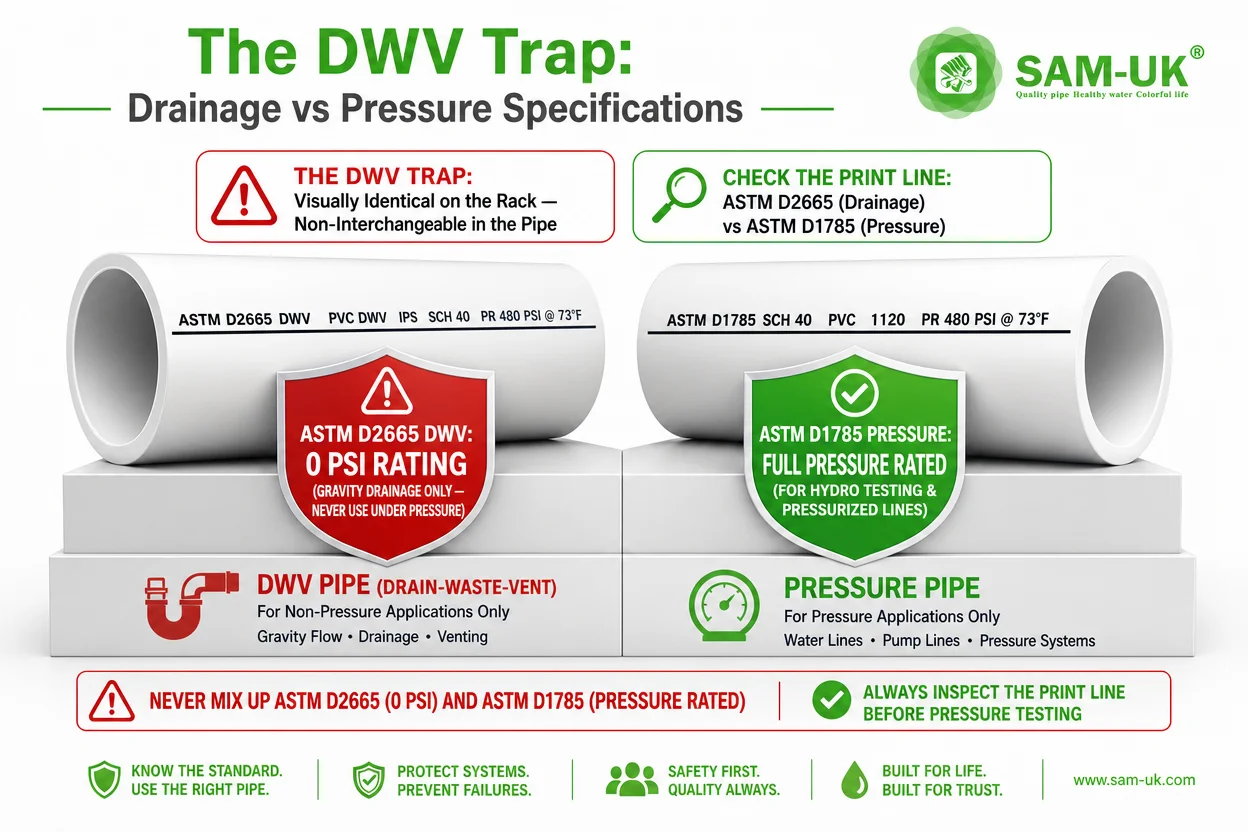
One more distinction that causes real failures: DWV pipe is not pressure pipe. PVC drain-waste-vent pipe made to ASTM D2665 carries a pressure rating of effectively zero — it’s a drainage product, and the maximum working temperature guidance drops to 140°F with no pressure allowance. Schedule 40 DWV pipe looks similar to Schedule 40 pressure pipe on a rack, and at 1-1/4-inch and larger the dimensions are close enough to be swapped by mistake. They are not interchangeable products. If the line is going to be pressure-tested or holds water under head, it must be pressure-rated pipe to ASTM D1785.
Fittings Must Match the Schedule
→ Click to view the high-resolution diagram ←
Schedule 40 socket fittings are made to ASTM D2466; Schedule 80 socket fittings are made to ASTM D2467, and threaded Schedule 80 fittings to ASTM D2464. Socket depths differ between the schedules at smaller sizes — published socket-length data shows Schedule 80 sockets running deeper than Schedule 40 through the smaller diameters, converging at 2-1/2-inch and above.
Mixing is where quality problems emerge. A Schedule 40 fitting on Schedule 80 pipe gives you a joint whose socket wasn’t dimensioned for that wall and whose rating will be the lower of the two components. It’s common practice in the field, and it’s tolerated in plenty of non-critical installations — but if the system is being engineered to a rating, keep pipe and fittings in the same schedule and buy them as a system from one manufacturer.
This is also where tooling quality separates suppliers. Socket depth, taper and wall concentricity come straight off the mold, and a worn mold produces fittings that solvent-weld with a slightly loose feel or a visible glue bead line that shouldn’t be there. A manufacturer running its own mold workshop controls that variable directly instead of discovering drift through customer complaints. SAM-UK has operated its own mold shop since 1995 out of Taizhou, with capacity around 50,000 tonnes a year and 30-day lead times on standard programs — the kind of setup that matters when you’re buying fittings by the container and need schedule consistency across shipments.
Selection Framework
→ Click to view the high-resolution diagram ←
| Application | Go with | Why |
|---|---|---|
| Residential cold water service, irrigation mains | Schedule 40 | Duty pressures sit far below the rating; more flow per dollar |
| DWV / drainage (ASTM D2665) | Schedule 40 DWV | Non-pressure by design; pressure-rated pipe is a waste of money here |
| Chemical feed lines, industrial process water | Schedule 80 | Higher margin against pressure spikes and external abuse |
| Any threaded connection | Schedule 80 | Only schedule 80 or heavier should be threaded at all |
| Lines running near 120–140°F | Schedule 80 (or CPVC Piping Series) | Derating eats Schedule 40’s margin first |
| Exposed pipe in traffic or washdown areas | Schedule 80 | Thicker wall absorbs impact; common industrial spec |
| Above 140°F continuous | CPVC | PVC is out of its temperature range entirely |
Cost: Look at the Whole Equation
→ Click to view the high-resolution diagram ←
Schedule 80 costs more per foot, and there’s a second cost most quotes miss — weight. A 2-inch Schedule 80 pipe weighs about 0.98 lb/ft against 0.72 lb/ft for Schedule 40, and at 6-inch the gap widens to 5.61 versus 3.20 lb/ft. That weight shows up in freight, in handling labor, and in hanger spacing decisions. On a container shipment it’s not a rounding error.
Set that against what Schedule 80 buys: a higher rating, threading capability, and more resistance to the mechanical abuse that actually kills pipe in industrial settings. The mistake is treating it as a default upgrade. Specify it where the duty requires it; don’t pay the premium — in material, freight and lost flow — on a line where Schedule 40 already has margin.
Frequently Asked Questions
Can I use Schedule 40 and Schedule 80 PVC together?
Physically yes, with solvent-weld joints, and the outside diameters match. But the joint rating defaults to the weaker component, and socket geometry differs between ASTM D2466 and D2467 at smaller sizes. For engineered pressure systems, keep pipe and fittings in one schedule.
Is Schedule 80 always stronger in every way?
No. It’s thicker and rated higher, but it has a smaller inside diameter — about 13% less flow area at 2-inch — and it weighs roughly 35% more per foot. For gravity or long-run systems, that flow penalty can require a larger pump or pipe size.
Why is 2-1/2-inch rated higher than 2-inch pipe?
Because schedule designations don’t scale linearly with diameter. The 2-1/2-inch Schedule 40 wall (0.203 inch) is proportionally heavier for its bore than the 2-inch wall (0.154 inch), so it carries a higher rating — 300 psi versus 280 psi. Ratings must be looked up per size and schedule.
What happens if I thread Schedule 40 PVC?
You remove wall material and create a stress concentration, and the published guidance is that only Schedule 80 or heavier should be threaded. Even on Schedule 80, threading cuts the rating by roughly half — a 2-inch pipe drops from 400 psi to about 200 psi.
Can Schedule 40 DWV pipe be used for pressure?
No. ASTM D2665 DWV pipe is not a pressure-rated product. It’s intended for drain, waste and vent service. Pressure lines need pipe to ASTM D1785. The two look similar on a rack and get confused constantly.
What is the maximum temperature for PVC pipe?
140°F (60°C) is the maximum service temperature for PVC pressure pipe, and at 140°F the pipe retains only about 22% of its 73°F pressure rating. For continuous service above 140°F, use CPVC.
About SAM-UK
SAM-UK (Taizhou Zhuoxin Plastics Co., Ltd.) has manufactured plastic pipe and fittings since 1995 — PVC , CPVC , PPH , PPR and PP systems, plus valves and taps. Our certifications: ISO 9001, NSF, UPC, ETL, CE and Watermark. We support color and size customization, and we supply ISO/IEC 17025 test reports to support your local market registration — in the Gulf, that registration is held by the importer or project entity, and we provide the evidence for it. Download the catalog or contact our team at [email protected].