Introduction
PPH is the right answer for hot, aggressive chemical service and the wrong answer for a buried cold-water main — and that single fact settles most of the arguments we see.
Buyers keep getting it backward anyway. PPH (polypropylene homopolymer) looks like PVC, fuses like PPR, and lands in a similar price bracket, so it gets treated as a drop-in swap for an existing PVC line. It isn’t one. PPH holds up to continuous service near 95°C and shrugs off chemistry that would destroy PVC inside a season — then loses badly where PVC has decades of quiet field proof.
What PPH Actually Is — and How It Differs from PPR and PVC
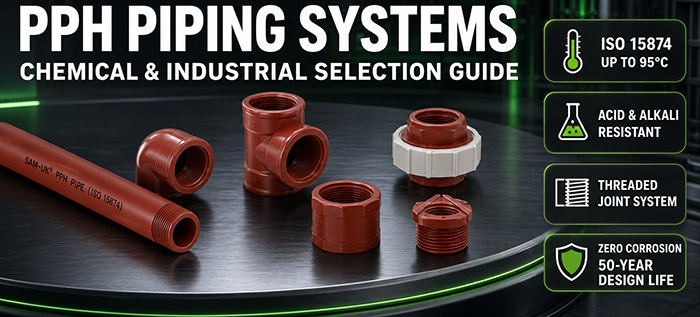
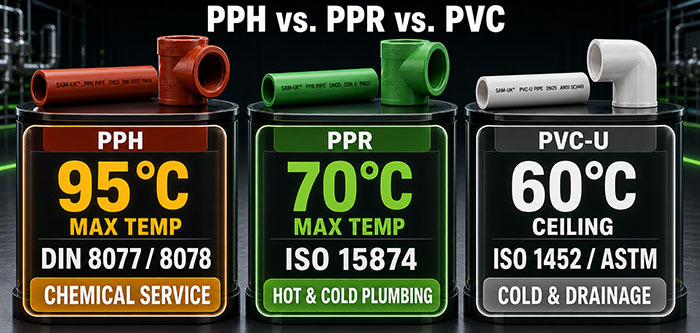
PPH stands for polypropylene homopolymer, and everything else follows from that word. Homopolymer means the chain is built from propylene units alone, giving maximum crystallinity and stiffness. PPR is the random copolymer: ethylene is sprinkled along the chain, which drops crystallinity and makes it weld more forgivingly. ISO 15874 governs PPR hot- and cold-water systems, and that standard gets quoted for PPH by mistake — it doesn’t apply. For PPH, DIN 8077 and DIN 8078 cover pipe dimensions and pressure ratings, with fittings usually following the matching PP fitting standard.
The PVC comparison matters more for most specifiers. PVC is chlorinated, cheap, stiff, and excellent for cold water and drainage. Its practical ceiling, though, sits around 60°C, and it’s vulnerable to solvents and concentrated chemistry in a way PPH isn’t. Push PPH into the band where PVC softens and it keeps working, because the homopolymer holds its shape to roughly 95°C continuous. The flip side is impact: below about 0°C, polypropylene turns brittle, and a length dropped in a winter laydown yard can crack where PVC would have bounced.
Here’s the confusion we hit constantly. A plant writes PPH on the requisition, the distributor substitutes PPR because “they’re both polypropylene,” and nobody notices until the weld behaves differently. They are not interchangeable. PPR trades stiffness and temperature headroom for toughness and weldability; PPH does the reverse.
The Temperature and Pressure Derating Reality
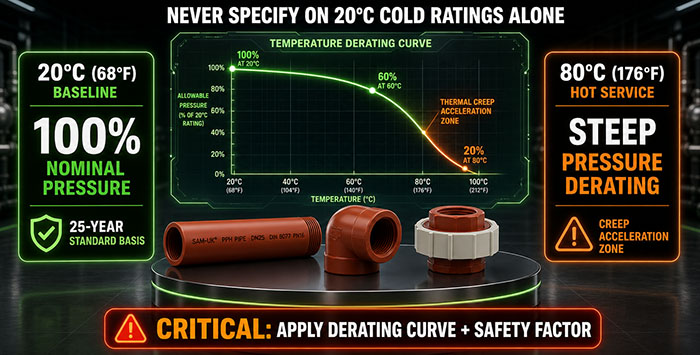
Read the derating curve before you size anything. Thermoplastic pipe pressure ratings are quoted on a 25-year basis at 20°C (68°F) — that’s the convention, and it’s the number buyers grab first. At 20°C the figure looks generous. But a 20°C rating says nothing about 80°C behavior, and a PPH line running hot chemistry at 80°C may carry only a fraction of its cold rating.
Derating is not a straight line. It bends downward as temperature climbs — steeply past 60°C — because long-term strength depends on creep, and creep accelerates with heat. Specify off the 20°C figure and you will over-pressure the line. The fix is boring: take the maximum continuous operating temperature, read the allowable pressure off the manufacturer’s derating curve, then apply a safety factor.
We’ve watched lines fail on the worst day of a heatwave — ambient pipe in a plant room hit 55°C, the process ran hotter, and a fusion joint that passed commissioning blew at 14 months. The design had used a 20°C number. If the only rating on your spec sheet is a cold one, the spec is incomplete.
Chemical Service Selection
PPH is the material you reach for when the medium would eat PVC. It handles most acids, bases, and salt solutions across a wide temperature range, without the leachable additives that make some materials suspect in high-purity lines. But “chemical resistant” is not a blanket pass. Strong oxidisers are the dealbreaker. Concentrated nitric acid, chromic acid, and fuming oxidisers attack the polymer backbone, and no derating curve rescues you.
| Service medium | Typical concentration | Temperature guidance | PPH suitability |
|---|---|---|---|
| Hydrochloric acid (HCl) | to ~30% | to elevated temperature | Excellent |
| Sulfuric acid, dilute | to ~30% | to elevated temperature | Excellent |
| Sulfuric acid, concentrated | ~98% | ambient, short contact only | Limited — verify before use |
| Sodium hydroxide (caustic) | to ~50% | to elevated temperature | Excellent |
| Sodium hypochlorite (bleach) | to ~12% | ambient to warm | Good — drops as strength and heat rise |
| Brine / chloride salt solutions | any | to elevated temperature | Excellent |
| Aqueous ammonia | any | to elevated temperature | Good |
| Alcohols (methanol, ethanol) | any | ambient to warm | Good |
| Nitric acid, concentrated / fuming | — | any | Not recommended — strong oxidiser |
| Chromic acid | — | any | Not recommended — strong oxidiser |
| Chlorinated solvents (methylene chloride, perchloroethylene) | — | any | Not recommended — swelling / dissolution |
| Aromatics (benzene, toluene) | — | any | Poor — swelling risk |
Chlorinated solvents and aromatics are the second trap — methylene chloride, perchloroethylene, benzene, toluene swell or slowly dissolve polypropylene, sometimes gently enough to masquerade as something else. Every figure above is valid only at the concentration and temperature tested, because ratings move with both. Confirm the exact pairing against the resin maker’s chart before you commit a line.
Joining PPH — Fusion Welding, Not Solvent Cement
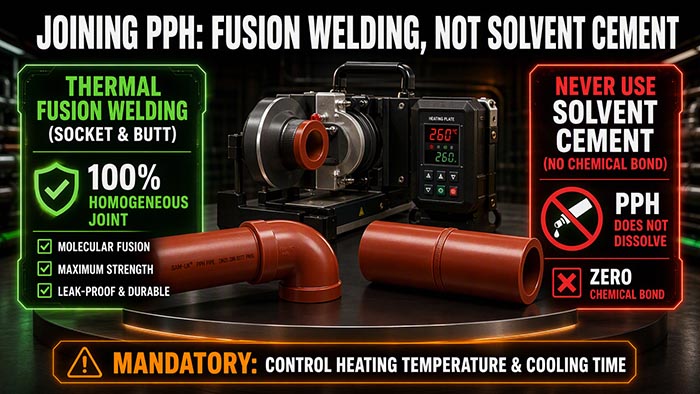
PPH is welded, full stop. You cannot solvent-cement it, because polypropylene doesn’t dissolve in the cements used on PVC — there’s no chemical weld to form. Butt fusion and socket fusion are the two routes: butt fusion for larger diameters and a flush bore, socket fusion for smaller lines and tight work. Both heat the surfaces to melt temperature, press them together, and let them cool into a homogeneous joint.
Equipment discipline decides whether those joints hold. A dirty heating plate is the classic killer — residue from the last weld carbonises onto the next and leaves a weak zone that passes a visual check, then fails under thermal cycling. Heating plate temperature and cool-down time are not suggestions. Set them per the standard and wall thickness, and hold them even when the crew is running late.
PVC goes together the opposite way. Solvent cement chemically welds the joint, so the skill is fit, primer, and cure time — and cure time can double in cold weather below 4°C. Don’t assume a PVC crew can weld PPH without training; the failure modes share almost nothing.
Where PPH Wins — and Where It Loses
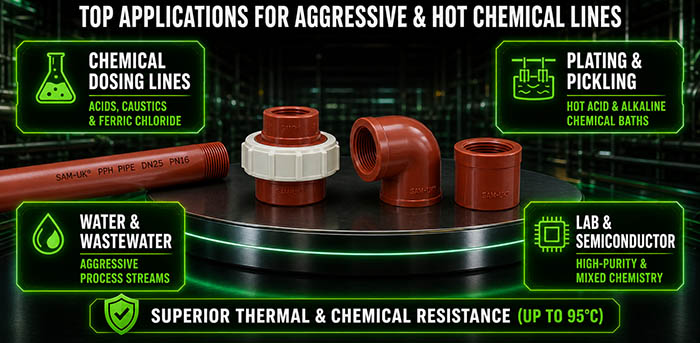
Here are the jobs where specifying PPH isn’t a close call:
- Chemical dosing lines — sodium hypochlorite, ferric chloride, caustic, and acid dosing at ambient-to-warm temperature, where PVC’s heat ceiling runs out.
- Plating and pickling lines — hot acid and alkaline baths that punish any metal and most plastics.
- Water and wastewater treatment — aggressive process streams and chemical feed where reliability outranks material cost.
- Laboratory waste drainage — mixed, unpredictable chemistry with heat, exactly what PPH’s broad acid/base resistance is built for.
- Semiconductor rinse and high-purity lines — where low extractables and a smooth bore matter.
- Industrial chilled and hot loops — closed HVAC systems running warmer than PVC can take.
What these share is heat plus chemistry. Take either away and the case for PPH weakens fast. Then there’s sunlight: UV degrades unprotected polypropylene, so an exposed run needs carbon black stabilisation, a UV-stabilised compound, or physical shielding — and even then expect a shorter life than indoors. On racks in the Middle East or Australia, plan for UV from day one.
Cold and high-pressure mains finish the story. Below roughly 0°C, polypropylene’s impact behaviour changes more than most crews expect. And a high-pressure cold-water main is not PPH territory — that’s PVC or HDPE ground, cheaper and proven. PPH is not a drop-in replacement for PVC on a cold-water main; force it there and you pay a premium for a material fighting the wrong job.
A Specifier’s Checklist
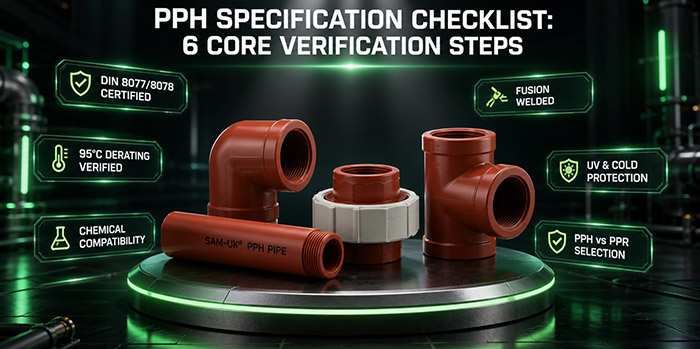
Before PPH goes on the requisition, work through six items:
- Confirm the medium against a resistance chart at the actual concentration and maximum temperature — not a generic “acid” label.
- Read the derating curve at the true operating temperature, then apply your safety factor.
- Choose PPH vs PPR deliberately, based on temperature headroom and stiffness rather than what’s in stock.
- Specify the standard — DIN 8077 / DIN 8078 for the pipe, matching PP fitting standard for joints — and confirm the supplier ships to it.
- Plan the joint method and verify the installer has PP fusion equipment and training, not just solvent-cement experience.
- Handle UV and cold if the line runs outdoors or the pipe ships through a winter.
When you shortlist suppliers, ask which standard they run to and how they hold it. SAM-UK, the export brand of Taizhou Zhuoxin Plastics Co., Ltd., has operated out of Taizhou, Zhejiang since 1995, with 300–350 employees and roughly 50,000 tonnes per year of capacity across PVC/uPVC, CPVC, PPH, PPR, and valves, exporting to North America, South America, Australia, Africa, and the Middle East. An in-house mold workshop and a 30-day lead time on standard programs matter here, because non-standard fittings are where PPH projects slip; OEM service is available for distributors running their own branding.
About SAM-UK
SAM-UK are a professional 20+ years manufacturer in producing vinyl building profile products and PVC , CPVC , PPH , PPR , PP pipes and pipe fittings, valves, taps and so on. See our certification records and product-specific scope. We support color /size customization. Welcome to consult for Catalog and Product. you can contact us at email [email protected]