Introduction
PPR and PVC aren’t competitors. They solve fundamentally different problems — and once you understand the dividing line, the choice becomes obvious for every single application.The following article will help you understand which type of pipe, PPR or PVC, is superior in terms of temperature, cost, and applications, and in which areas it excels.
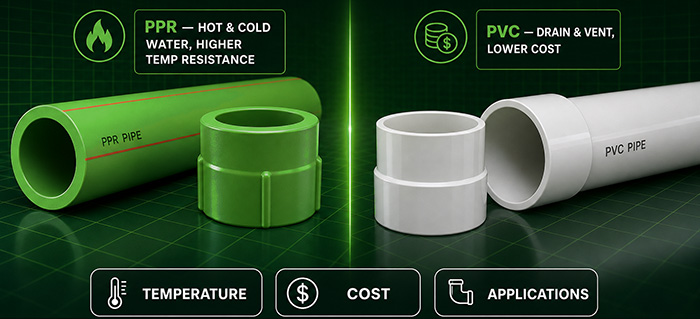
Temperature: The Deciding Factor
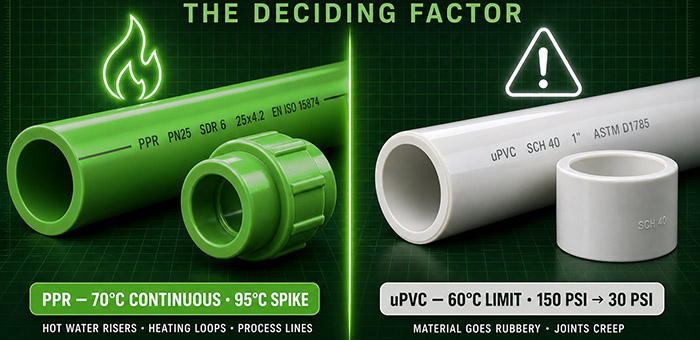
If there’s one number that splits these two materials, it’s 60°C (140°F). Below that line, PVC and PPR both work. Above it, PVC is out. Period.
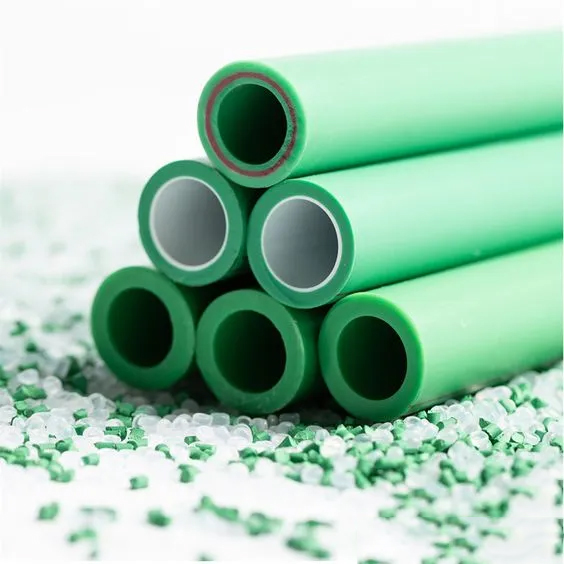
PPR handles continuous operating temperatures up to 70°C (158°F) at standard pressure ratings, with short-term spikes to 95°C (203°F) without structural failure. That’s why you see PPR in every hot water riser, central heating loop, and industrial hot-process line across Europe and Asia. The material doesn’t soften appreciably until you push past those numbers. Standard PVC (uPVC) starts losing mechanical strength above 60°C. The pressure rating derates rapidly — a pipe rated for 150 PSI at 23°C might handle only 30 PSI at 60°C. The material gets rubbery, joints creep, and eventually the system sags between supports like overcooked spaghetti.
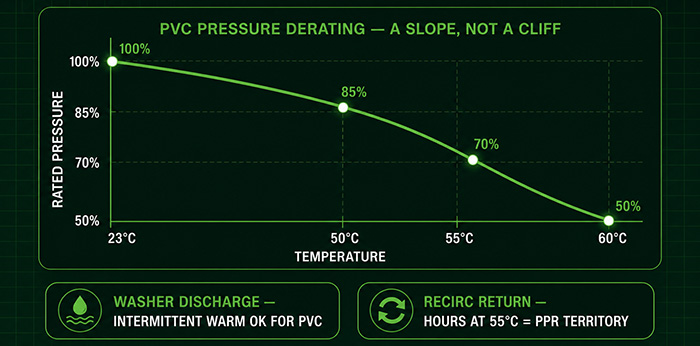
Here’s the nuance nobody talks about: PVC’s temperature limit isn’t a cliff — it’s a slope. At 50°C, PVC loses maybe 15% of its rated pressure capacity. At 55°C, you’ve lost 30%. At 60°C, you’re at roughly 50% of the room-temperature rating. The derating curve matters because a lot of “cold water” systems actually see intermittent warm water — think of the discharge from a washing machine or the return loop on a recirculating system. If your “cold water” application occasionally touches 55°C, you might be fine with PVC. But if it sits at 55°C for hours a day, you’re in PPR territory. Most contractors never check the actual temperature profile of the system they’re designing — they just pick PVC for cold and PPR for hot. That’s oversimplified but directionally correct.
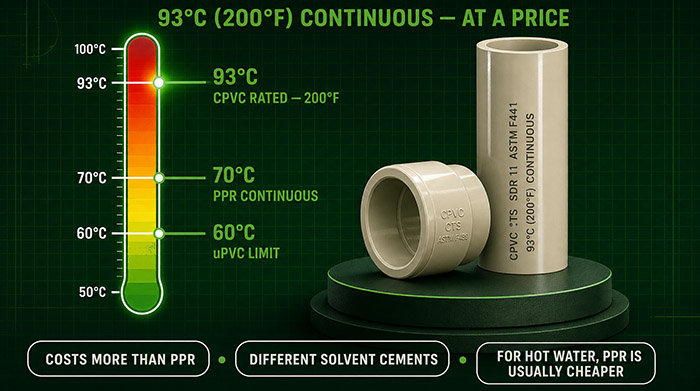
CPVC bridges the gap — rated to 93°C (200°F) continuous — but it costs more than PPR and needs different solvent cements. If you’re already looking at CPVC pricing, PPR is usually the cheaper option for hot water. That’s a comparison most spec sheets won’t make because they sell one material or the other. We make both, so we can be honest about it.
Installation: Fusion Welding vs Solvent Cement
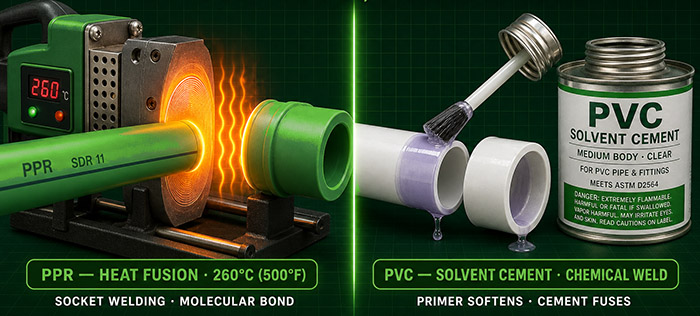
The installation methods for PPR and PVC are so different they might as well be different trades. PVC uses solvent cement — a chemical welding process where primer softens the surface and cement fuses the pipe and fitting into a single piece. PPR uses heat fusion — a socket welding process where both pipe and fitting are heated to roughly 260°C (500°F) on a fusion tool, then pushed together and held until they cool into a homogeneous joint.
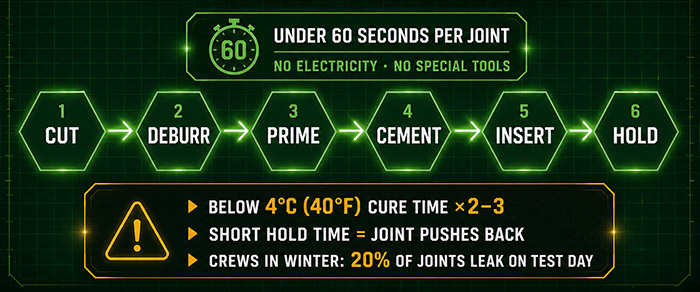
Solvent cement is fast. A trained installer can make a PVC joint in under 60 seconds: cut, deburr, prime, cement, insert, hold, next. No electricity needed. No special tools beyond a saw and a dauber. That speed translates to lower labor cost on big commercial runs. The downside? Cure time is temperature-dependent and unforgiving. Below 4°C (40°F), cure time doubles or triples. And if the installer doesn’t hold the joint for the full set time, the pipe pushes back out of the socket — you lose engagement depth, and the joint fails a pressure test. I’ve watched crews in winter rush the hold time and then wonder why 20% of their joints leak on test day.
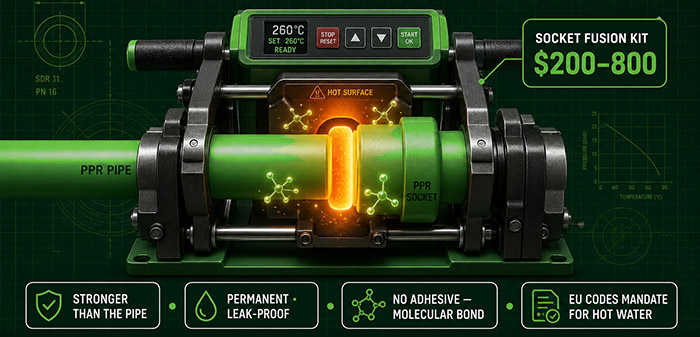
Fusion welding is slower per joint but creates a connection that’s literally stronger than the pipe. The socket and pipe melt together at the molecular level — there is no adhesive, no chemical bond, just molten polypropylene becoming one solid piece when it cools. You need a fusion machine and power, which adds tool cost. A decent socket fusion kit runs $200–800 depending on size range. But the joint is permanent, leak-proof, and doesn’t degrade with age the way a solvent cement joint can if it was installed in marginal conditions. Most European plumbing codes mandate fusion-welded PPR for hot water precisely because the joint failure mode is “doesn’t exist” when done correctly.
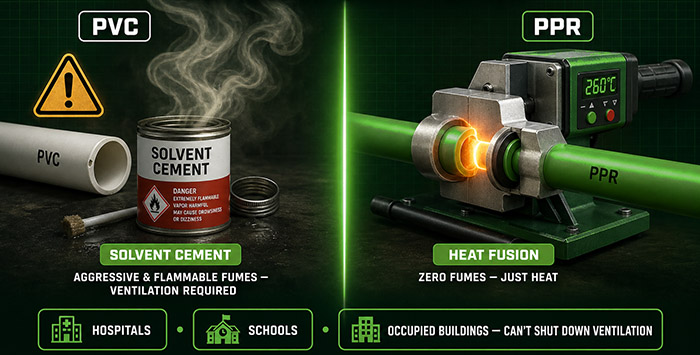
One practical difference that matters on job sites: solvent cement fumes are aggressive and flammable. Working in a confined mechanical room with a gallon of PVC cement open means you need ventilation. Fusion welding produces zero fumes — just heat. For hospitals, schools, and occupied buildings where you can’t shut down ventilation, that’s a real advantage.
Cost Breakdown: Material, Labor, Lifecycle
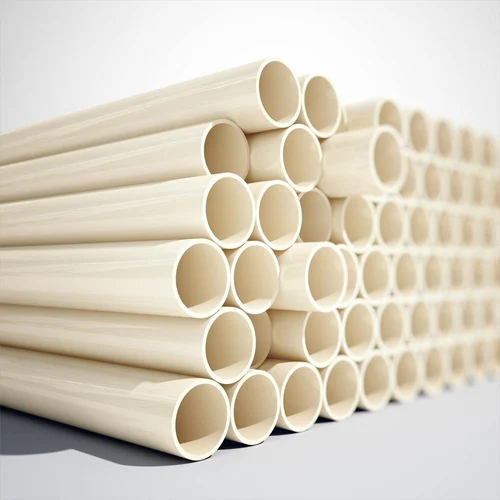
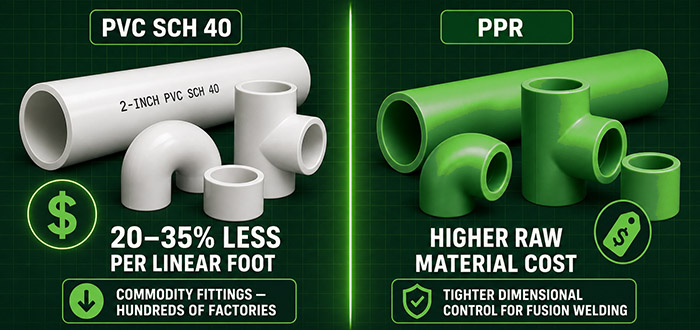
Let’s talk money. PVC is cheaper at the material level, no contest. Raw PVC compound costs less than random copolymer polypropylene, and the manufacturing process is simpler. A 2-inch PVC Schedule 40 pipe runs roughly 20–35% less per linear foot than equivalent PPR. Fittings follow the same pattern — PVC elbows, tees, and couplings are commodity items cranked out by hundreds of factories worldwide. PPR fittings need tighter dimensional control for fusion welding, which drives up the per-unit cost.
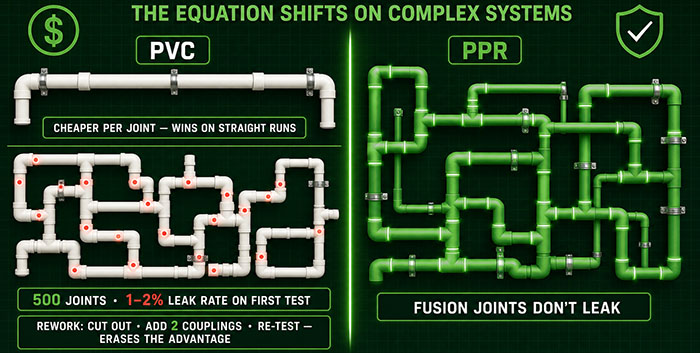
But material cost is roughly half the story. Labor is the other half, and here the math gets interesting. PVC installation labor is cheaper per joint — solvent welding takes less time and less skill than fusion welding. On a straight run with few fittings, PVC wins on installed cost by a significant margin. On a complex system with lots of branches, the equation shifts. Fusion-welded PPR joints don’t leak. A PVC system with 500 joints might have a 1–2% leak rate on first pressure test. Each leak means cutting out the fitting, adding two couplings, and re-testing. That rework labor erases PVC’s per-joint speed advantage on complicated layouts.
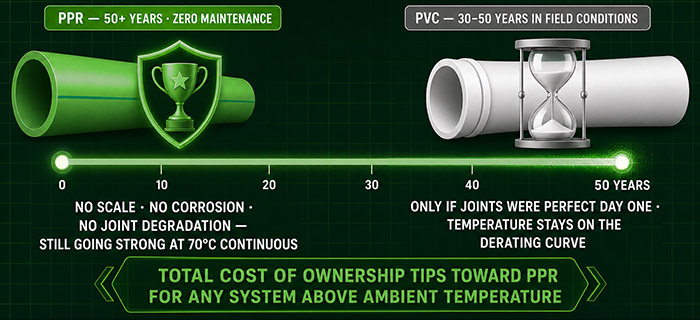
Then there’s the 50-year picture. PPR systems routinely hit 50+ years of service life with essentially zero maintenance — no scale buildup (the inner surface is too smooth for minerals to anchor), no corrosion, no joint degradation. PVC systems can hit 50 years too, but only if the solvent joints were perfect on day one and the operating temperature never exceeded the derating curve. Realistically, PVC DWV and cold water systems last 30–50 years in field conditions. PPR hot water systems at 70°C continuous are still going strong at the half-century mark with no intervention. The total cost of ownership math tips toward PPR piping system for any system running above ambient temperature.
| Factor | PPR (Polypropylene Random) | PVC (Polyvinyl Chloride) |
|---|---|---|
| Max continuous temperature | 70°C (158°F) | 60°C (140°F) |
| Short-term peak temperature | 95°C (203°F) | 70°C (158°F) — risk of deformation |
| Joining method | Heat fusion welding (260°C) | Solvent cement (chemical weld) |
| Joint strength vs pipe | Stronger than pipe (homogeneous) | Approximately equal to pipe wall |
| Material cost (2-inch pipe) | Higher — 20–35% premium over PVC | Lower — most economical plastic pipe |
| Installation speed | Slower per joint (heat/cool cycle) | Faster per joint (~60 seconds) |
| Tool requirements | Fusion machine + power ($200–800) | Hand tools only (saw, dauber) |
| Service life (hot water) | 50+ years | Not recommended for hot water |
| Service life (cold water) | 50+ years | 30–50 years |
| UV resistance | Moderate — needs UV stabilizer additive | Poor — chalks and embrittles unless stabilized |
| Chemical resistance | Excellent — acids, alkalis, most solvents | Good — acids, alkalis; poor with ketones, aromatics |
| Frost resistance | Good — remains ductile below freezing | Poor — becomes brittle in freezing conditions |
| Recyclability | Fully recyclable — can be reground and re-extruded | Recyclable but requires additive replenishment |
| Fume/odor during installation | None — clean fusion process | Solvent fumes — ventilation required |
| Key standards | ISO 15874, DIN 8077/8078, AS/NZS 4129 | ASTM D1785, ASTM D2665, ISO 1452, EN 1452 |
Chemical & UV Resistance
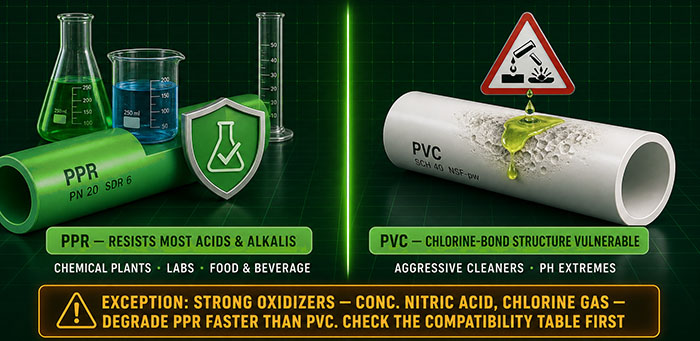
PPR handles a wider range of chemicals than PVC. This matters in industrial settings — chemical processing plants, laboratories, food and beverage facilities — where the pipe might see aggressive cleaning agents, process chemicals, or pH extremes. PPR shrugs off most acids and alkalis at concentrations that would attack PVC’s chlorine-bonded structure. The one notable exception: strong oxidizing agents like concentrated nitric acid or chlorine gas will degrade PPR faster than PVC. Know your chemical compatibility table before specifying either material for industrial service.
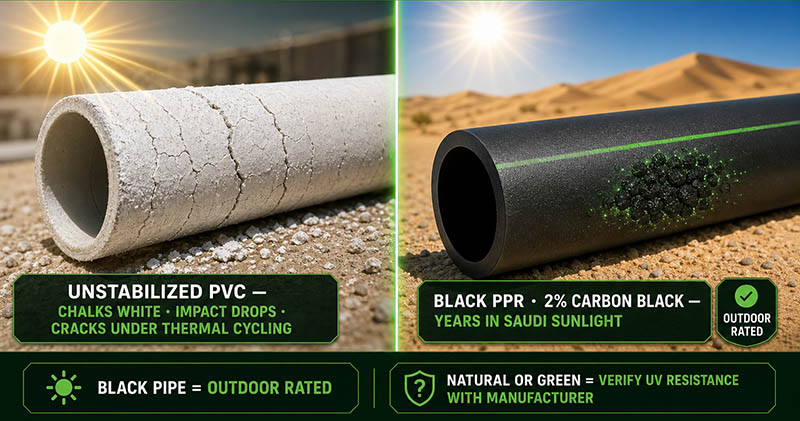
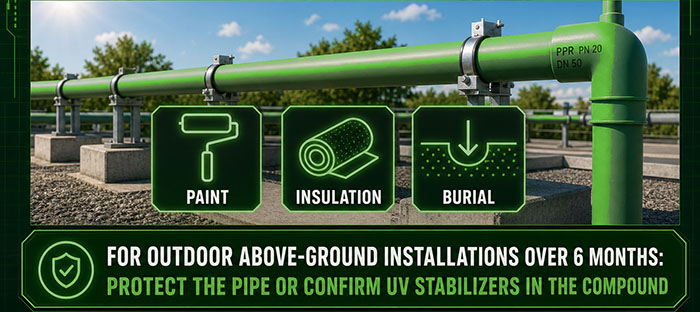
UV is the Achilles’ heel of both materials — but in different ways. Unstabilized PVC degrades fast in sunlight: the surface chalks white, impact resistance drops, and the material becomes brittle enough to crack under thermal cycling. You’ve seen it on old irrigation pipes left in the sun — that’s PVC without UV inhibitors. PPR is naturally somewhat more UV-tolerant but still needs carbon black or UV stabilizer additives for outdoor use. Black PPR pipe with 2% carbon black loading can sit in Saudi Arabian sunlight for years without significant degradation. Natural or green PPR without stabilizers will degrade nearly as fast as PVC. The color tells you something about the stabilizer package — black pipe = outdoor rated, other colors = verify UV resistance with the manufacturer.
Decision Framework: Which Pipe for Which Application
Enough theory. Here’s where the rubber meets the road — a straight-up decision matrix based on what I’ve seen work (and fail) across hundreds of projects.
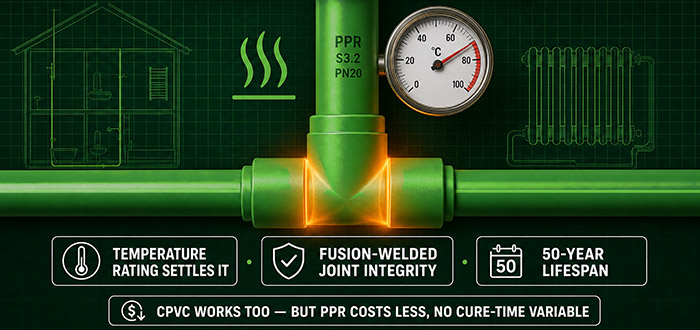
Hot water plumbing — PPR PIPR & FITTINGS. No debate. The temperature rating alone settles it. Add the fusion-welded joint integrity and the 50-year lifespan, and PPR is the only plastic pipe I’d put in a hot water riser for a building I had to warranty. CPVC works too, but PPR costs less and doesn’t have the solvent cement cure-time variable.
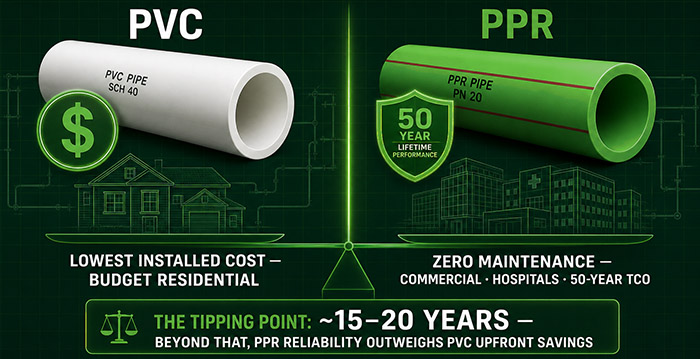
Cold water distribution — PVC piping system wins on cost, PPR wins on longevity. For budget-driven residential projects, PVC does the job at the lowest installed cost. For commercial buildings, hospitals, or anywhere you care about 50-year total cost of ownership, PPR’s higher initial cost pays back in zero maintenance. The tipping point is around 15–20 years of service life — beyond that, PPR piping system reliability advantage outweighs PVC’s upfront savings.
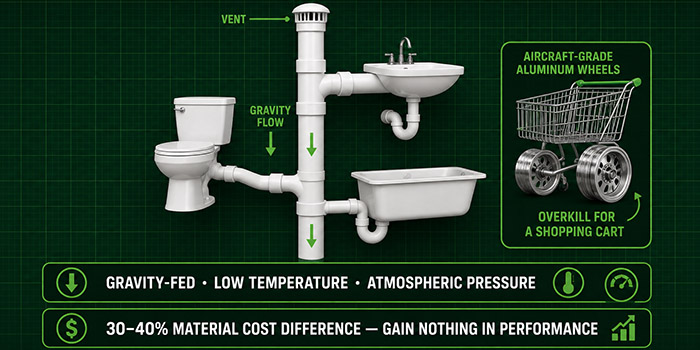
DWV (drain, waste, vent) — PVC. End of discussion. DWV is gravity-fed, low-temperature, and uses solvent-weld joints that are perfectly adequate for atmospheric-pressure service. PPR in DWV would be massive overkill — like putting aircraft-grade aluminum wheels on a shopping cart. The material cost difference is 30–40%, and you gain nothing in performance.
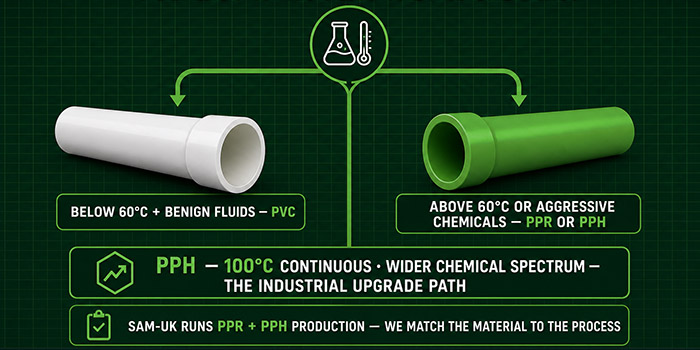
Industrial process piping — depends on temperature and chemicals. Below 60°C with benign fluids? PVC. Above 60°C or with aggressive chemicals? PPR or even PPH (polypropylene homopolymer) for higher chemical resistance. PPH piping system handles 100°C continuous and resists a wider chemical spectrum than PPR — it’s the industrial upgrade path. SAM-UK runs PPH production alongside PPR, so we can match the material to the process conditions.
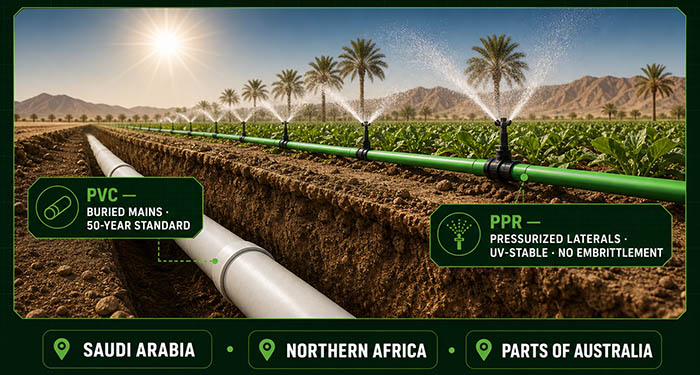
Irrigation and agriculture — PVC for mains, PPR for pressurized laterals in hot climates. Buried PVC irrigation mains have been the standard for 50 years and they work fine. But in desert agriculture — Saudi Arabia, Northern Africa, parts of Australia — surface-level PPR pipe hold up better because the material doesn’t embrittle under UV with proper stabilization.
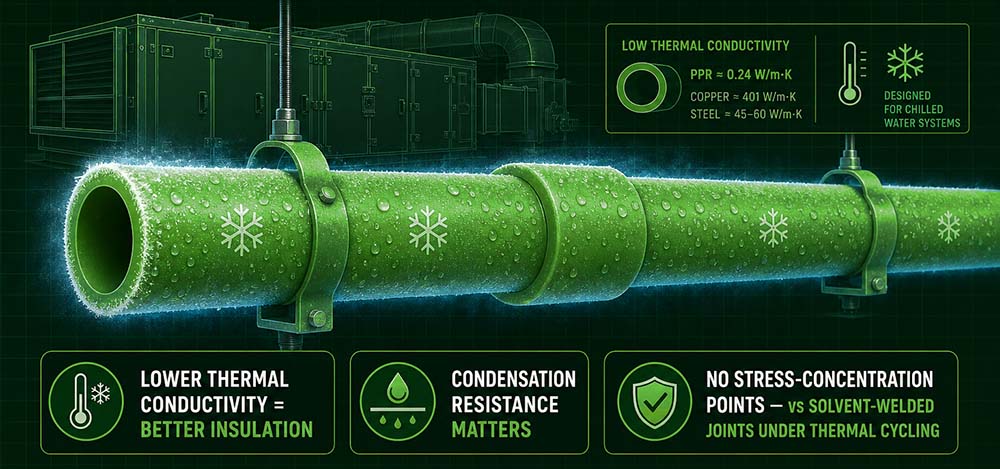
Chilled water and HVAC — PPR. The insulation value of PPR is slightly better than PVC (lower thermal conductivity), and condensation resistance matters in chilled water service. The fusion-welded joints also don’t have the stress-concentration points that solvent-welded PVC joints develop under thermal cycling between chilled water and ambient air.
Why Sourcing Both from One Manufacturer Matters
Here’s something that doesn’t show up in comparison tables but makes a real difference on projects: when your PPR and PVC come from different factories, the quality philosophy isn’t consistent. One manufacturer might run tight dimensional tolerances on PPR but ship commodity-grade PVC. The other might have great PVC but their PPR fusion characteristics are inconsistent because they don’t understand the material science deeply.
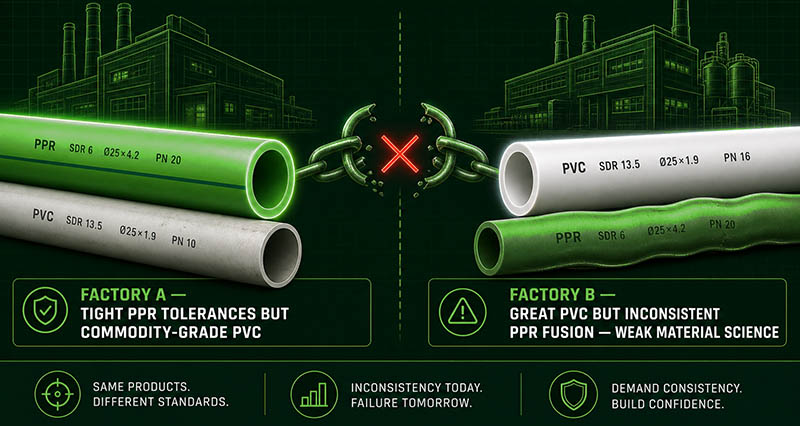
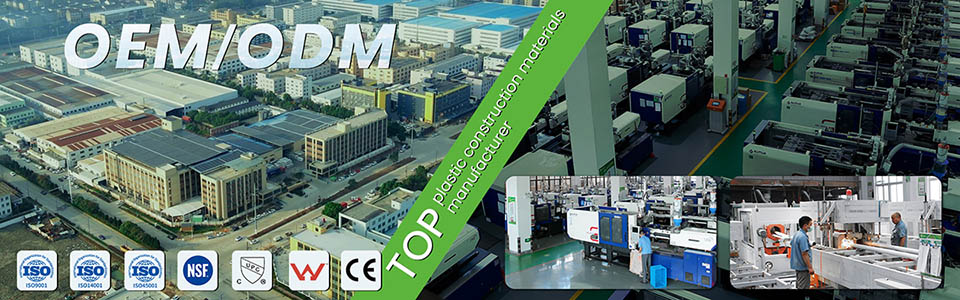
SAM-UK is one of the few manufacturers worldwide running both PPR and PVC production under one roof — same quality lab, same inspection protocols, same ISO 9001 system. We extrude PPR pipes on German-engineered lines with in-line ultrasonic wall thickness monitoring. We injection-mold PVC fittings in our own tool shop where we control die geometry down to micron-level precision. The quality standard doesn’t change when the material changes because the people checking the product don’t change.
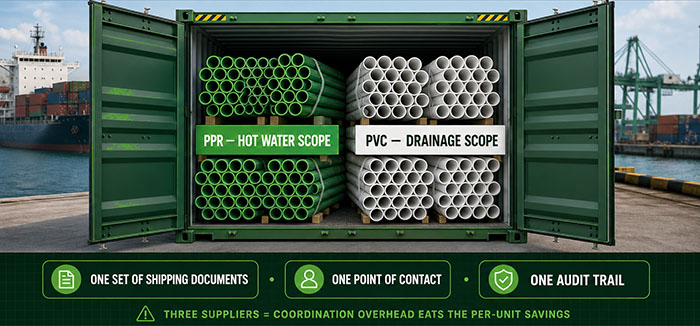
From a procurement standpoint, single-source supply simplifies logistics. One container can carry PPR for the hot water scope and PVC for the drainage scope. One set of shipping documents. One point of contact for technical questions. One audit trail for compliance documentation. When a mixed-material project specs material from three different suppliers, the coordination overhead eats up whatever per-unit savings the buyer thought they were capturing.
And the mold workshop advantage is real. Need a specialty DWV configuration that’s not in the catalog — an offset toilet flange, a non-standard reducing wye, a vent elbow with an integrated cleanout? Our in-house mold shop can design, cut, and test a new mold in under 30 days. Try getting that turnaround from a factory that outsources tooling to a third-party mold maker. You’ll wait 90 days minimum and pay double the tooling cost.

Frequently Asked Questions
Can PPR and PVC be connected together in the same system?
Not directly — you can’t fusion-weld PPR to PVC and you can’t solvent-cement PVC to PPR. You need a mechanical transition fitting: typically a brass or stainless steel threaded union with one side compatible with PPR (socket fusion or threaded) and the other side compatible with PVC (threaded or slip). Flanged connections also work for larger diameters. Never try to glue or fuse the two materials directly — the joint will fail.
Is PPR pipe safe for drinking water?
Yes. PPR is non-toxic, does not leach chemicals into water, and is approved for potable water systems under ISO 15874 and most national plumbing codes. It’s the dominant drinking water pipe material in much of Europe, the Middle East, and Asia. SAM-UK PPR pipes carry NSF/ANSI 61 certification for drinking water safety.
Why is PPR more expensive than PVC?
Three reasons: raw material cost (polypropylene random copolymer is more expensive per kilogram than PVC compound), manufacturing complexity (PPR extrusion requires tighter temperature control and slower line speeds), and market scale (PVC is produced in vastly larger volumes globally, driving down unit cost). The price gap narrows at larger diameters where material cost dominates over manufacturing overhead.
Does PPR pipe need insulation for hot water?
Yes, for energy efficiency — not for pipe protection. PPR has lower thermal conductivity than metal pipes but still loses heat to ambient air. In long hot water runs, insulation pays for itself in reduced energy cost within 2–3 years. The pipe itself doesn’t need insulation for structural reasons — it handles the temperature fine without it.
Which is better for underground installation — PPR or PVC?
For cold water and drainage: PVC is the standard and works well when properly bedded in sand or gravel. For hot water or aggressive soil conditions: PPR handles ground movement better because it’s more ductile and less prone to brittle fracture from soil settlement. In freeze-prone regions, PPR’s flexibility gives it an edge — PVC can crack if the surrounding soil freezes and expands.
About SAM-UK
SAM-UK are a professional 20+ years manufacturer in producing vinyl building profile products and PVC , CPVC , PPH , PPR , PP pipes and pipe fittings, valves, taps and so on. See our certification records and product-specific scope. We support color /size customization. Welcome to consult for Catalog and Product. you can contact us at email [email protected]