Introduction
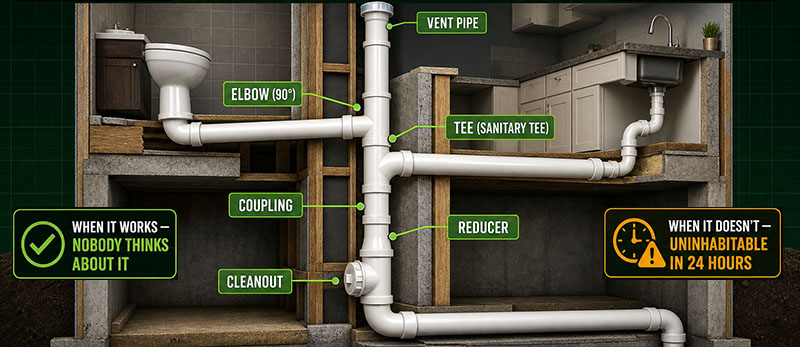
DWV is the invisible system in every building — when it works, nobody thinks about it. When it doesn’t, the building is uninhabitable within 24 hours.
Choosing the right PVC DWV (Drain, Waste & Vent) pipe fittings is essential for building a reliable, leak-resistant drainage system. From elbows and tees to couplings, reducers, and cleanouts, each fitting has a specific role in directing wastewater, connecting pipes, and maintaining proper system flow. This guide explains the most common PVC DWV fittings, their applications, connection methods, and key selection considerations to help contractors, engineers, and buyers choose the right fittings for residential, commercial, and industrial drainage systems.
DWV System Basics — What Makes It Different from Pressure Pipe
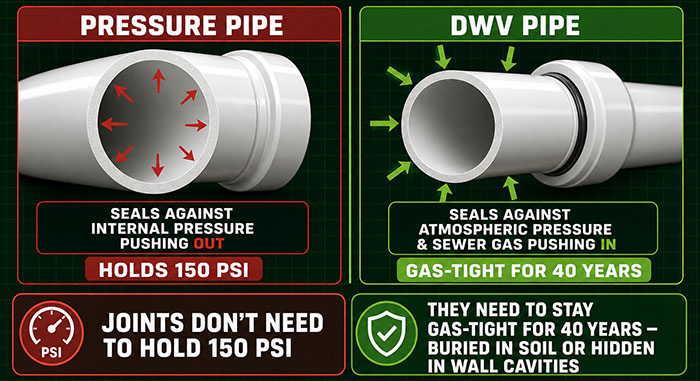
Most people lump all PVC pipe into one bucket. Big mistake. DWV pipe and fittings operate under zero pressure — they’re gravity-fed, which changes everything about how you design and install them. Pressure pipe seals against internal force trying to push out. DWV seals against atmospheric pressure and sewer gas trying to push in. The joints don’t need to hold 150 PSI. They need to stay gas-tight for 40 years while buried in soil or hidden inside a wall cavity.
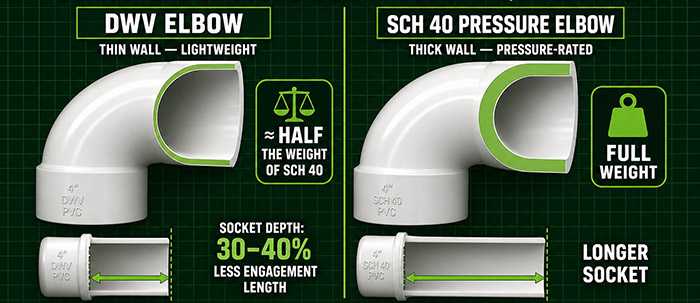
Here’s the thing most spec sheets won’t tell you: DWV fittings have much thinner walls than Schedule 40 pressure fittings of the same nominal size. A 4-inch DWV 90-degree elbow weighs maybe half what a Sch 40 pressure elbow weighs. That’s by design — you’re not containing pressure, so the extra material is dead weight. The socket depths are shorter too. About 30–40% less engagement length compared to pressure fittings. Installers who grab a pressure coupling for a DWV repair are wasting money and adding unnecessary weight to the system. I’ve seen entire commercial jobs where the wholesaler shipped pressure fittings for the DWV scope because nobody checked the spec line. The contractor installed them. The system worked. It also cost 60% more than it needed to.
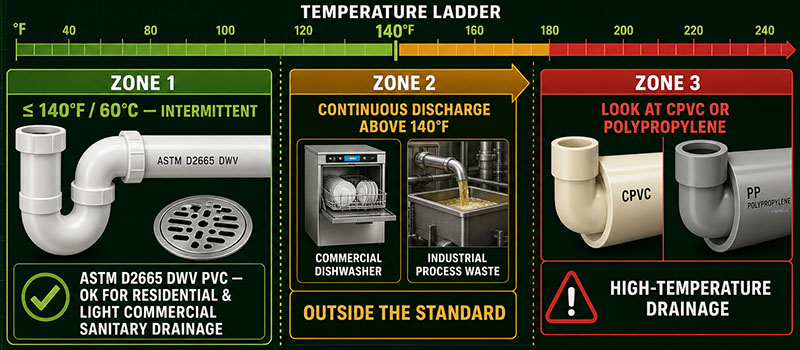
Temperature’s another thing. ASTM D2665 DWV systems are rated for intermittent exposure up to 140°F (60°C). Continuous discharge above that — think commercial dishwasher drains, industrial process waste — and you’re outside the standard. That’s when you look at CPVC or polypropylene. But for residential and light commercial sanitary drainage? DWV PVC is the workhorse period.
Essential DWV Fitting Types
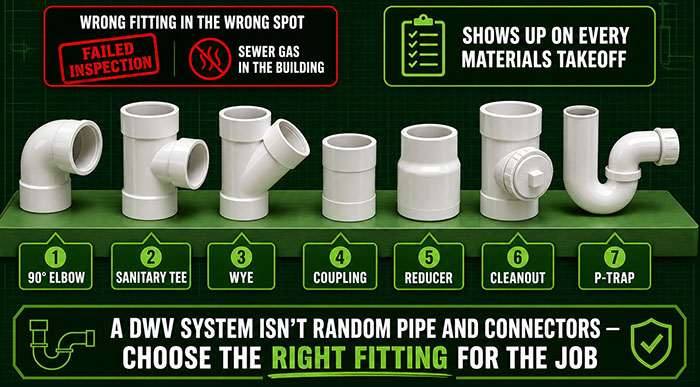
A DWV system isn’t random pipe and connectors. Every fitting has a specific job dictated by fluid dynamics and plumbing code. Wrong fitting in the wrong spot = failed inspection at best, sewer gas in the building at worst. Let’s walk through the core types that show up on every materials takeoff.
Sanitary Tees vs Wyes — Flow Direction Is Everything
This is the number-one DWV fitting question I get from procurement teams: “Can we substitute a sanitary tee for a wye?” Answer: depends entirely on orientation and application.
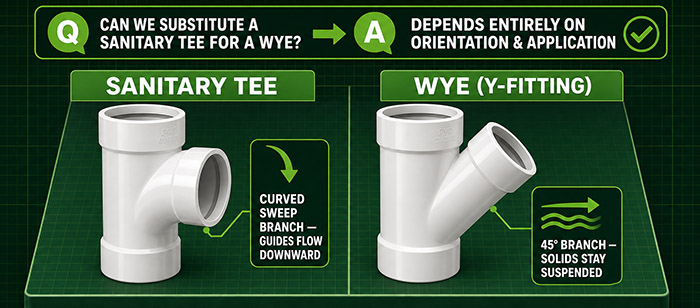
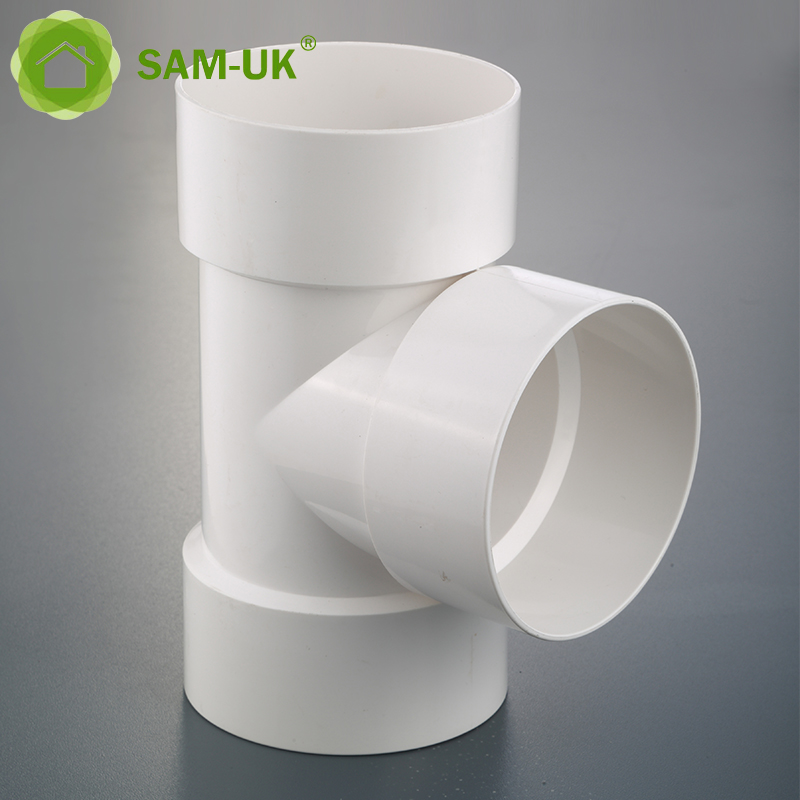
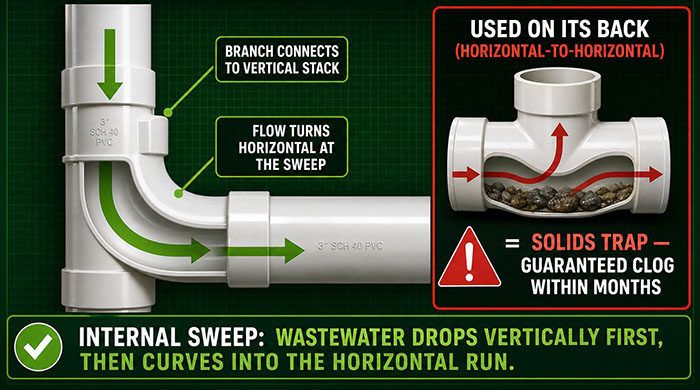
A sanitary tee has a curved sweep on the branch inlet that guides flow downward. Code allows it only in vertical-to-horizontal transitions — meaning the branch connects to a vertical stack and the flow turns horizontal at the tee. The internal sweep is designed so wastewater drops vertically first, then curves into the horizontal run. Use a sanitary tee on its back (horizontal-to-horizontal) and you’ve just created a solids trap. Guaranteed clog within months.
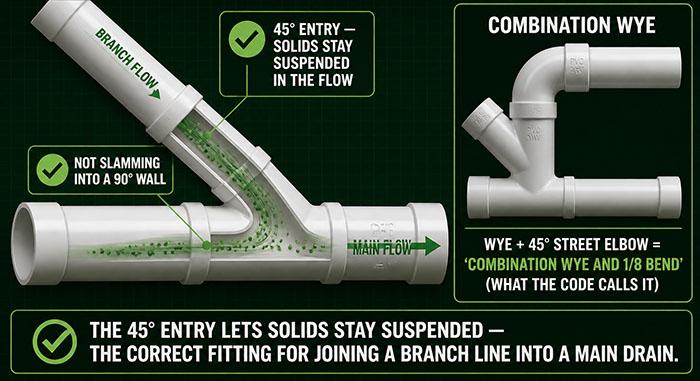
A wye (Y-fitting) branches at a 45-degree angle from the main run. It’s the correct choice for horizontal-to-horizontal connections where you’re joining a branch line into a main drain. The 45-degree entry lets solids stay suspended in the flow rather than slamming into a 90-degree wall. Most contractors pair a wye with a 45-degree street elbow to bring the branch horizontal — this combo is what the code calls a “combination wye and 1/8 bend.”
One exception you need to know: on trap arm connections to the vent stack, code requires a sanitary tee, not a wye. A wye at the vent connection creates too much turbulence and can siphon the trap. That’s a rookie mistake that lets sewer gas pour into a bathroom.
| Feature | Sanitary Tee | Wye (Y-Fitting) |
|---|---|---|
| Branch angle | 90° with internal sweep | 45° from main run |
| Correct orientation | Vertical stack → horizontal branch only | Horizontal drain → horizontal branch |
| Flow characteristic | Gravity-assisted vertical drop | Low-turbulence angled merge |
| Vent connection | Required for trap arm vents | Not allowed on trap arms |
| Solids handling | Good on vertical stacks | Excellent on horizontal runs |
| ASTM standard | ASTM D2665 | ASTM D2665 |
P-Traps — The Water Seal That Blocks Sewer Gas
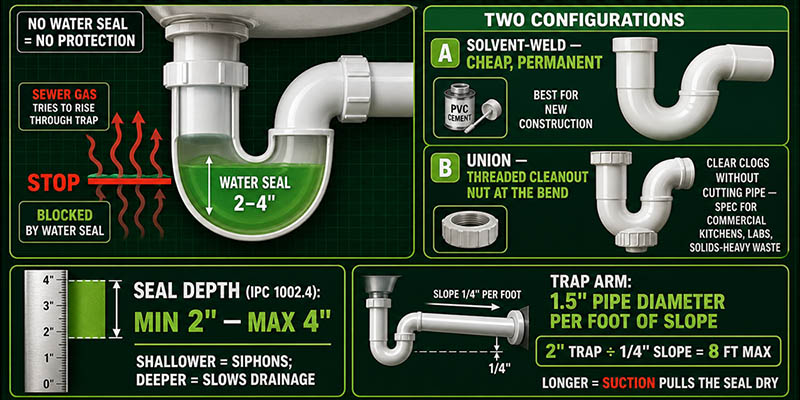
The P-trap is the only thing standing between a living space and raw sewer gas. That U-shaped bend holds roughly 2–4 inches of standing water that acts as a physical gas barrier. No water seal, no protection.
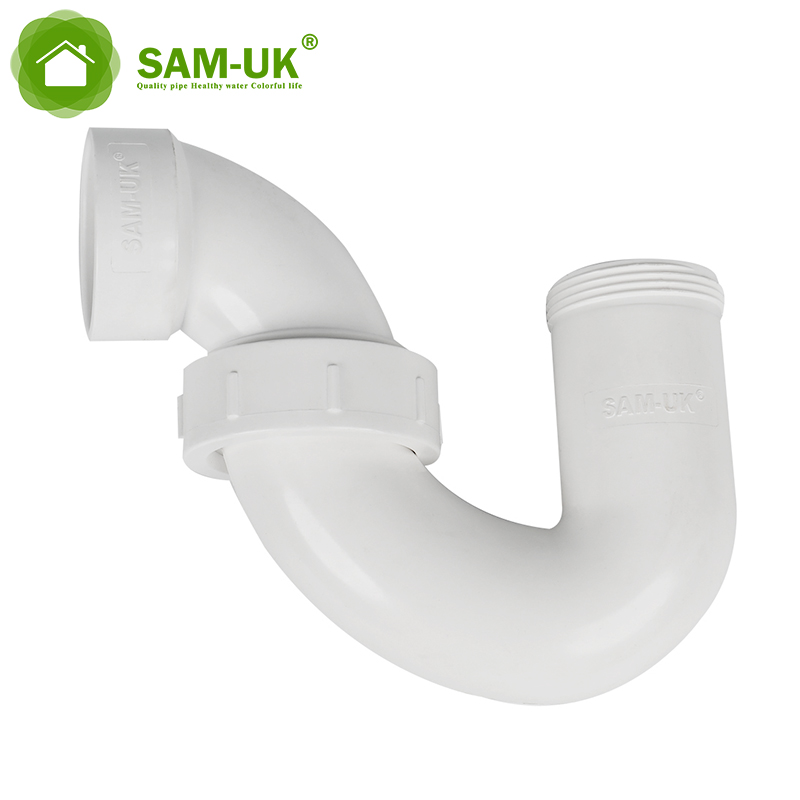
PVC DWV P-traps come in two configurations: solvent-weld and union-style. Solvent-weld traps are cheaper and permanent — great for new construction where accessibility isn’t a concern. Union traps have a threaded cleanout nut at the bottom of the bend, which lets you clear clogs without cutting pipe. For commercial kitchens, labs, or any fixture handling solids-heavy waste, spec the union trap. The maintenance crew will thank you.
Code sets minimum trap seal depth at 2 inches and maximum at 4 inches (IPC Section 1002.4). Anything shallower siphons too easily. Deeper than 4 inches creates too much resistance and slows drainage. Trap arm length — the horizontal pipe between the trap weir and the vent — is capped at 1.5-inch pipe diameter per foot of slope. So a 2-inch trap with 1/4-inch-per-foot slope gets a maximum 8-foot trap arm (2 ÷ 0.25 = 8). Longer than that and the water velocity at the vent connection creates suction that pulls the seal dry.
Vent Elbows & Vent Tees — Letting Air In So Water Flows
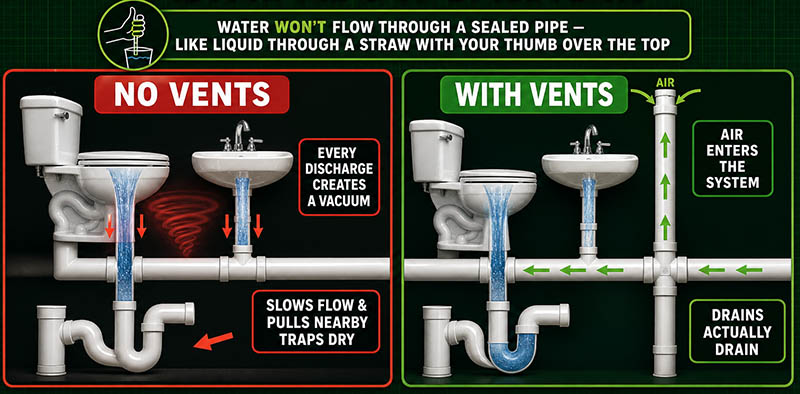
Water won’t flow through a sealed pipe any better than liquid through a straw with your thumb over the top. The vent system is what lets drains actually drain. Without vents, every fixture discharge creates a vacuum behind it that slows flow and pulls nearby traps dry.
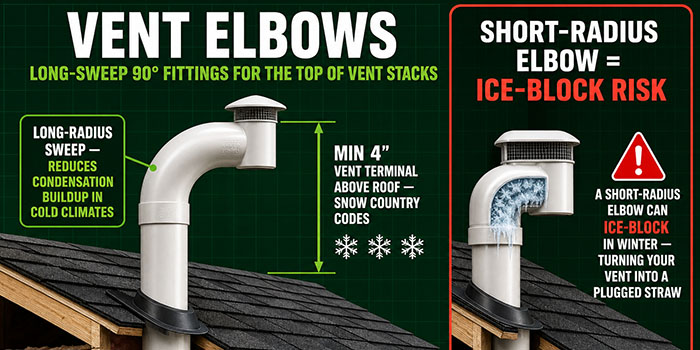
Vent elbows are long-sweep 90-degree fittings designed for the top of vent stacks where they transition through the roof. The long radius reduces condensation buildup in cold climates — a short-radius elbow can ice-block in winter, turning your vent into a plugged straw. Most codes require a minimum 4-inch vent terminal above the roof in snow country.
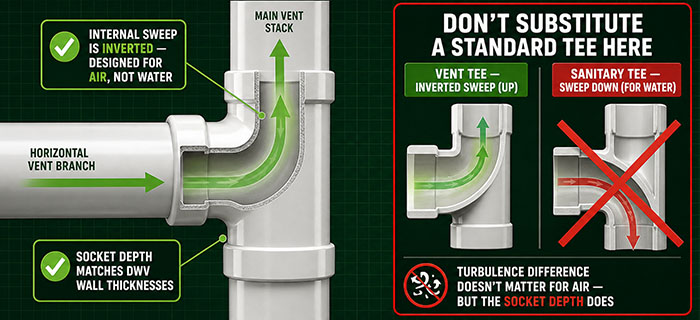
Vent tees connect horizontal vent branches into the main vent stack. They look like sanitary tees but the internal sweep is inverted — designed for air flow, not water. Don’t substitute a standard tee here. The turbulence difference doesn’t matter for air, but vent tees have a slightly different socket depth that matches DWV wall thicknesses.
Couplings, Adapters & Cleanouts
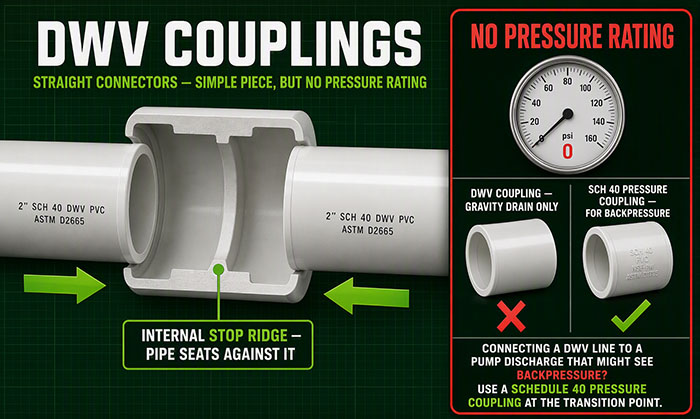
DWV couplings are straight connectors with an internal stop ridge in the center. Simple piece, but here’s what trips people up: DWV couplings have no pressure rating. If you’re connecting a DWV line to a pump discharge that might see backpressure, you need a Schedule 40 pressure coupling at that transition point.
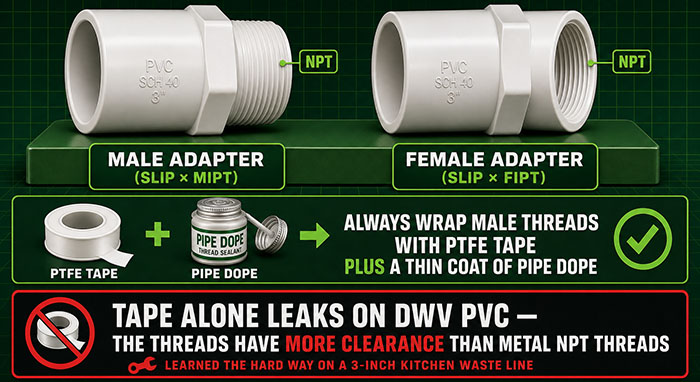
Adapters bridge DWV to threaded connections — male adapters (slip x MIPT) and female adapters (slip x FIPT). The threaded side follows NPT (National Pipe Thread) standards. Always wrap male threads with PTFE tape plus a thin coat of pipe dope. Tape alone leaks on DWV PVC because the threads have more clearance than metal NPT threads. I learned that one the hard way on a 3-inch kitchen waste line.
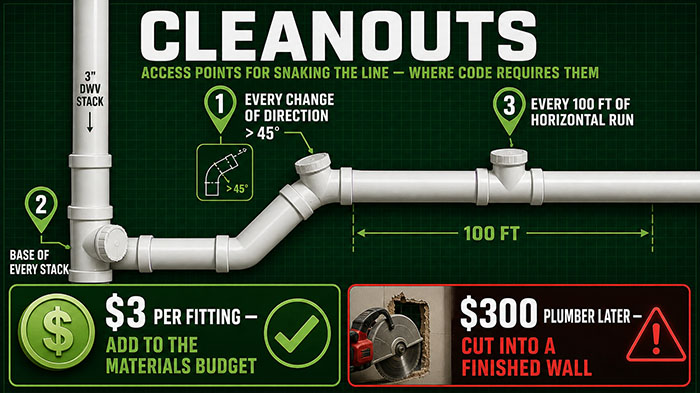
Cleanouts are access points for snaking the line. Code requires them at every change of direction greater than 45 degrees, at the base of every stack, and every 100 feet of horizontal run. Missing cleanouts are the most common DWV inspection failure I see. They add maybe $3 per fitting to the materials budget. Skip them and you’ll pay a plumber $300 to cut into a finished wall later.
ASTM D2665 — The DWV Standard That Matters
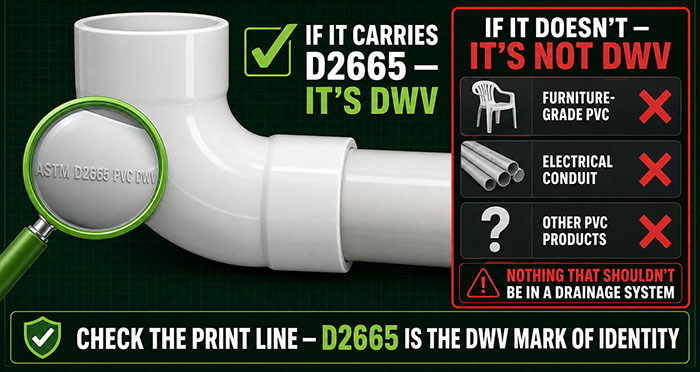
ASTM D2665 is the specification that governs PVC DWV pipe and fittings in North America. If your fittings don’t carry this standard on the print line, they’re not DWV — they might be furniture-grade, electrical conduit, or some other PVC product that nobody should be putting in a drainage system.
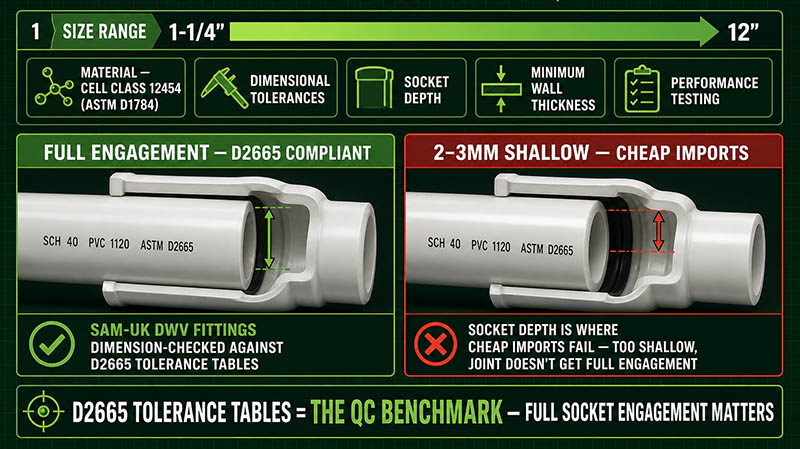
The standard covers Schedule 40 PVC DWV pipe and injection-molded fittings from 1-1/4 inch through 12-inch diameters. It specifies material requirements (cell class 12454 per ASTM D1784), dimensional tolerances, socket depth, minimum wall thickness, and performance testing. Every SAM-UK DWV fitting gets dimension-checked against the D2665 tolerance tables. Socket depth is where cheap imports fail — they run 2–3mm shallow to save material, and the joint doesn’t get full engagement.
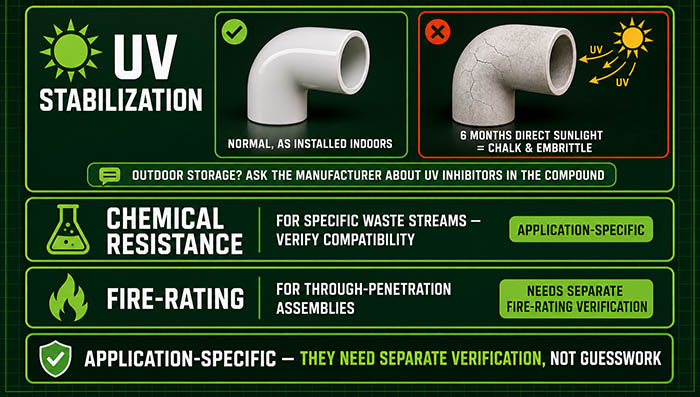
Three things the standard doesn’t cover that you should verify anyway: UV stabilization (D2665 fittings are typically for interior use), chemical resistance for specific waste streams, and fire-rating for through-penetration assemblies. These are application-specific and need separate verification. If your DWV fittings will sit in direct sunlight on a job site for 6 months, ask the manufacturer about UV inhibitors in the compound. Standard DWV PVC will chalk and embrittle with prolonged exposure.
3 Common DWV Code Violations That Kill Inspections
I’ve reviewed hundreds of plumbing takeoffs and these three problems show up with depressing regularity. Every one is preventable at the procurement stage.
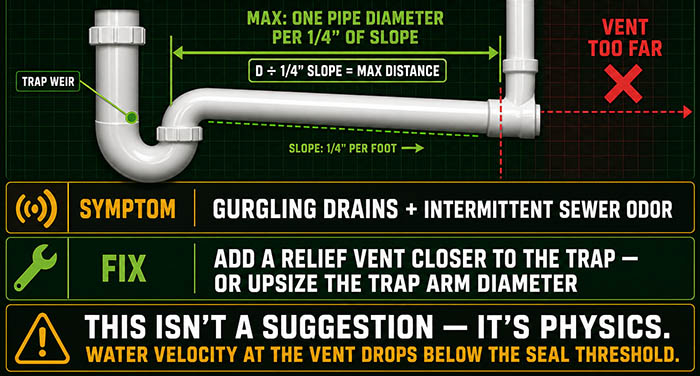
1. Vent distance from trap exceeds code maximum. IPC allows the vent opening on a trap arm to be no further than one pipe diameter per 1/4-inch of slope from the trap weir. This isn’t a suggestion — it’s physics. Too far and the water velocity at the vent drops below the threshold needed to maintain the trap seal. The symptom: gurgling drains and intermittent sewer odor. The fix is either adding a relief vent closer to the trap or upsizing the trap arm diameter.
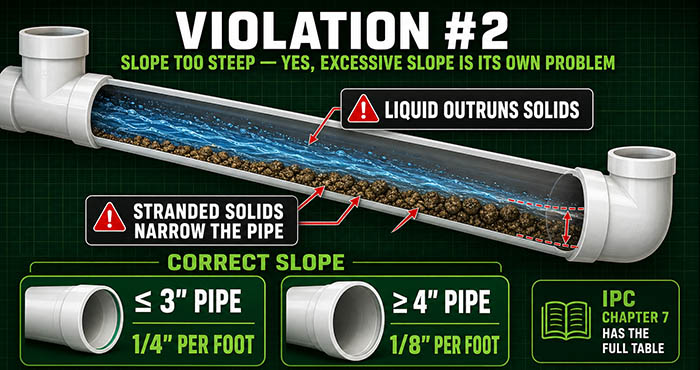
2. Slope too steep. Yes, you read that right. Most people worry about insufficient slope, but excessive slope causes its own problems. When the pipe is too steep (>1/2-inch per foot for smaller diameters), the liquid outruns the solids. Solids get stranded on the pipe bottom, liquids drain away, and you’re left with a growing deposit that narrows the effective diameter. The correct DWV slope is 1/4-inch per foot for pipes 3 inches and smaller, 1/8-inch per foot for 4 inches and larger. IPC Chapter 7 has the full table.
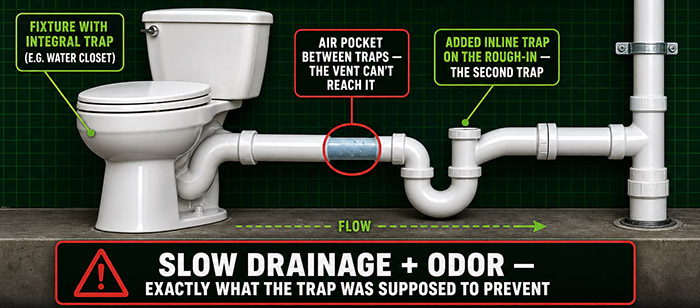
3. Double-trapping. Two traps in series on the same fixture arm. This happens when someone installs a fixture with an integral trap (like a floor-mounted water closet) and then adds an inline trap on the rough-in. The second trap creates an air pocket between them that the vent can’t reach. Result: slow drainage and odor — exactly what the trap was supposed to prevent.
 n
n
What to Look for in DWV Fittings Quality
Not all ASTM D2665 fittings are equal — the standard sets minimums, and then manufacturing quality determines where you land above that floor. Here’s what separates commodity fittings from the ones you want in a 30-story tower.
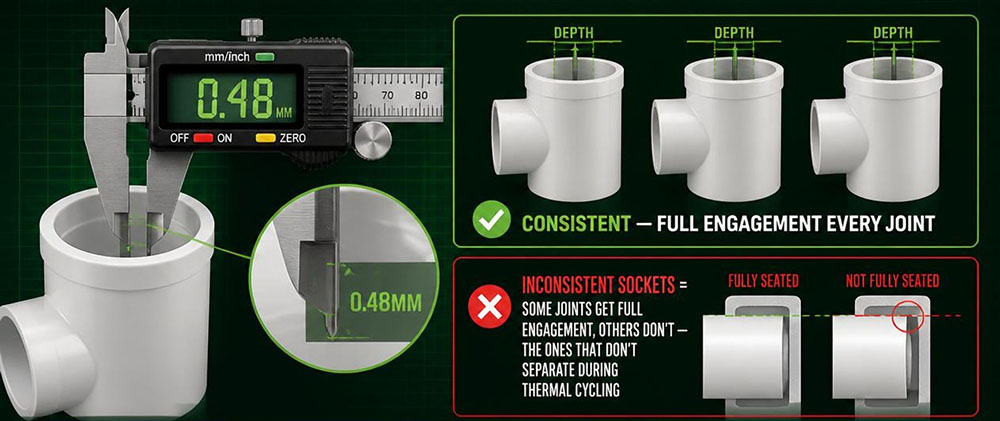
Socket depth consistency. Grab a caliper and measure sockets across a sample of the same SKU. Variation should be under 0.5mm. Inconsistent sockets mean some joints get full engagement and others don’t — and the ones that don’t are the ones that separate during thermal cycling. SAM-UK’s in-house mold shop lets us hold socket depth tolerance tighter than anything bought off a generic mold catalog. When you control the tooling, you control the dimension.
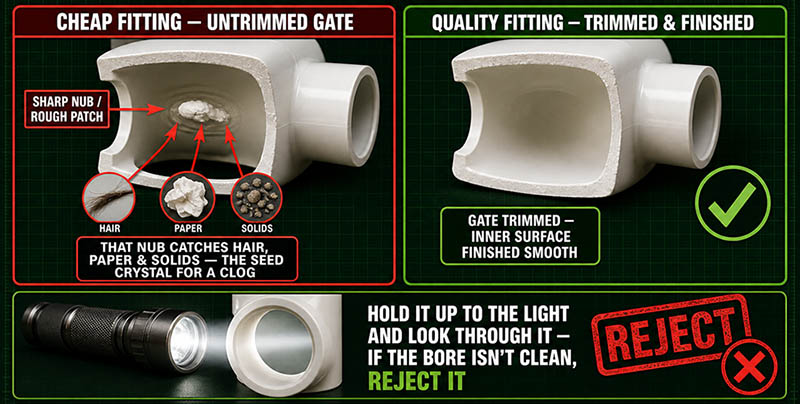
Gate vestige cleanup. Every injection-molded fitting has a gate mark where molten PVC entered the cavity. On cheap fittings, that gate vestige is a sharp nub or a rough patch inside the flow path. That nub catches hair, paper, and solids — and becomes the seed crystal for a clog. Quality fittings have the gate trimmed and the inner surface finished smooth. Hold a fitting up to the light and look through it — if the bore isn’t clean, reject it.
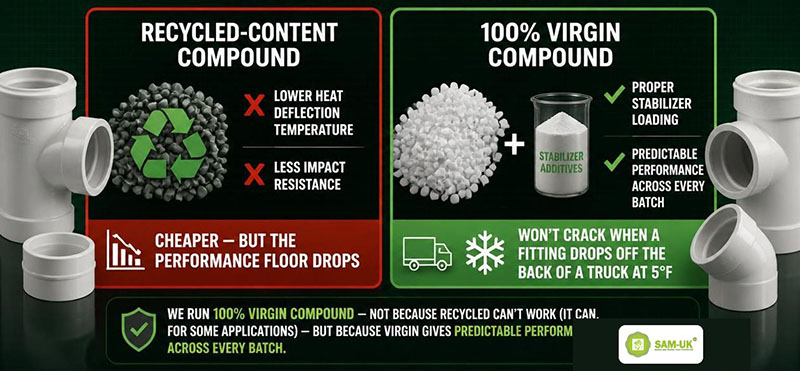
Compound quality. DWV PVC compound is not all the same. Recycled-content compounds are cheaper but have lower heat deflection temperature and less impact resistance. Virgin PVC compound with proper stabilizer loading won’t crack when a fitting drops off the back of a truck at 5°F. We run 100% virgin compound. Not because recycled can’t work — it can, for some applications — but because virgin compound gives predictable performance across every batch.
Frequently Asked Questions
Can I use Schedule 40 pressure fittings for DWV applications?
Technically yes — pressure fittings exceed DWV requirements — but you’re paying 40–60% more for wall thickness and socket depth you don’t need. The extra weight also adds dead load on hangers. Only reason to do it is if DWV-specific fittings aren’t available in the size you need and the job can’t wait.
What’s the difference between DWV Schedule 40 and DWV Schedule 30?
Schedule 30 DWV has thinner walls than Schedule 40 DWV — roughly 20–30% thinner. It’s lighter and cheaper but only allowed in select jurisdictions. Many codes (including IPC) require minimum Schedule 40 for DWV above ground. Always check local amendments before substituting.
Do DWV fittings need primer before solvent cement?
Yes. Purple primer is not optional on PVC DWV — it chemically softens the surface so the solvent cement can create a molecular bond. Primer is required by ASTM D2855 and by virtually every plumbing code in North America. Skip it and you have a glue joint, not a solvent weld. They fail differently — glue peels, solvent welds shear.
What temperature can PVC DWV fittings handle?
ASTM D2665 rates DWV systems for intermittent discharge up to 140°F (60°C). Continuous exposure above that — like a commercial dishwasher running all day — will soften the PVC and cause sagging between supports. For sustained hot waste, switch to CPVC or polypropylene.
How do I verify ASTM D2665 compliance on imported fittings?
Look for the standard marking printed or molded directly on the fitting. It should read “ASTM D2665” along with the manufacturer’s name or trademark, material designation (PVC), and size. Third-party certification marks (NSF, UPC, IAPMO) add another layer of verification. Ask for the certifier’s online listing — SAM-UK fittings are traceable through our NSF and UPC listings.
About SAM-UK
SAM-UK are a professional 20+ years manufacturer in producing vinyl building profile products and PVC , CPVC , PPH , PPR , PP pipes and pipe fittings, valves, taps and so on. See our certification records and product-specific scope. We support color /size customization. Welcome to consult for Catalog and Product. you can contact us at email [email protected]