Article Introduction
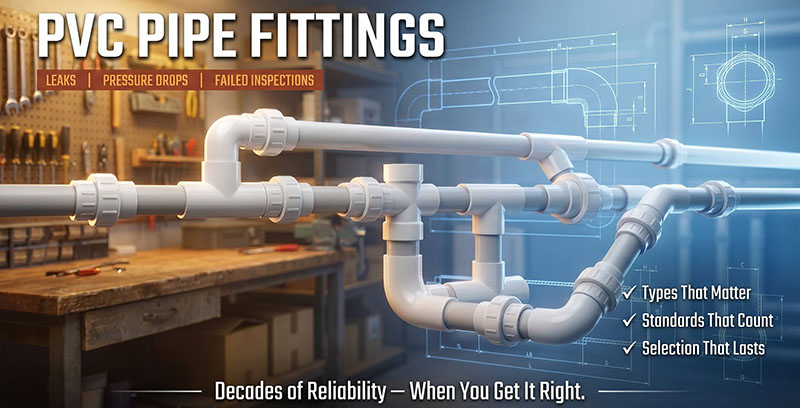
PVC fittings are the connectors that turn straight pipes into functional plumbing systems. Get them wrong and you’re looking at leaks, pressure drops, and failed inspections. Get them right and the system runs for decades. Here’s everything a B2B buyer needs to know about PVC pipe fitting types, the standards that matter, and how to pick the right ones for your market.
PVC Fitting Types and What They Actually Do
Every PVC piping system is built from a handful of fundamental fitting types. The names are straightforward. The selection mistakes usually aren’t.
Elbows (90° and 45°)
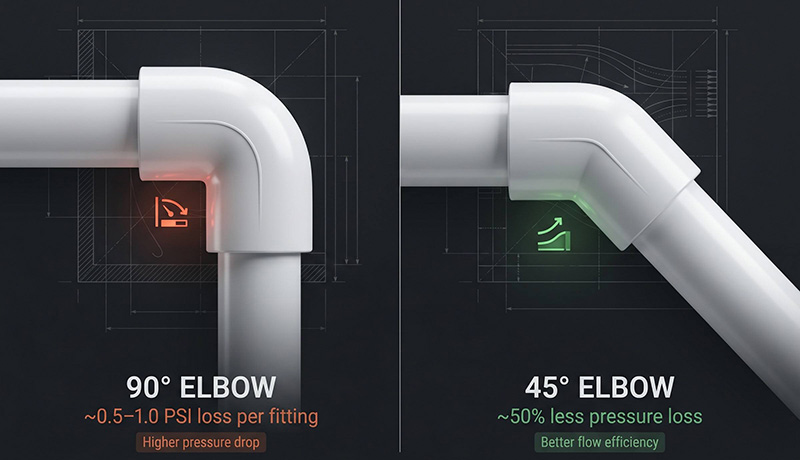
Elbows change flow direction. 90-degree elbows create the most pressure drop — expect roughly 0.5 to 1.0 PSI loss per fitting in a standard 2-inch schedule 40 system at typical flow rates. Not a dealbreaker for drainage, but it adds up in long pressure pipe runs. 45-degree elbows cut that loss by about half. We’ve seen engineers spec 90s everywhere on paper, then wonder why the pump needs to work harder than the calculations predicted.
Key standards: ASTM D2466 for schedule 40 pressure fittings, ASTM D2467 for schedule 80 pressure fittings. Both cover socket-type and threaded-end elbows.
Tees
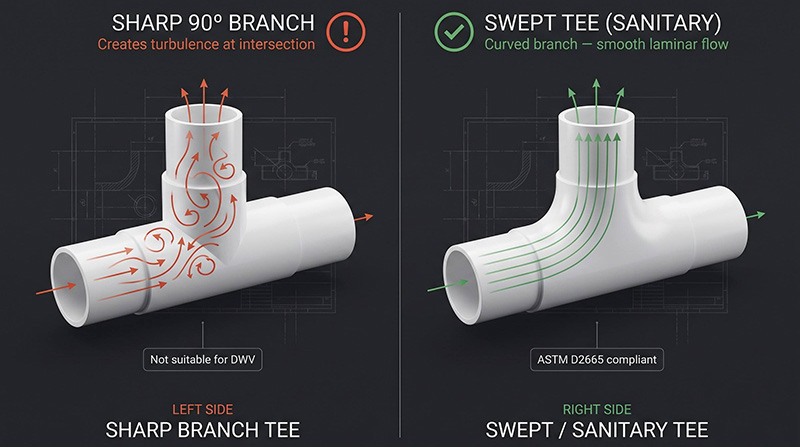
Tees split or combine flow. Equal tees (all three ports same diameter) handle branch connections. Reducing tees step down one outlet to a smaller diameter — common in DWV systems where a 4-inch main transitions to a 2-inch branch. The most overlooked spec on tees? The radius at the branch intersection. A sharp 90-degree branch corner creates turbulence. Swept tees (sanitary tees with a curved branch) reduce it significantly — mandatory for DWV applications under ASTM D2665.
Couplings
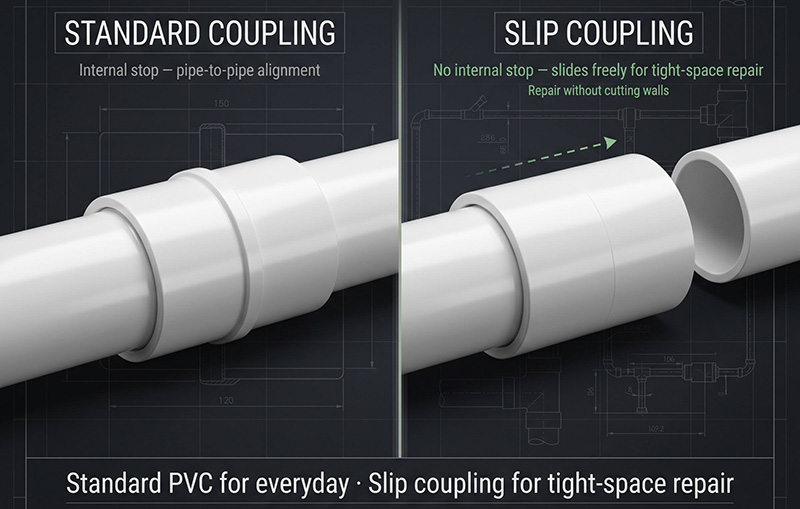
Straight connectors for joining two pipes end-to-end. Simple in concept, but the material choice matters. Standard PVC couplings work for most applications. For repair work in tight spaces, slip couplings (without an internal stop) let you slide the fitting completely onto one pipe, position the second pipe, then slide it back. A $3 fitting that saves cutting out wall sections.
Unions
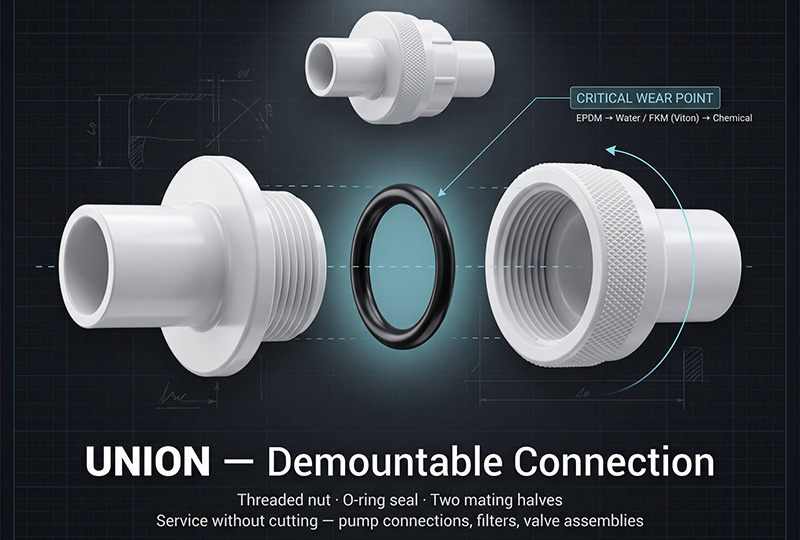
Unions are the difference between a system you can service and a system you have to cut apart. They create a demountable connection — threaded nut, O-ring seal, two mating halves — that lets you disconnect and reconnect without destroying the fitting. Critical anywhere you’ll need future access: pump connections, filter housings, valve assemblies. The O-ring is the wear point. EPDM works for water. FKM (Viton) for chemical exposure. Wrong O-ring material is the #1 union failure we see in the field.
Flanges
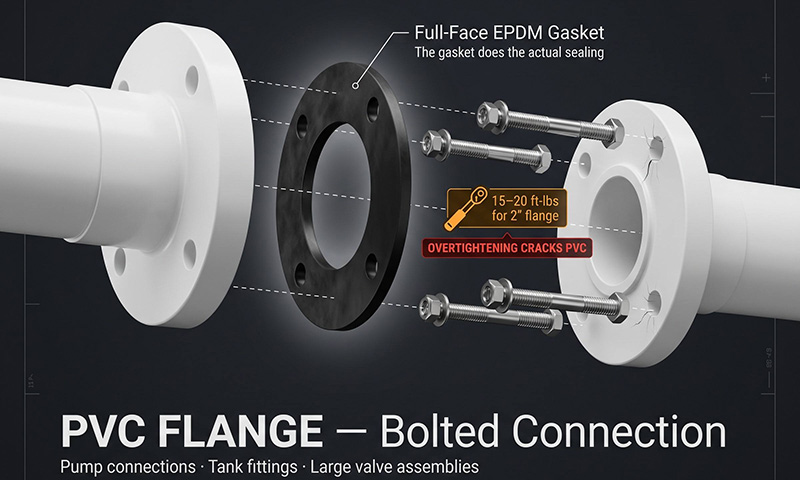
Flanges bolt two pipe sections or connect pipe to equipment — pumps, tanks, larger valves. PVC flanges typically follow ANSI B16.5 bolt patterns with flat-face design. The gasket does the actual sealing. Full-face EPDM gaskets are standard for water service. The bolt torque spec is easy to ignore and expensive to get wrong — overtightening cracks PVC flanges. 15-20 ft-lbs for a 2-inch flange is the sweet spot. Higher than that and you’re gambling.
| Fitting Type | Primary Function | Key ASTM Standard | Common Failure Mode |
|---|---|---|---|
| 90° Elbow | Sharp direction change | D2466 / D2467 | Pressure drop accumulation |
| 45° Elbow | Gradual direction change | D2466 / D2467 | Less common — preferred for pressure systems |
| Tee | Branch connection | D2466 / D2665 | Wrong type for application (pressure vs. sanitary) |
| Coupling | Pipe-to-pipe connection | D2466 | Incomplete solvent welding |
| Union | Demountable connection | D2466 | O-ring material mismatch |
| Flange | Equipment connection | ANSI B16.5 pattern | Overtightening, gasket creep |
Schedule 40 vs Schedule 80: The Real Difference
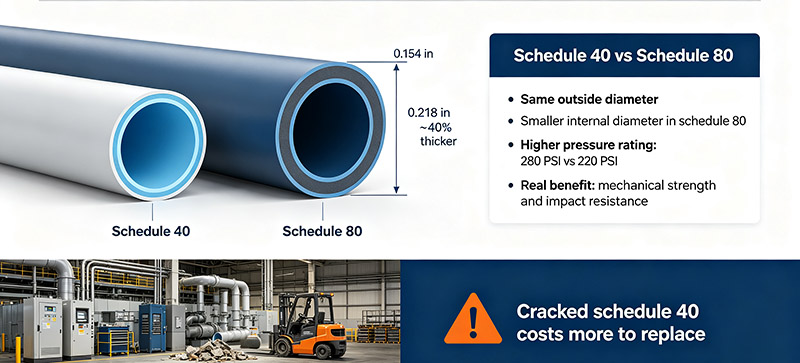
The wall is thicker. That’s what schedule 80 means. For a 2-inch pipe, schedule 40 has a wall thickness of 0.154 inches. Schedule 80 bumps that to 0.218 inches — roughly 40% thicker. The outside diameter stays the same (2.375 inches for 2-inch nominal), which means schedule 80 has a smaller internal diameter and therefore slightly lower flow capacity at the same pressure.
But here’s what most buyers miss: schedule 80 isn’t just about pressure rating. It’s about mechanical strength. In industrial settings where pipes get bumped by forklifts, walked on during maintenance, or exposed to external impact, schedule 80 survives what schedule 40 doesn’t. The pressure rating difference (280 PSI vs 220 PSI at 73°F for 2-inch) is secondary to the abuse-resistance difference in a lot of real-world installations.
What to Look for in a PVC Fittings Manufacturer
Not all PVC fittings are created equal. The differences aren’t always visible, but they show up over time.
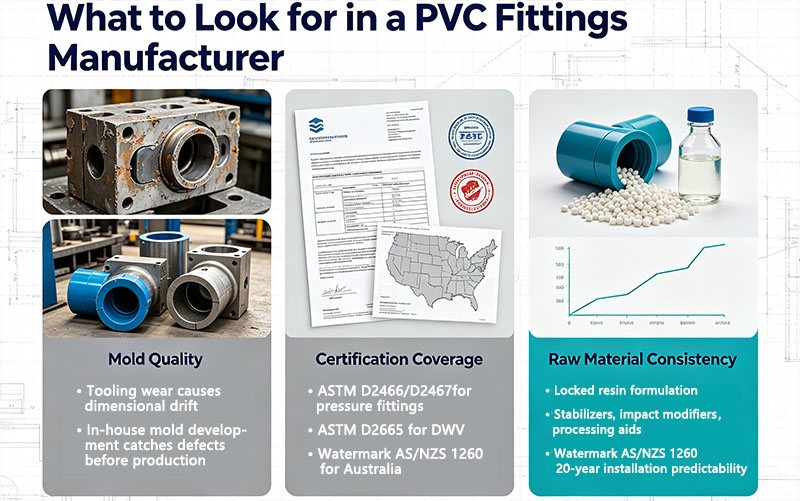
Mold quality controls everything: A worn mold produces fittings with dimensional drift — socket depth slightly off, wall thickness tapering at the gate, threads that bind or leak. A manufacturer with in-house mold development catches tooling wear before it becomes a QC problem. One without it discovers the issue when customers start filing claims. The difference between a fitting that installs smoothly every time and one that fights the installer on every joint comes down to mold maintenance — and you can’t maintain what you don’t control.
Certification coverage tells you which markets the factory is actually built for: A manufacturer holding ASTM D2466 and D2467 compliance means they produce pressure fittings for the North American market. Add ASTM D2665 and they cover DWV. Add Watermark AS/NZS 1260 and Australia is in their wheelhouse. Each standard requires separate third-party testing and factory audits. The certification portfolio is essentially a map of the markets where that manufacturer has proven compliance capability.
Raw material consistency separates industrial-grade from commodity-grade production.:PVC compound formulation — the ratio of resin to stabilizers, impact modifiers, and processing aids — directly affects long-term fitting performance. Manufacturers who buy resin from the same qualified suppliers with locked formulations produce fittings that behave predictably over 20-year installations. Price-driven resin switching saves pennies on the pellet and costs dollars in field performance variance.
Frequently Asked Questions
What’s the difference between ASTM D2466 and D2467 PVC fittings?
ASTM D2466 covers schedule 40 PVC pressure fittings with socket-type joints. ASTM D2467 covers schedule 80 PVC pressure fittings. The key difference is wall thickness — schedule 80 is approximately 40% thicker. Both standards cover elbows, tees, couplings, unions, caps, and plugs for pressure applications.
Can I use schedule 40 PVC fittings with schedule 80 pipe?
Yes — the outside diameters are identical across schedules. A 2-inch schedule 40 fitting will accept 2-inch schedule 80 pipe. However, the pressure rating of the system is limited to the lowest-rated component. If you’re mixing schedules, the schedule 40 fitting determines the system’s maximum pressure rating.
What certifications should PVC fittings have for drinking water applications?
NSF/ANSI 61 certification is the primary drinking water safety standard in North America. It verifies that the fitting does not leach harmful contaminants into potable water. For Australia and New Zealand, Watermark certification (AS/NZS 4020) serves the same function. Always verify the certification covers the specific fitting size and type you’re purchasing — not just the manufacturer’s general listing.
How do I choose between socket weld and threaded PVC fittings?
Socket weld (solvent cement) joints are stronger and leak-proof when properly assembled — they chemically bond the pipe and fitting into one piece. Use them for permanent installations. Threaded connections allow disassembly but introduce a potential leak path at every joint. Use them where future access is required: valve connections, equipment interfaces, and service points. Never thread schedule 40 PVC pipe — the wall thickness isn’t sufficient. Thread schedule 80 only.
What causes PVC fitting failures in the field?
The top three causes we see: (1) improper solvent cement application — insufficient coverage or wrong cement type; (2) dimensional mismatch from worn molds — the fitting doesn’t engage properly with the pipe; (3) overtightening threaded fittings, which creates stress cracks that may not leak immediately but fail within 6-18 months. Quality fittings from a manufacturer with proper QC processes eliminate cause #2, which is the hardest to diagnose after installation.
About SAM-UK
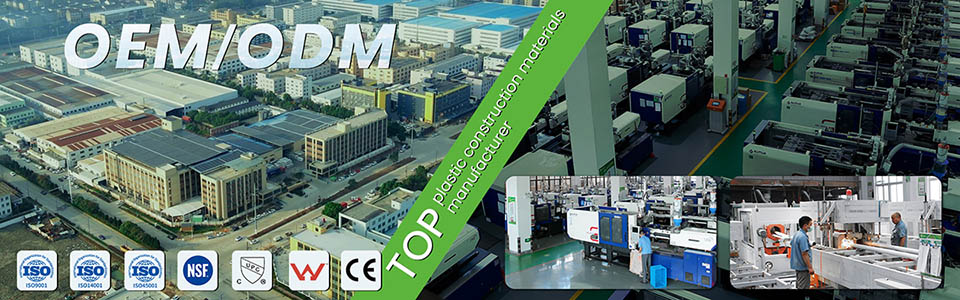
SAM-UK are a professional 20+ years manufacturer in producing vinyl building profile products and PVC , CPVC , PPH , PPR , PP pipes and pipe fittings, valves, taps and so on. See our certification records and product-specific scope. We support color /size customization. Welcome to consult for Catalog and Product. you can contact us at email [email protected]