Introduction
A PVC pressure test is a commissioning step with a written procedure, not a box to tick the afternoon the glue dries. The lines that blow are almost never the ones that were sized wrong. They are the ones where somebody shortened the cure time, skipped the high-point vents, or left the rig pressurized overnight “to make sure.” Here is how to run the test so it proves the line instead of destroying it.
What AWWA C605 Actually Requires: Test Pressure and Hold Time
For buried PVC pressure pipe, the governing document in North America is ANSI/AWWA C605, which covers installation and hydrostatic testing. Read it before you write the test plan, because the target pressure depends on where you measure it.
Test pressure is at least 1.5× the maximum working pressure, measured at the low point of the test section. The commonly cited reading for the high point of the same section is 1.25×. The leakage test — the makeup-water check — then runs about 2 hours at maximum operating pressure.
| Parameter (per ANSI/AWWA C605) | Requirement |
|---|---|
| Test pressure at the low point of the section | At least 1.5× maximum working pressure |
| Test pressure at the high point of the section | At least 1.25× maximum working pressure |
| Leakage (makeup water) test | Typically 2 hours at maximum operating pressure |
| Holding time, pipe under 400 mm nominal | 1–3 hours |
| Holding time, 400 mm nominal and larger | 3 hours |
Holding time tracks diameter. Pipe under 400 mm nominal usually holds somewhere in the 1–3 hour band; at 400 mm and larger, plan on the full 3 hours. Material changes the reference point too — field leak testing of polyethylene systems follows ASTM F2164, not C605, and the procedure is different. Test to the standard that matches the material you actually buried, not the one you used on the last project.
It helps to separate the two checks C605 is really asking for. The pressure test proves the pipe and joints can take the load — strength. The leakage test proves they are tight — makeup water. They are not the same thing, and a line can pass one while failing the other. A joint starved of solvent cement can hold pressure for a spell and still weep enough makeup water to fail the leakage test, while a slightly oval pipe can slip past the water-volume check and crack on strength. Run both, log both, and treat a pass as provisional until the numbers are written down.
Test With Water, Never Air
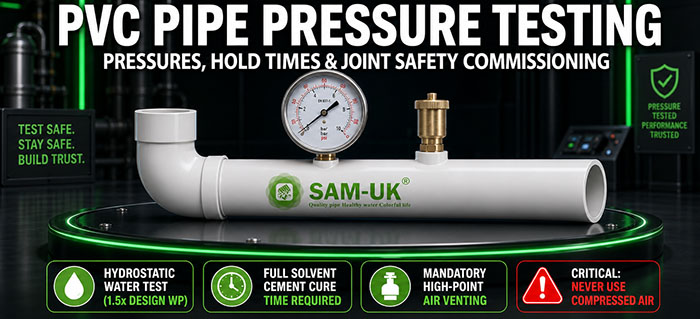
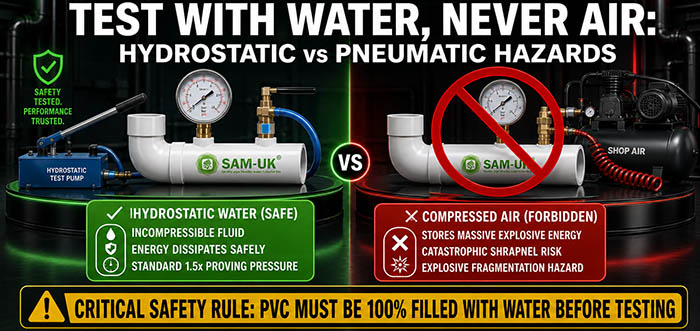
Air is not a test medium on a PVC line. At the same gauge pressure, compressed air stores far more energy than water, so a PVC failure under air is an explosion, not a leak — fragments, not a puddle. Water is nearly incompressible. A failure releases its energy over a few inches instead of across the room.
This one keeps happening anyway. Somebody “saves time” by hooking a new run to the shop compressor, the pipe cracks, and a piece of it crosses the bay. Hydrostatic means water, full stop. If the section can’t be filled with water where it sits, it is not ready to test — that is a fill and access problem, not a reason to reach for air.
Do Not Test Uncured Solvent-Cemented Joints
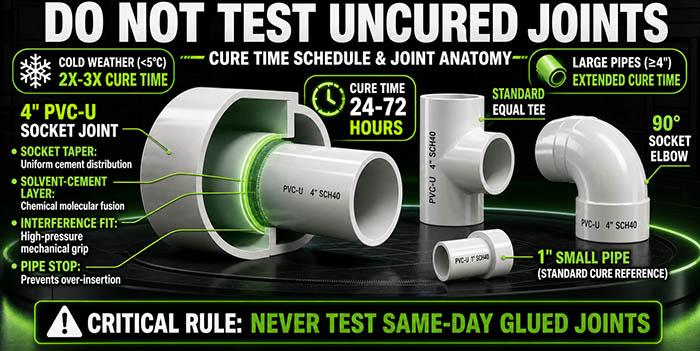
Solvent-cemented joints must cure fully, and testing the same day you glued is the single most common cause of joint blowouts. The joint often holds at first and lets go as pressure climbs, which is the worst possible version because it fails with people standing over it. Cure time is driven by temperature and joint size, and it runs much longer in cold weather than the can label implies.
Give the schedule its time. A shortcut here buys one afternoon and risks the entire section, because re-cutting and re-gluing a run that blew under test costs far more than the wait. Cold weather can double or triple the cure window, particularly on larger-diameter joints. Build that into the schedule instead of pretending it away.
Restrain the Ends or Launch a Cap Through a Wall
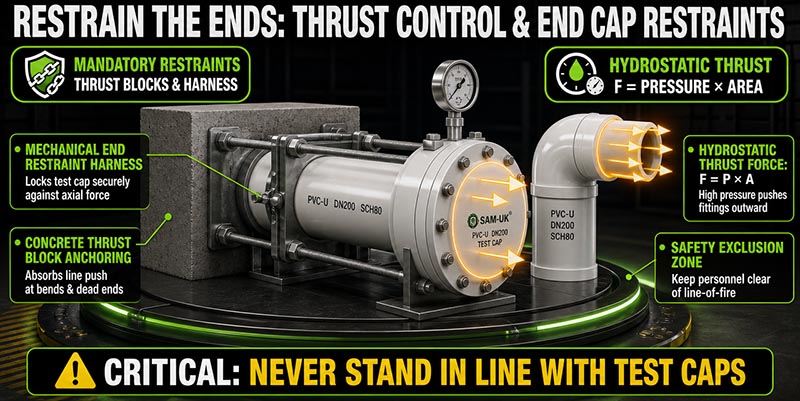
An unrestrained test cap on a pressurized line is a projectile with a pressure gauge bolted to it. Thrust blocks and end restraints are part of the test setup, not an optional extra. The same logic applies at every bend, tee, and change of direction, because those fittings push back with real force once the line is under test pressure.
Field failures cluster at unrestrained ends. A 6″ cap that lets go at a couple hundred psi will travel, and it does not care who is in the way. Block the ends before you pressurize, and keep everyone clear of caps and fittings while the test is live. Restraint steel is cheap; a struck crew member is not.
Mechanical restraints, harnesses, and flexible joints all have to be set before water goes in. If the section includes valves or flanged connections, check those assemblies too. A flanged joint running old gaskets will leak under test even when every solvent-welded joint is perfect, and chasing that leak after the trench is open again costs a day and a crew. Inspect the whole test boundary, not just the caps.
Fill Slow, Vent High, and Read the Makeup Water Honestly
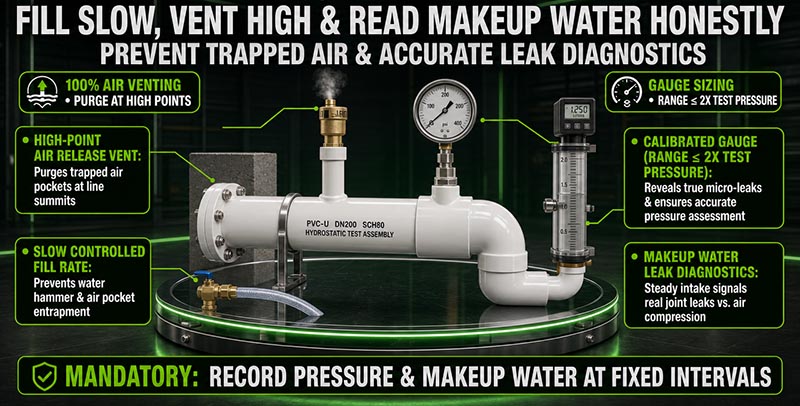
Entrapped air is what makes a gauge jump and hands you a false leakage number. Fill the section slowly and vent at the high points so the air has a place to leave. A slow fill with working high-point vents is the only way the makeup-water figure means anything at all.
Once the section is full and vented, bring it to test pressure and watch how much water you have to add to hold it. That makeup water is your leak signal. Big jumps early usually mean air is still escaping; a small, steady trickle points to a real joint leak. Read the trend, not the first number — a gauge that wanders is telling you there is still air in the line, not that the pipe is failing.
Use a calibrated gauge with a range no more than about double the test pressure. A 1,000 psi gauge on a 200 psi test buries the small movements that actually tell you what is happening, and the operator ends up guessing at the end. Record pressure and makeup water at a fixed interval so the data tells a story over the whole hold instead of a single snapshot somebody eyeballed once.
PVC Is Viscoelastic: Do Not Leave the Rig Overnight
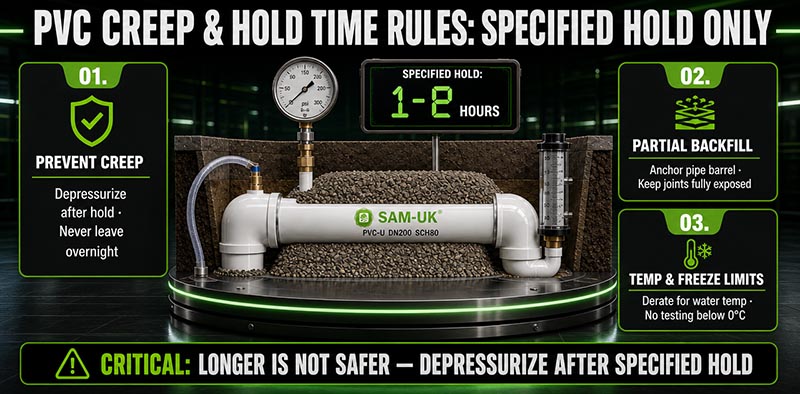
PVC creeps. Hold a line at high pressure for an extended time and the pipe slowly yields, so a rig left pressurized overnight bleeds strength out of the section for no benefit. Run the specified hold, log the numbers, and shut it down. Longer is not safer here — it is the opposite.
Two more rules that save pipe. Make sure the test pressure never exceeds the pipe’s rating at the actual water temperature; a rating quoted for cold water applied on a warm day is a mistake waiting to happen. And do not test in freezing weather. Brittle PVC, cold water, and stored pressure is exactly how pipes crack. If the ground is frozen or the air is at freezing, wait for better conditions.
Sequencing against backfill trips people up too. In a trench, the pipe usually wants enough cover to keep it from shifting under pressure, but you cannot bury joints that may still need a repair. The practical order is to restrain, partly backfill, test, and finish the backfill only once the section passes — not to close the trench and hope the numbers come out.
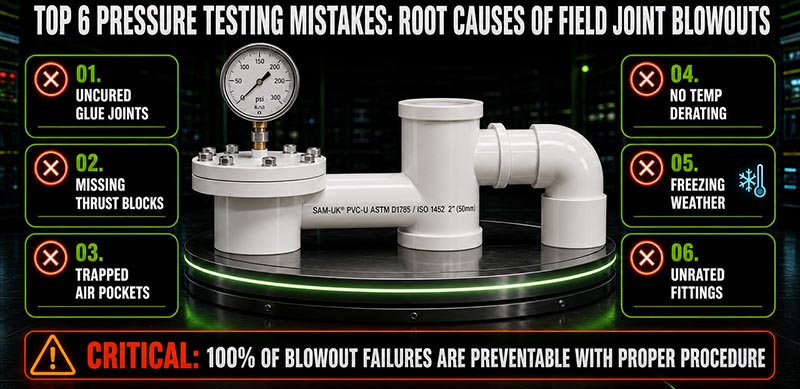
The lines that fail tend to fail the same ways, and the list is short:
- Uncured solvent-cemented joints — the number-one blowout cause.
- Missing thrust restraint at caps, bends, and tees.
- Trapped air pockets that spike the gauge and fake the leakage reading.
- Over-pressurization above the rating derated for the actual temperature.
- Testing below the frost line or in freezing weather.
- Energizing fittings that were never rated for the line’s pressure class.
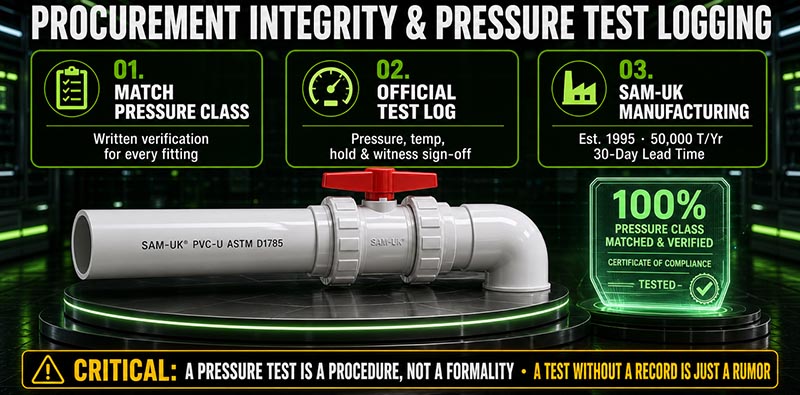
One procurement point that surfaces at test time: every fitting in the section has to carry the same pressure class as the pipe. A fitting rated below the line fails under the test even when the pipe is flawless, and the pipe gets the blame. SAM-UK, the export brand of Taizhou Zhuoxin Plastics (founded 1995 in Taizhou, Zhejiang), produces PVC/uPVC, CPVC, PPH and PPR pipe and fittings plus PVC ball and butterfly valves at roughly 50,000 tonnes a year of capacity, with a 30-day lead time on standard programs and OEM service. Whichever supplier you use, confirm each component’s pressure class in writing before the test plan is signed — the test will find any piece that does not belong.
Keep the record simple but complete: test pressure at the low and high points, water temperature, hold time, makeup water at each interval, and who witnessed it. On a municipal job that log is the proof the section passed; on the next project it is the baseline that tells you whether a slow leak is new or was always there. A test without a record is just a rumor.
Frequently Asked Questions
How long should a PVC pressure test hold?
Per ANSI/AWWA C605, the leakage test normally runs about 2 hours at maximum operating pressure. Holding time is typically 1–3 hours for pipe under 400 mm nominal and 3 hours at 400 mm and larger.
What test pressure should I use for PVC pipe?
At least 1.5× the maximum working pressure measured at the low point of the section, and about 1.25× at the high point. Never exceed the pipe’s rating at the actual water temperature.
Can I pressure test PVC pipe with air?
No. Compressed air stores far more energy than water, so a PVC failure under air is an explosion rather than a leak. Always test with water.
How long after gluing can I pressure test PVC?
Until the solvent cement is fully cured for the joint size and temperature. Testing the same day you glued is the most common cause of joint blowouts, and cold weather can double or triple the cure window.
Can I leave a PVC pressure test pressurized overnight?
No. PVC is viscoelastic and creeps under sustained pressure, so an overnight hold bleeds strength from the pipe for no benefit. Run the specified hold, log it, and shut the rig down.
Why does my PVC line lose pressure during a test?
Usually because of trapped air, an uncured joint, or a missing restraint — not a burst pipe. Vent the high points, confirm the joints are fully cured, and read the makeup-water trend rather than the first gauge reading.
About SAM-UK
SAM-UK are a professional 20+ years manufacturer in producing vinyl building profile products and PVC , CPVC , PPH , PPR , PP pipes and pipe fittings, valves, taps and so on. See our certification records and product-specific scope. We support color /size customization. Welcome to consult for Catalog and Product. you can contact us at email [email protected]