Introduction
Picking PVC by schedule number alone is how projects end up either overpaying for pipe they never needed or, worse, solvent-welding DWV into a pressurized main. Schedule 40 and schedule 80 share an outside diameter; the schedule changes wall thickness, and that one variable sets the pressure rating, whether the pipe can be threaded, the flow you get from a given pump, and the price per foot. Here is how to specify between them without wasting money or building a line that splits at commissioning.
Same Outside Diameter, Different Wall: What the Schedule Actually Changes
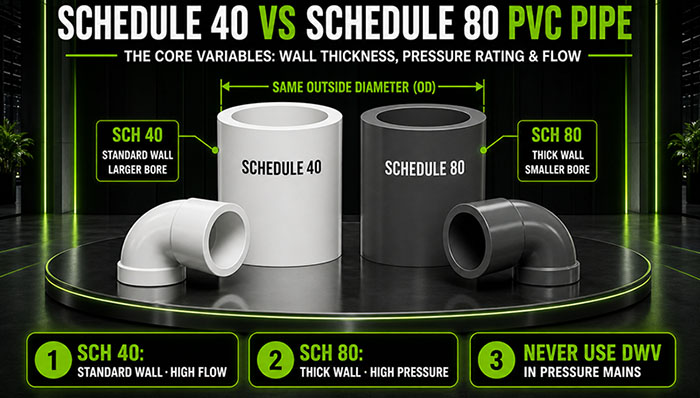
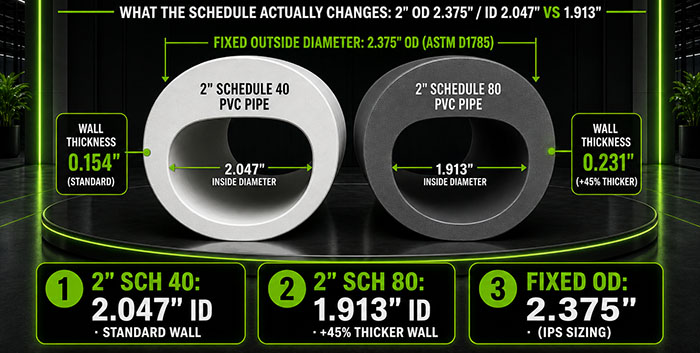
U.S. PVC pressure pipe is made to ASTM D1785, the specification that covers schedules 40, 80, and 120. Outside diameter is fixed by IPS sizing, not by the schedule. A 2″ pipe is 2.375 in O.D. either way, a 4″ is 4.500 in, and a 6″ is 6.625 in. The schedule controls thickness only.
At any nominal size, sch 80 carries a wall roughly 40–50% heavier than sch 40. All that extra material goes to the inside, so the two pipes look nearly identical from ten feet away and behave nothing alike once you put pressure to them. A 2″ sch 40 has a 2.047 in inside diameter; the sch 80 version of the same size is 1.913 in. You did not get a bigger pipe. You got a thicker one with a smaller hole.
| Nominal size | Sch 40 wall (in) | Sch 80 wall (in) | Sch 40 max W.P. @73°F (psi) | Sch 80 max W.P. @73°F (psi) |
|---|---|---|---|---|
| 1/2″ | 0.109 | 0.147 | 600 | 850 |
| 1″ | 0.133 | 0.179 | 450 | 630 |
| 2″ | 0.154 | 0.218 | 280 | 400 |
| 4″ | 0.237 | 0.337 | 220 | 320 |
| 6″ | 0.280 | 0.432 | 180 | 280 |
Every rating above is a maximum working pressure at 73°F, the reference temperature PVC ratings in North America are quoted against. Look at the inside diameters the thicker wall costs you. At 4″ the sch 80 bore is 3.786 in against 3.998 in for sch 40; at 6″ it is 5.709 in against 6.031 in. That is the price of the extra 100 psi, and on long runs it is a price you feel at the pump.
Pressure Ratings at 73°F — and the Flow You Pay for the Extra Wall
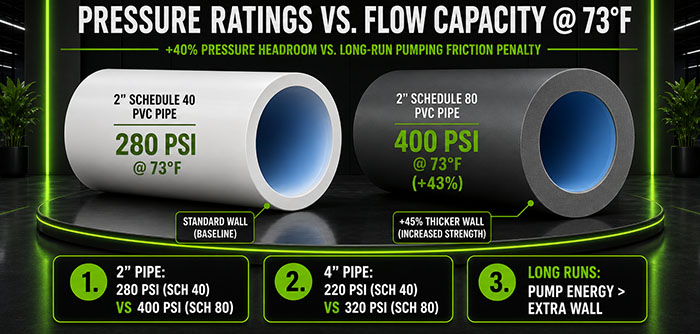
Sch 80 typically buys 30–45% more pressure headroom than sch 40 at the same nominal size. On a 2″ line that is the gap between 280 psi and 400 psi. On a 4″ line it is 220 psi against 320 psi. Most municipal distribution mains and farm irrigation laterals never see anything close to 220 psi in normal service, which is the whole argument against paying for sch 80 on a straight cold-water run.
Here is the trade the catalog never spells out. A tighter bore raises velocity, and velocity raises friction loss. Friction loss is what your pump fights every hour of every day for the life of the line. Push the same flow through 2″ sch 80 instead of 2″ sch 40 and the energy penalty shows up on the power bill, not the pipe invoice. On a 50 ft header you will never notice it. On a 2,000 ft transmission run the smarter move is often to jump to the next sch 40 diameter rather than step up to sch 80 at the same size.
So sch 80 is not the “better” pipe. It is the thicker pipe. Better depends on what the line has to survive, and that is a design question, not a catalog sort order.
Why You Cannot Thread Schedule 40
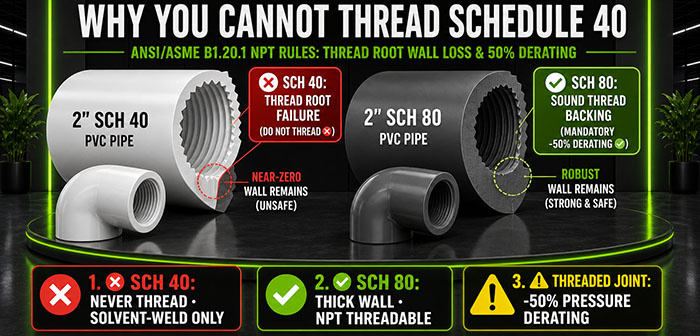
A tapered NPT thread cut to ANSI/ASME B1.20.1 needs material to bite into. At the smaller sizes, sch 40 walls are too thin to carry a sound thread — the cut removes most of the wall at the thread roots, and the joint fails right there rather than in the pipe body. Thread sch 80 or heavier, and leave sch 40 to solvent-weld or gasketed joints where it belongs.
That said, threading is never free even on sch 80. The cut concentrates stress and locally removes wall, so the threaded assembly is derated well below the pipe’s own pressure rating. Field experience is blunt about this: a threaded sch 80 joint on a line that was sized right at the pipe rating will weep or crack at the threads. If a spec calls for threaded PVC, find the derating figure before you assume the line still meets its class. And never thread a thin-wall pipe just because the die physically cut threads into it. It did. It will also fail.
Fittings and the DWV Trap: D2466, D2467, and D2665
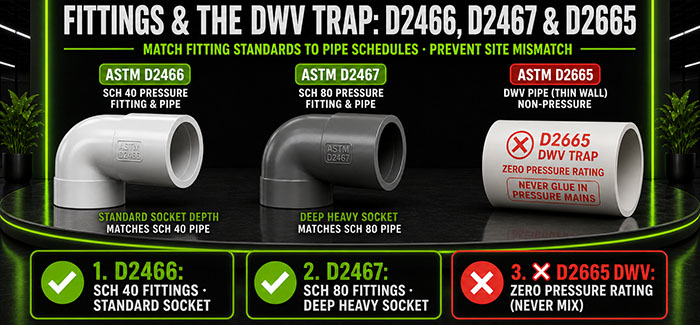
Fittings follow their own standards, and they do not substitute cleanly across schedules. Schedule 40 fittings are molded to ASTM D2466; schedule 80 fittings to ASTM D2467. The sch 80 fitting has a deeper socket to accept the heavier wall and a thicker body to match the pipe’s rating. Bolt a sch 80 fitting onto sch 40 pipe and you have neither rating — you have a mismatch waiting to leak.
Mix schedules at a joint and you change the insertion depth and the cement gap. The pipe may bottom out early or float shallow, the solvent cement starves on one side and smears on the other, and the joint looks perfectly fine while you are building it. Six months later that is the leak the owner calls about. Match the fitting standard to the pipe schedule, and if a transition is unavoidable, make it with a purpose-made transition fitting rather than with whatever length was on the truck.
The single worst substitution on any site is drain-waste-vent pipe to ASTM D2665. DWV pipe has the same outside diameter as sch 40 pressure pipe, so it slides into sch 40 sockets without complaint. It also has a thin, non-pressure wall — D2665 is not pressure rated at all. Glue it into a pressure line and it holds through fill-up and fails under test or under service, splitting along the wall. That failure almost always traces back to a helper grabbing a length off the wrong stack, which is why DWV and pressure pipe should never share a rack.
Temperature Derating: PVC Loses Strength Above 73°F
Every rating in this article assumes 73°F, and none of them hold above it. PVC softens as it warms, so the allowable working pressure drops with temperature. Multiply the 73°F rating by the factor below to get the pressure the line can actually carry in service. Any line running warm water, sitting in a hot mechanical room, or baking in summer sun across the southern tier needs this math done before the pipe is ordered, not after it fails.
| Operating temperature | Derating factor (× 73°F rating) |
|---|---|
| 73°F | 1.00 |
| 80°F | 0.88 |
| 90°F | 0.75 |
| 100°F | 0.62 |
| 110°F | 0.51 |
| 120°F | 0.40 |
| 130°F | 0.31 |
| 140°F | 0.22 |
Run the 4″ sch 40 number as a reality check. At 73°F it holds 220 psi. At 120°F that same pipe is good for about 88 psi, and at 140°F closer to 48 psi. A line designed on the 73°F column and installed in a hot plant can be over its real rating on day one, and the pipe gives no warning until it lets go. This is the most common way a correctly sized system still fails.
How to Specify: Where Sch 40 Wins, Where Sch 80 Earns Its Price
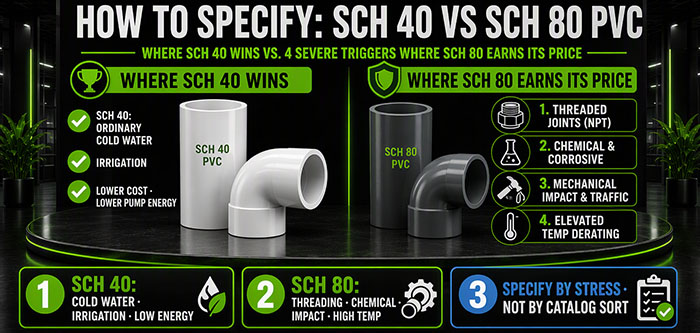
Specify Schedule 40 fittings for ordinary cold-water and irrigation pressure lines. It carries ample pressure at the sizes and loads most projects see, it costs less, and its wider bore keeps pump energy down. Reserve sch 80 for the jobs that actually stress the pipe.
Use sch 80 when:
- Any part of the line will be threaded — a tapered thread needs the heavy wall.
- The line carries chemical or corrosive service, where the extra wall buys service life and a cleaner joint.
- The pipe runs where it will be mechanically abused — heavy traffic, active construction zones, wash-down areas, exposed crossings.
- The pressure class still needs to hold after temperature derating is applied.
And do not specify by color. White means sch 40 and gray means sch 80 across most of North America, but that is convention, not law, and makers ship both schedules in assorted stocks. Call out the schedule number and the standard code and let the supplier sort the color. A spec that says “gray pipe” is not a spec at all.
When you vet a supplier for either schedule, ask for the dimensional tolerances and the exact fitting standard the factory molds to — D2466 or D2467, never “sch 40/80 compatible.” A maker with its own mold workshop controls socket depth, and socket depth is where the mixed-schedule mysteries live. SAM-UK, the export brand of Taizhou Zhuoxin Plastics (founded 1995 in Taizhou, Zhejiang), runs PVC/uPVC, CPVC, PPH and PPR pipe and fittings plus PVC ball and butterfly valves, with about 50,000 tonnes a year of capacity and a 30-day lead time on standard programs. If a project requires potable-water listing, treat that as a requirement the buyer must confirm against the local authority’s approved list, and ask any supplier to state in writing exactly what the pipe is listed to.
Frequently Asked Questions
Is schedule 80 always better than schedule 40 PVC?
No. Sch 80 only wins where you need the heavier wall — threading, chemical service, or mechanical-abuse locations. On a plain cold-water or irrigation run it costs more and flows less, so sch 40 is the better buy.
Can I glue a schedule 40 fitting onto schedule 80 pipe?
Do not. The socket depths differ between ASTM D2466 (sch 40) and ASTM D2467 (sch 80), so the insertion depth and cement gap change and the joint starves or smears. Match the fitting standard to the pipe schedule.
Can I use DWV pipe for a pressure line?
Never. DWV pipe to ASTM D2665 has the same O.D. as sch 40 pressure pipe and glues in easily, but it is not pressure rated and will split under pressure. Keep DWV and pressure pipe on separate racks.
Why is schedule 40 not allowed for threaded connections?
Its wall is too thin to carry a sound tapered thread to ANSI/ASME B1.20.1, so the joint fails at the thread roots. Thread sch 80 or heavier, and expect the threaded joint to be derated below the pipe’s solvent-weld rating.
How much does temperature reduce a PVC pressure rating?
Noticeably. Multiply the 73°F rating by the derating factor — 0.62 at 100°F, 0.40 at 120°F, 0.22 at 140°F. A 4″ sch 40 pipe rated 220 psi at 73°F is good for only about 88 psi at 120°F.
Does schedule 80 reduce flow?
Yes. The heavier wall means a smaller bore — a 2″ sch 80 ID is 1.913 in against 2.047 in for sch 40 — which raises velocity and friction loss. On long runs that can cost more in pump energy than it saves in rating.
About SAM-UK
SAM-UK are a professional 20+ years manufacturer in producing vinyl building profile products and PVC , CPVC , PPH , PPR , PP pipes and pipe fittings, valves, taps and so on. See our certification records and product-specific scope. We support color /size customization. Welcome to consult for Catalog and Product. you can contact us at email [email protected]