Introduction
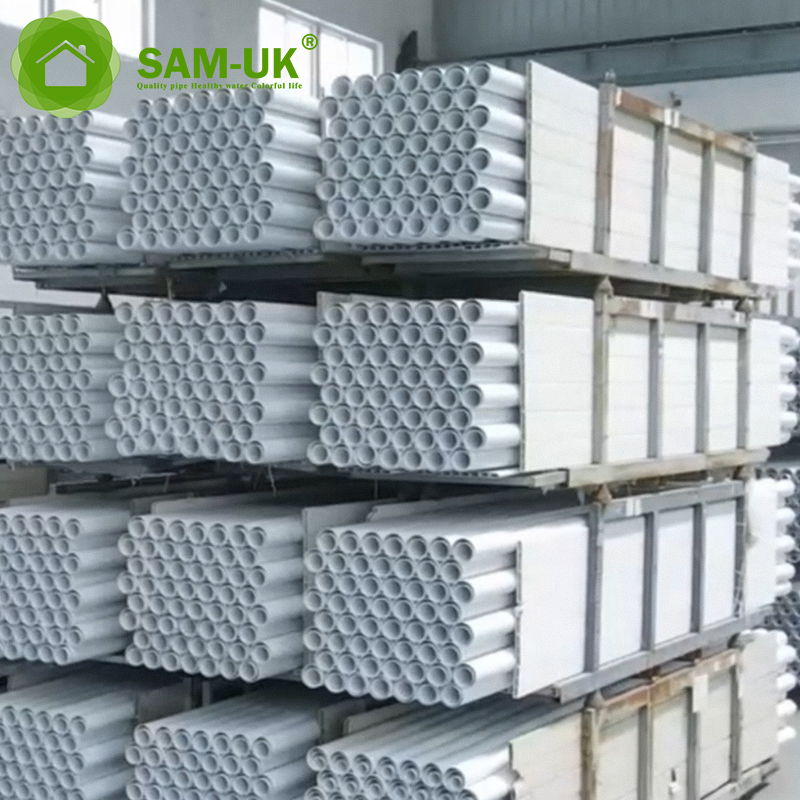
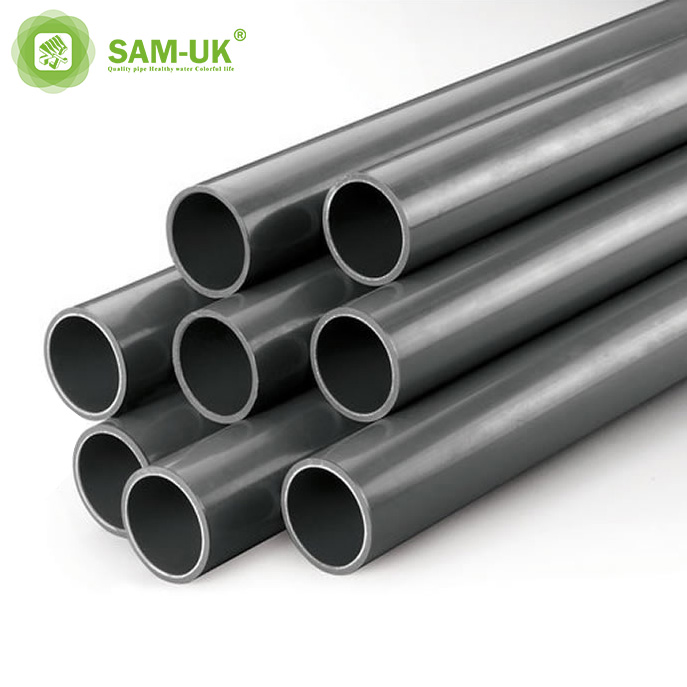
A PVC pressure pipe is designed to convey fluids under pressure, widely used for water supply, irrigation, and industrial applications due to its strength, corrosion resistance, and cost-effectiveness. They come in different types and pressure classes to suit various needs.
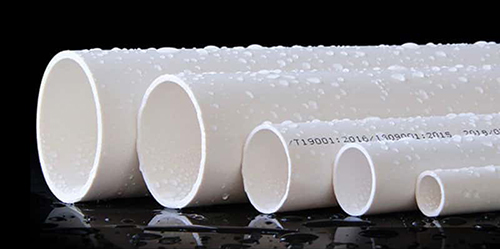
Here’s a clear, professional overview of PVC Pressure Pipe — including its definition, classification, and main applications:
What is a PVC Pressure Pipe?
1. PVC Pressure Pipe is a type of polyvinyl chloride (PVC) pipe specifically designed to carry fluids under pressure, such as water, irrigation flow, or industrial liquids.
2. It is manufactured using unplasticized PVC (UPVC) resin, which provides high strength, rigidity, and corrosion resistance, making it suitable for long-term pressurized systems.
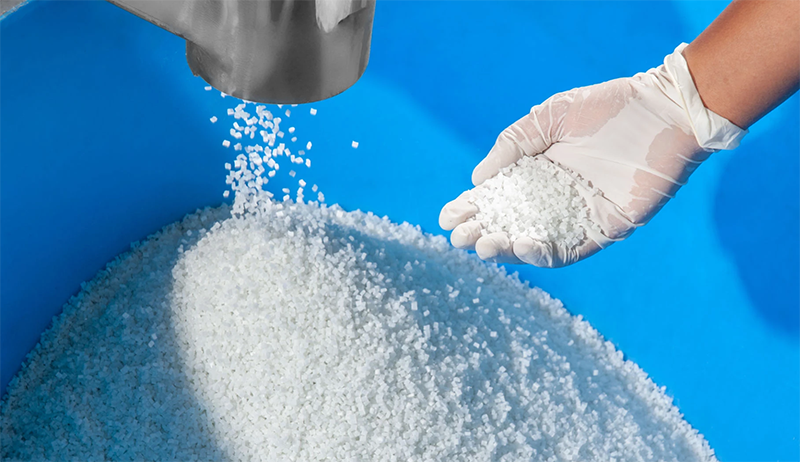
3. PVC pressure pipes are typically joined using solvent cement joints, rubber ring (push-fit) joints, or threaded fittings, depending on the pressure rating and application.

🚰 Types of PVC Pressure Pipes
Here are the main types of PVC pipes used for pressure applications:
| Type of PVC Pipe | Key Characteristics | Common Applications |
|---|---|---|
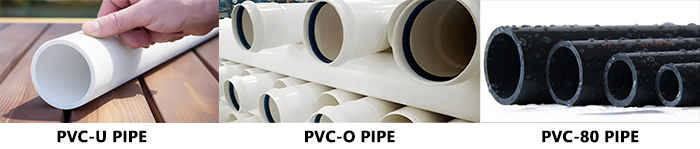
| PVC-U (Unplasticized) | Rigid, cost-effective, excellent corrosion resistance. Maximum operating temperature typically 45-60°C. | Municipal water supply, pressure drainage, irrigation. |
| PVC-O (Oriented) | Molecular orientation enhances strength and impact resistance; higher pressure rating (up to 2.5 MPa). | Buried or above-ground pressure water systems, suitable for higher-pressure applications. |
| Industrial Schedule 80 | Thicker walls than standard PVC-U, made from rigid PVC compound for higher physical strength. | Chemical processing, industrial plant water, wastewater treatment. |
💧 Pressure Classes: What PN Actually Means
PVC-U water supply pipe is graded by nominal pressure (PN), with standard classes of PN6, PN8, PN10, PN12.5, and PN16 (0.6–1.6 MPa). Every PN rating is based on 20°C water temperature — it’s written into the standard, yet it’s the detail buyers ignore most.
The number itself is misleading: PN16 does not mean you can run 16 bar indefinitely. It means the rated working pressure at 20°C, and the moment temperature rises, that rating must be derated (next section). The classic mistake procurement managers make is treating PN as an absolute pressure ceiling, then sizing to peak operating conditions — and wondering why the system fails the first time it runs hot.
Second distinction that must not be blurred: PVC-O and PVC-U have different PN ceilings. PVC-U stops at PN16 in standard product lines; PVC-O, strengthened through molecular orientation, reaches PN25 (2.5 MPa). The old “PN6–PN25” line on this page wasn’t wrong — it was wrong to state both materials in one breath. The accurate way to say it: PVC-U typically runs PN6–PN16; PVC-O goes up to PN25.
Schedule 40/80 sits outside both systems — that’s the ASTM D1785 North American framework, graded by wall thickness, not PN. Fix the market standard first, then argue about the class.

PVC Pressure Pipe Standards by Market
If an RFQ only says “PVC pressure pipe,” no reputable supplier can quote it directly — because specification systems differ completely from market to market. The standard number is the buyer’s language. Get the standard wrong and the goods won’t mate with the system, or worse, they’ll fail inspection on arrival.
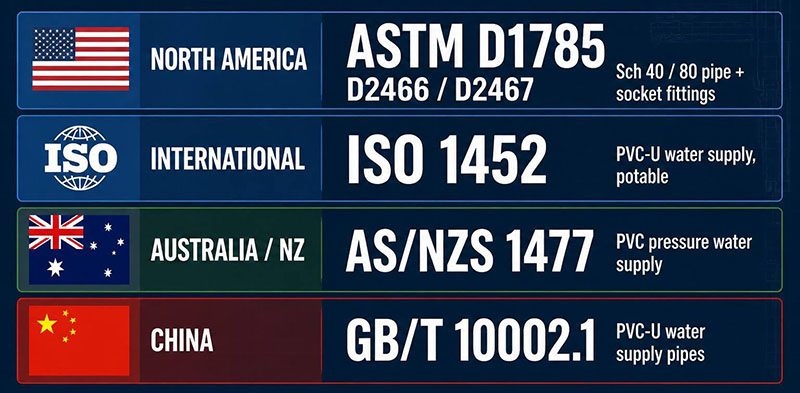
Four systems cover most of the world’s PVC pressure pipe procurement:
| Market | Standard | What It Covers |
|---|---|---|
| North America | ASTM D1785 | PVC Schedule 40 / Schedule 80 pressure pipe |
| North America | ASTM D2466 / D2467 | Sch 40 / Sch 80 socket fittings (mate with D1785) |
| International (ISO) | ISO 1452 | PVC-U pipes for water supply, including potable systems |
| Australia / NZ | AS/NZS 1477 | PVC pressure pipe for water supply |
| China | GB/T 10002.1 | PVC-U water supply pipes |
One misconception deserves to be called out:
Sch 40/80 and PN ratings are not interchangeable. ASTM D1785 grades by wall thickness; ISO 1452 grades by nominal pressure. The pressure basis, safety factors, and test methods all differ. Carry the idea that “PN16 equals Sch 40” into a selection and it will bite you eventually. Before you order, confirm two things: which market standard you’re buying to, and that pipe and fittings come from the same standard family — mixing ASTM pipe with ISO fittings is the most common low-level mistake we see on jobsites.
Temperature Derating: Read This Before You Spec
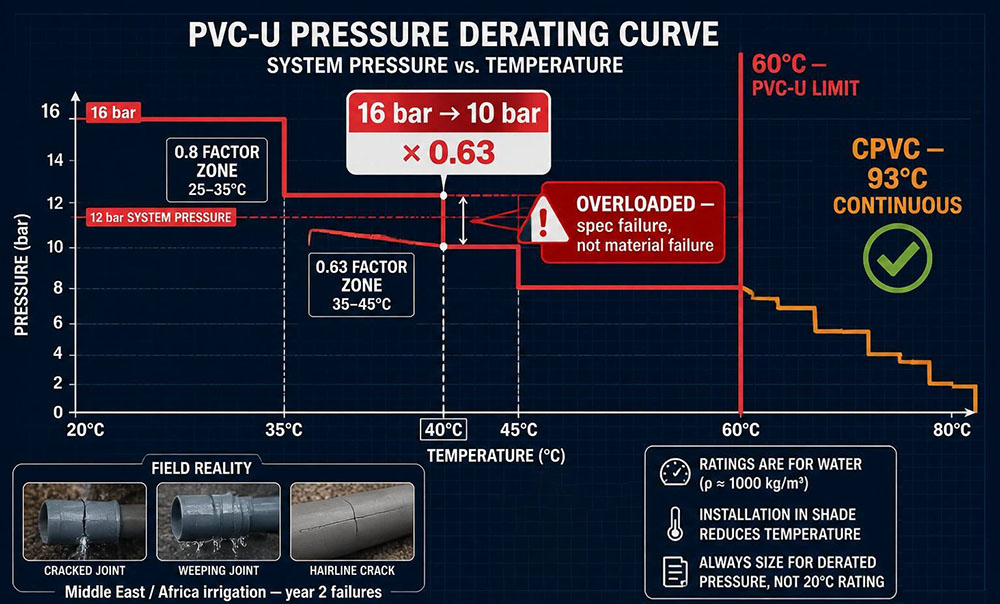
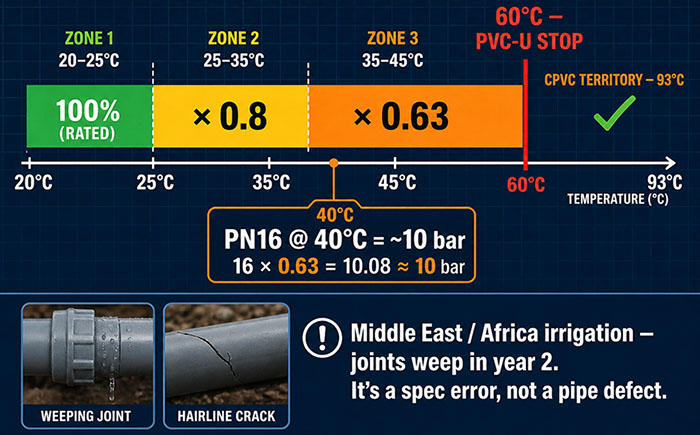
PVC pressure pipe ratings are all based on 20°C water. Raise the fluid temperature and the rating has to be discounted — that’s derating, and the industry-standard factors are 0.8 for 25–35°C, 0.63 for 35–45°C.
Run the numbers and it becomes obvious. A PN16 pipe handles 16 bar at 20°C. Push the fluid to 40°C and you’re left with roughly 10 bar (16 × 0.63). If your system actually runs at 12 bar, that pipe is already overloaded — not a material failure, a spec failure.
We’ve watched this replay too many times on irrigation projects in the Middle East and Africa: engineer sizes for 20°C, site water measures 40°C+, and by year two the joints weep and hairline cracks show up in the walls. Lab tests come back clean every time. The derating factor in the spec sheet was the only thing that failed.
And the boundary condition — above 60°C, standard PVC-U should not be used at all. That’s CPVC territory. Chlorination lifts CPVC’s continuous service temperature to 93°C (200°F) while keeping the PVC family’s corrosion resistance and cost advantage. For hot-water systems, stop wondering whether PVC can “make do” and go straight to a CPVC piping system.
🏗️Applications of PVC Pressure Pipe
PVC pressure pipes are used across municipal, industrial, agricultural, and residential systems. Common applications include:
1. Water Supply Systems
Potable (drinking) water distribution networks
Main and branch pipelines
Rural and urban water supply systems
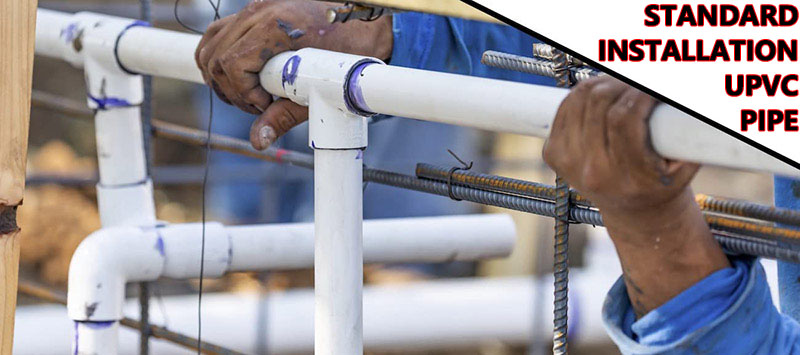
2. Irrigation Networks
Agricultural irrigation mains and laterals
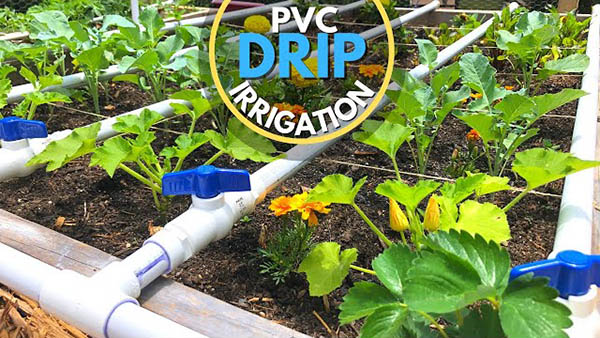
Drip and sprinkler systems
3. Construction and Building Services
Plumbing supply lines
Roof and floor riser systems
Advantages of PVC Pressure Pipe
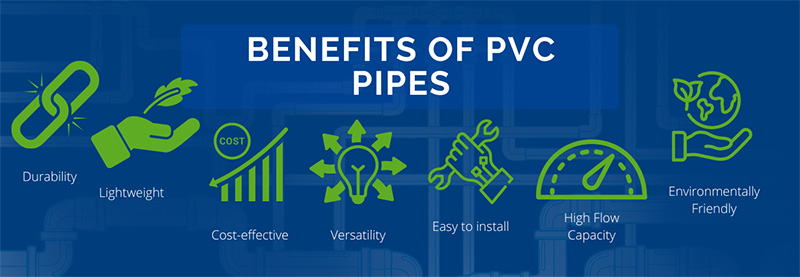
- Lightweight → Easy to transport and install
- Corrosion and chemical resistant → Long lifespan in diverse environments
- Smooth inner surface → Reduces friction loss, maintains high flow rates
- Economical → Lower cost than metal pipes for similar performance
- Non-toxic and safe for potable water
Temperature Derating: Read This Before You Spec
PVC pressure pipe ratings assume 20°C water. The moment your fluid runs hotter, the rating drops — this is called derating. As a rule of thumb: 25–35°C → multiply rated pressure by 0.8; 35–45°C → multiply by 0.63. Above 60°C, standard PVC-U shouldn’t be used at all — that’s what CPVC is for.
For hot-climate irrigation projects in the Middle East or Africa, we routinely see engineers skip this step, then wonder why joints weep in year two. It’s not a pipe defect — it’s a spec error.
Summary
Available in pressure classes from PN6 to PN16 for PVC-U, up to PN25 in PVC-O, or Schedule 40/80 per ASTM D1785 for North American projects.
I hope this overview helps you understand PVC pressure pipes. If you have a specific application in mind and need help choosing a suitable pipe class, feel free to ask.
Frequently Asked Questions
1. Can PVC pressure pipe be used for drinking water?
Yes — provided the product carries the potable-water certification for your market. North America recognizes NSF/ANSI 61; other regions have their own schemes. Lead-free stabilizers are the floor, not a differentiator. Ask for a copy of the certificate at inquiry stage, don’t take verbal assurances, and check that the certified model range matches what actually lands in your warehouse.
2. What’s the difference between Schedule 40 and Schedule 80?
At the same OD, Sch 80 wall thickness runs about 40–50% thicker than Sch 40 (closer to 55% in large diameters), with a significantly higher pressure rating — at the cost of smaller ID, marginally lower flow, and a higher unit price. Chemical and high-pressure industrial lines justify Sch 80. Municipal water and irrigation, with their routine pressure profiles, don’t — spending Sch 80 money there buys nothing.
3. How do I choose the right PN class?
Calculate the system’s maximum working pressure, then apply a safety factor of 1.25–1.5 — and don’t forget water hammer. When a valve closes fast, the pressure surge can briefly double the line pressure. When in doubt, step up one class: the price difference between pipe grades is trivial next to the cost of tearing out a leaking line.
4. Can PVC pressure pipe be buried?
Yes — most municipal water mains are buried PVC. Two rules though: any above-ground run needs UV protection (wrapping or painting; direct sunlight embrittles the surface layer), and trench backfill must be compacted and free of sharp stones. Crushed pipe walls from poor backfill are the number one cause of premature failure in buried installations.
5. PVC pressure pipe or HDPE — which one?
It depends on the duty, and anyone who answers “one is better” in general terms is overselling you. PVC is rigid, cheaper per meter, and faster to join — right for pump stations, above-ground runs, and routine supply lines. HDPE flexes, butt-fuses into continuous lengths, and shrugs off ground settlement — right for long buried mains and geologically active ground. For long municipal trunk lines we generally recommend HDPE; inside plant boundaries and above ground, PVC wins on cost.
About SAM-UK
SAM-UK are a professional 19+ years manufacturer in producing vinyl building profile products and PVC , CPVC , PPH , PPR , PP pipes and pipe fittings, valves, taps and so on. See our certification records and product-specific scope. We support color /size customization. Welcome to consult for Catalog and Product. you can contact us at email [email protected]