Introduction
If you’re ordering PVC pipe for a project — water supply, drainage, irrigation, industrial lines — the first decision is not the brand. It’s the grade. PVC comes in pressure-rated and drainage-rated versions, with wall thicknesses (Schedule) that change both performance and price. Get the grade wrong on an RFQ and you’ll either overpay or end up with a line that fails inspection.
This guide covers what to specify: pipe types, nominal sizes, Schedule vs. SDR grades, and the standards behind them (ASTM D1785, D2665, D3034). Contractors, distributors, and DIYers will all find what they need — but if you’re buying in volume, the RFQ checklist at the end is where to pay attention.
Types of PVC Pipe
The first thing to know is that not all PVC is the same. The two main types you’ll encounter are PVC Schedule 40 and PVC DWV.
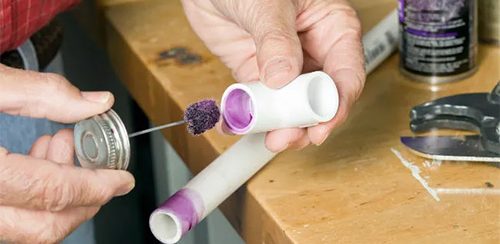
1. PVC Schedule 40 (Pressure Pipe)
- What it is: The most common and versatile PVC pipe grade, rated for internal pressure.
- Purpose: Carries pressurized water and other fluids; manufactured to ASTM D1785.
- Common Uses: Residential and commercial water supply lines, irrigation mains, pool and spa plumbing, underground utilities, and contractor-built structures.
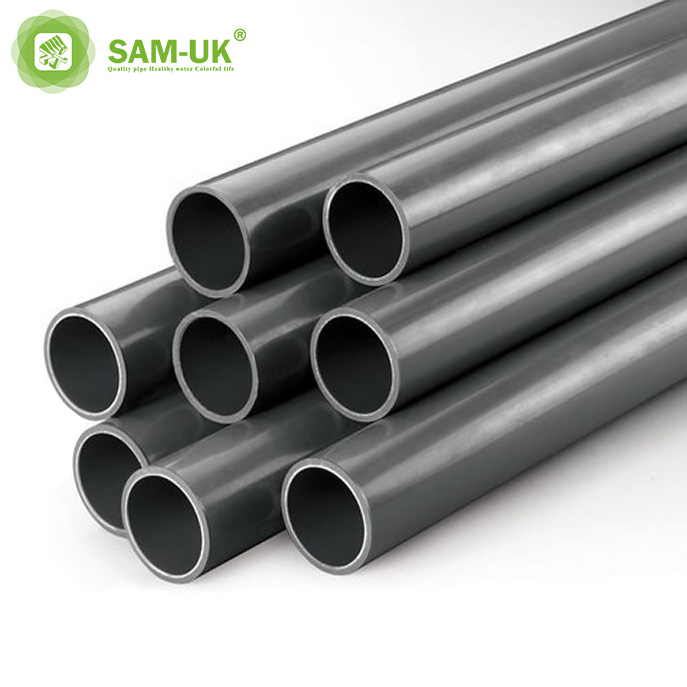
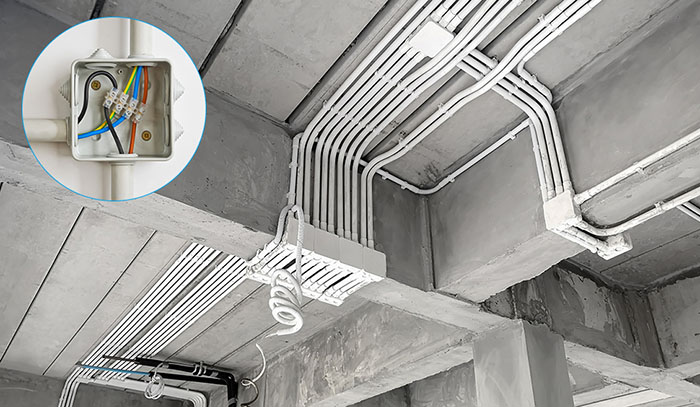
- Color: Usually white; dark gray for electrical conduit.
- Key Feature: Thicker walls than DWV pipe, sized to withstand working pressure — not to be confused with drainage grades.
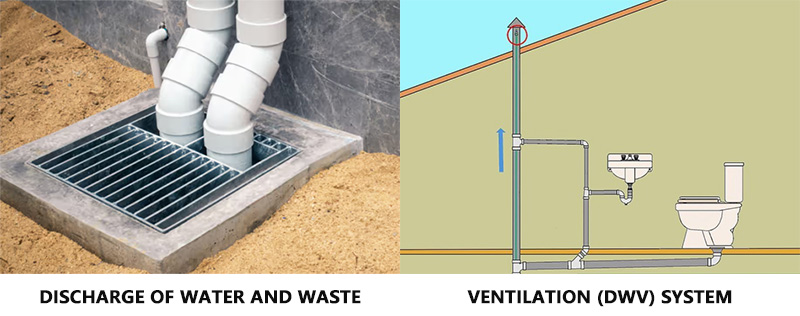
2. PVC DWV (Drain, Waste, Vent)
- What it is: A non-pressure grade built for gravity drainage; manufactured to ASTM D2665.
- Purpose: Carries wastewater from sinks, toilets, and showers, and vents the plumbing system.
- Common Uses: Drain lines inside walls and under floors; waste and vent stacks.
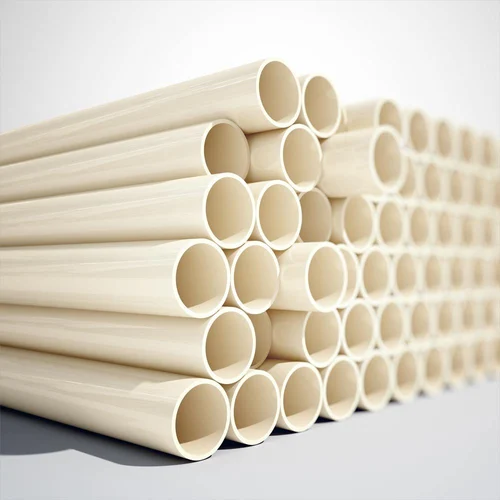
- Color: Almost always a creamy, off-white.
- Key Feature: Thinner walls than Sch 40 because it never sees pressure. Fittings have wider, smoother bores to prevent clogs. Never use DWV pipe in a pressurized line — this is a code violation and a field failure waiting to happen.

3. Other Common Vinyl Pipes (Often Confused with PVC)
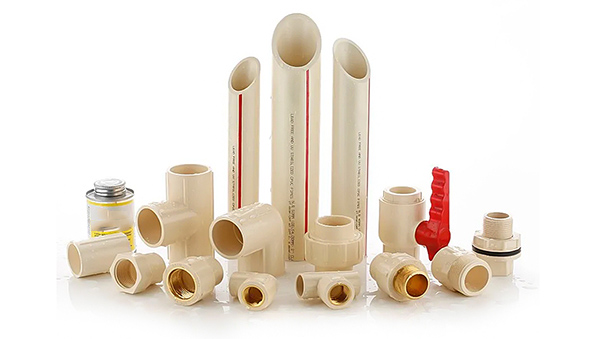
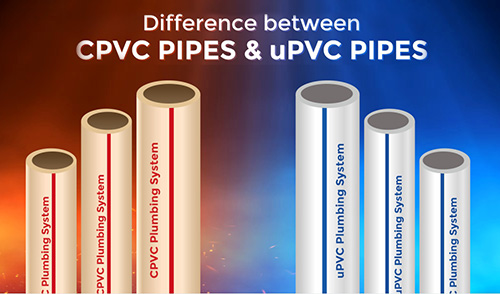
(1)CPVC (Chlorinated Polyvinyl Chloride):
- Identified by:Its distinctive cream or light yellow color.
- Key Feature:Can handle higher temperatures than PVC, making it suitable for hot and cold water supply lines inside your home.
- Note:It requires special CPVC cement and is not interchangeable with standard PVC fittings.
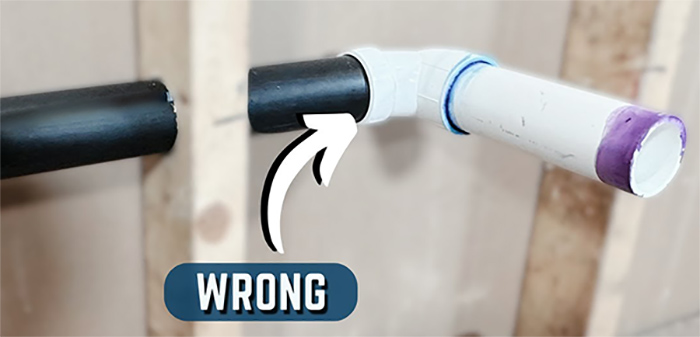
(2)ABS (Acrylonitrile Butadiene Styrene):
- Identified by:Its black color.
- Common Use:Primarily used for drain, waste, and vent (DWV) systems, similar to PVC DWV. It’s common in some regions and for underground outdoor use.
- Note:Requires special ABS cement and is not glued to PVC without a special transition cement.
Understanding PVC Pipe Sizes
This is the most confusing part for beginners. PVC pipe sizes are “nominal,” meaning they are a name for the size, not a direct measurement.
1. The Two Key Measurements:
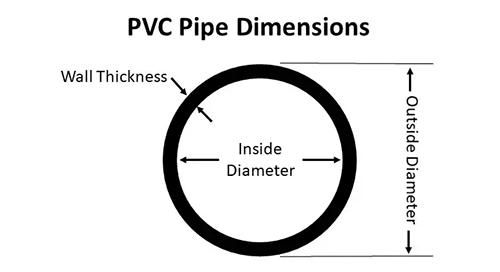
Nominal Pipe Size (NPS): This is the approximate inner diameter based on historical standards. A “1/2-inch” pipe does not have a 1/2-inch inner diameter.
Outside Diameter (OD): This is a fixed, consistent measurement. All 1/2-inch Schedule 40 pipes have the exact same outside diameter, regardless of the manufacturer. This ensures that fittings are universal.
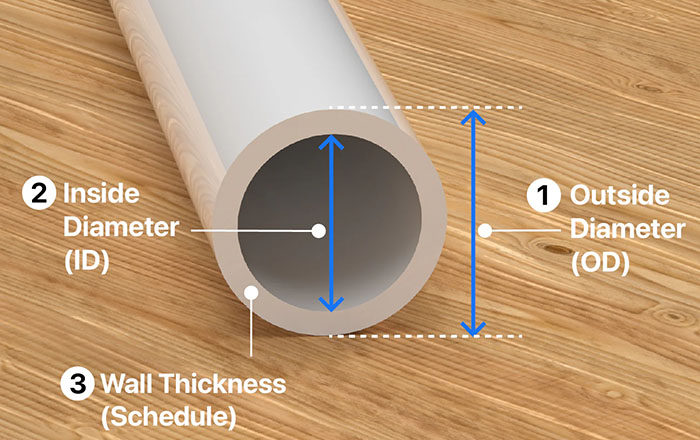
Why is this important? When you glue a fitting onto a pipe, you are connecting based on the Outside Diameter.
2. Common PVC Pipe Sizes:
| Nominal Size | Typical Use Case |
|---|---|
| 1/2″ | Sink faucet supply lines, low-flow irrigation |
| 3/4″ | Main water supply line to a house, common for irrigation |
| 1″ | Main water supply, larger irrigation lines |
| 1-1/4″ | Drain lines for sinks and bathtubs |
| 1-1/2″ | Drain lines for kitchen sinks, washing machines, shower stalls |
| 2″ | Drain lines for laundry sinks, some toilet branches |
| 3″ | Main toilet drain lines |
| 4″ | Main house sewer lines, underground drainage |
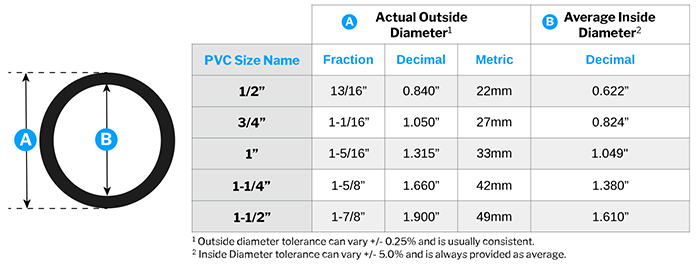
3. Metric (ISO) Size Equivalents
The table above is imperial (NPS). If you’re sourcing for a metric market, here’s the trap: metric PVC pipe uses ISO 1452 metric ODs — 20, 25, 32, 40, 50, 63, 75, 90, 110, 160 mm — which are NOT interchangeable with NPS sizes, even where the numbers look similar. A “50 mm” pipe is not a “2-inch” pipe.
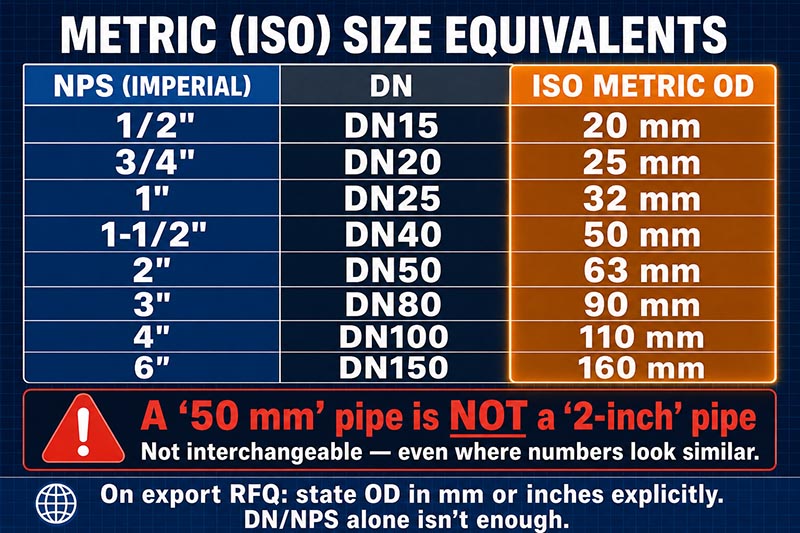
Never match by eyeballing the number. On an export RFQ, state the OD in millimeters or inches explicitly — the DN/NPS label alone is not enough to guarantee the fitting will fit.
Wall Thickness Grades (Schedules)
The “Schedule” (often abbreviated as “SCH”) refers to the wall thickness of the pipe. A higher schedule number means a thicker, stronger wall.
1. Common Schedules:
| Schedule | Description & Common Uses |
|---|---|
| Schedule 40 | The most common grade. Strong enough for most pressure and structural applications. Used for water supply, irrigation, and DIY projects. |
| Schedule 80 | Has a thicker wall than Schedule 40, making it stronger and more durable. Used for higher-pressure industrial applications or where extra physical strength is needed. It has the same Outside Diameter as Schedule 40, but a smaller Inside Diameter. |
| Schedule 120 | An even thicker wall, used for very high-pressure applications. Less common for general use. |
| SDR (Dimension Ratio) | Common for underground water mains and sewer lines. The DR number (e.g., DR 18, DR 35) is a ratio of the pipe’s outside diameter to its wall thickness. A lower DR number means a thicker wall. |
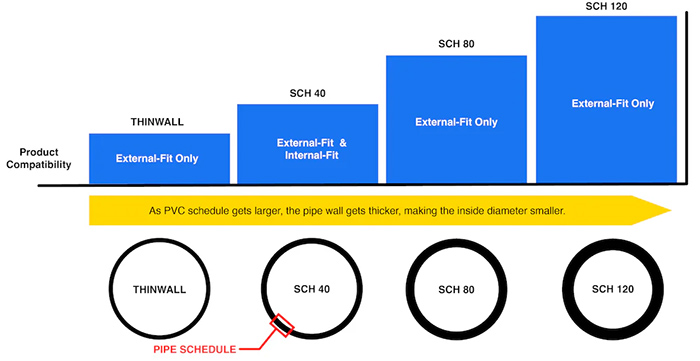
2. SDR vs. Schedule:
- Schedule is a legacy term that defines a set of wall thicknesses.
- SDR (Standard Dimension Ratio) is a more modern, calculated system where the wall thickness is directly proportional to the diameter. SDR 35 is a very common grade for underground non-pressure sewer and drain pipe.
4. Standards Quick Reference
Every PVC pipe grade traces back to a standard. Specify the standard on your RFQ and the supplier knows exactly what to ship:
| Standard | Covers |
|---|---|
| ASTM D1785 | PVC Schedule 40 / 80 pressure pipe (North America) |
| ASTM D2665 | PVC DWV pipe and fittings |
| ASTM D3034 | PVC gravity sewer pipe, including SDR 35 |
| ASTM D2466 / D2467 | Sch 40 / Sch 80 socket fittings (mate with D1785 pipe) |
| ISO 1452 | PVC-U pressure pipes for water supply (metric markets) |
Pipe and fittings must come from the same standard family. Mixing ASTM D1785 pipe with ISO 1452 fittings is one of the most common specification errors we see — the dimensions look close, but the tolerances don’t match, and joints leak under pressure.

3. Quick Comparison Table: Schedule 40 vs. Schedule 80
| eature | Schedule 40 | Schedule 80 |
|---|---|---|
| Wall Thickness | Standard | Thicker — roughly 40–50% more wall at the same OD (close to 55% in large diameters) |
| Pressure Rating (per ASTM D1785) | Baseline | About 40–45% higher pressure rating at the same size — e.g. 1″ pipe: 450 psi (Sch 40) vs 630 psi (Sch 80); 2″: 280 psi vs 400 psi; 4″: 220 psi vs 320 psi |
| Inside Diameter | Larger | Smaller (same OD, thicker wall) |
| Cost | Less Expensive | More Expensive |
| Weight | Lighter | Heavier |
| Color | Usually White | Usually Dark Gray |
One correction to a widely repeated myth: Sch 80 is not “twice as strong” — its pressure rating runs about 40–45% higher than Sch 40 at the same nominal size, per the ASTM D1785 rating tables. Wall thickness rises by roughly half, and pressure rating follows it almost linearly. If a supplier quotes a bigger number than that, ask for the standard’s table, not their word.
PN vs. Schedule: Same Job, Two Languages
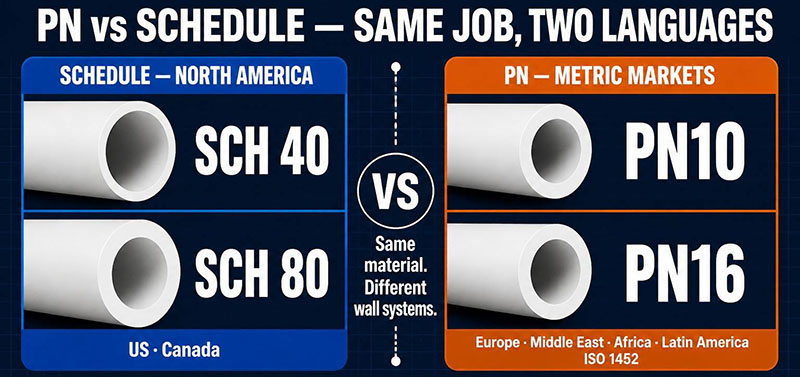
North America grades PVC pressure pipe by Schedule. Metric markets — Europe, the Middle East, Africa, Latin America — grade by PN (nominal pressure): PN10, PN16, and so on, per ISO 1452. Same material, same job, different wall thickness systems.
If you export, write both on the RFQ: “Sch 40 / PN16”. One tells your supplier the American expectation, the other the metric one — and it forces them to confirm which wall thickness you’re actually getting. A “PN16” pipe from a metric supplier and a “1-inch Sch 40” pipe are not necessarily the same wall. Ask the question before you order, not after the container lands.
How to Choose the Right PVC Pipe:
1. What is the application?
- Pressurized Water? -> PVC Schedule 40 or CPVC Sch40.

- Drain Line (Sink, Toilet)? -> PVC DWV.

- Underground Drainage? -> PVC SDR 35.

- High-Pressure Industrial? -> PVC Schedule 80.

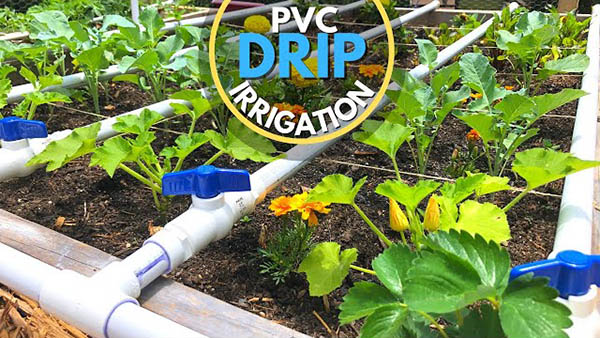
- DIY Structure (e.g., Greenhouse)? -> PVC Schedule 40.


2. What size do you need?
- Measure the existing pipe or check the specifications of what you’re connecting to. Remember, you match based on the Nominal Size.
- Always check your local plumbing codes for any restrictions or required materials, especially for projects inside your home.
Summary
PVC pipes are available in multiple types (pressure, drainage, conduit), sizes, and wall thickness grades (Schedule or PN) to suit various applications. Understanding these distinctions helps ensure optimal performance, safety, and cost-effectiveness in your piping system.
Frequently Asked Questions
1. Is Schedule 40 PVC safe for drinking water?
Yes — when the product carries the potable-water certification for your market. In North America that’s NSF/ANSI 61; metric markets have their own schemes. Lead-free stabilizers are the baseline, not a premium feature. Ask for the certificate at RFQ stage and verify the certified model range matches the delivered goods.
2. What’s the difference between PVC and CPVC?
CPVC is PVC that has been chlorinated to raise its heat tolerance — continuous service up to 93°C (200°F) vs. roughly 60°C (140°F) for standard PVC. That makes CPVC the choice for hot-water lines. Two hard rules: CPVC needs its own solvent cement, and CPVC fittings do not mate with standard PVC fittings.
3. Can I glue Schedule 40 and Schedule 80 together?
Technically yes — same OD, and standard PVC cement works on both. But the joint is only as strong as the weaker pipe, so the assembly is rated to Sch 40 pressure. If you need Sch 80 performance, use Sch 80 throughout. Mixing grades to save money on fittings is false economy on a pressure line.
4. What does SDR 35 mean?
SDR (Standard Dimension Ratio) is outside diameter divided by wall thickness. SDR 35 means the OD is 35 times the wall — a thin-wall grade for gravity sewer and drainage per ASTM D3034, common in underground non-pressure service. A lower SDR number means a thicker wall (SDR 26 is heavier-duty than SDR 35). SDR pipe is not rated for pressure service.
About SAM-UK
SAM-UK are a professional 19+ years manufacturer in producing vinyl building profile products and PVC , CPVC , PPH , PPR , PP pipes and pipe fittings, valves, taps and so on. See our certification records and product-specific scope. We support color /size customization. Welcome to consult for Catalog and Product. you can contact us at email [email protected]